
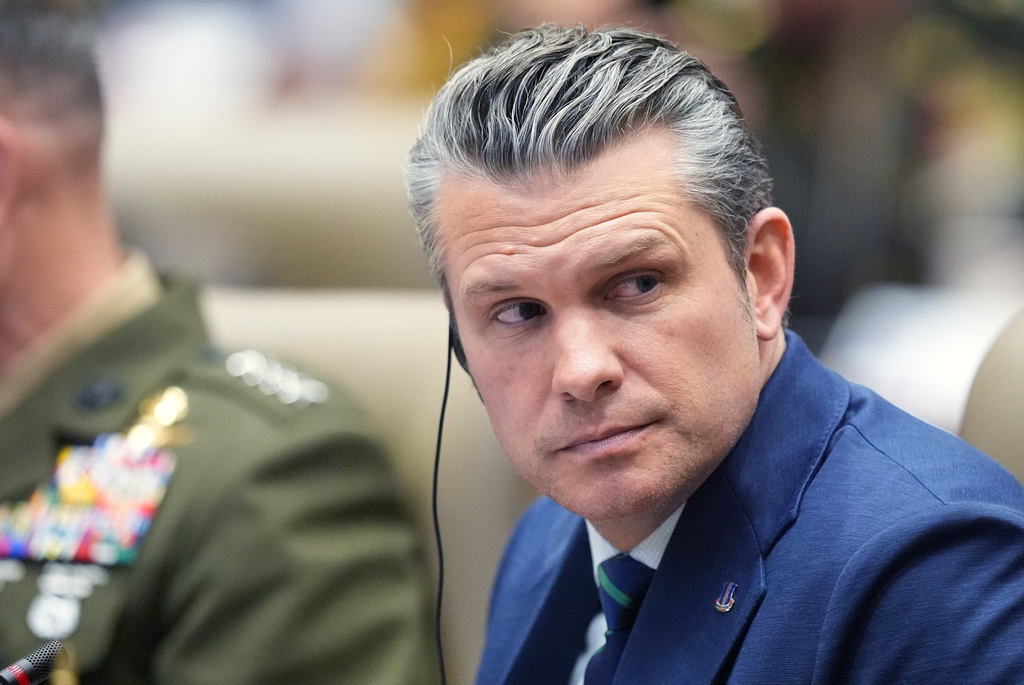
Secretary of War Pete Hegseth said Wednesday that U.S. Central Command “will be busy tonight” as the military prepares to launch major strikes on Iran, turning President Trump’s threats to bomb the country into a near-certain promise of action within hours.
“Central Command will be busy tonight because President Trump said we will be hitting Iran hard, and we will be,” Hegseth told reporters at CENTCOM headquarters, pledging strikes that would be strong and clear. Picking up on the president’s accusation that Iran has been stalling, he warned that Tehran’s foot-dragging at the negotiating table was about to be answered with force.
Iranian negotiators, he said, are going to have “tap, tap, tap bombs dropping on key facilities” from the United States.
Hegseth framed the coming strikes as leverage rather than the start of a new war. The goal, he said, is not to restart the war but to set the terms for a deal. He told reporters that if the United States needs to negotiate with bombs, it will, and that it is good at it. The strikes set for Wednesday evening would be strong and clear, he added, and if they had to happen the following night, they would be just as strong.
Trump struck the same note earlier in the day. He said the United States would resume attacks on Iran, citing slow progress in talks, and insisted that all Tehran has to do is “start signing a paper” to reach a deal. He also declined to rule out strikes on critical civilian infrastructure, including power plants and bridges.
The escalation follows a week of exchanges that began with the downing of a U.S. Army Apache helicopter near the Strait of Hormuz. Central Command said the two pilots went down off the coast of Oman on Monday evening and were rescued by an unmanned surface vessel, a maritime drone that pulled them from the water. The U.S. answered with strikes on Iranian targets, and Iran retaliated in a limited fashion. Iranian state media reported that U.S. strikes hit two water reservoirs, cutting the local water supply.
Diplomacy has not stopped even as the bombs are readied. A Qatari delegation is meeting Iranian negotiators in Tehran in an effort to bridge the remaining gaps. According to Axios, the administration is weighing a strike plan that would be extensive in scale but tightly limited in duration, designed to pressure Tehran into shifting its position in the talks.
The broader war opened on Feb. 28 with joint U.S. and Israeli strikes, followed by a fragile ceasefire that has frayed in recent days. Talks in Pakistan in April failed to produce a peace deal, and Trump has kept a U.S. naval blockade in place until negotiations conclude one way or the other.
(YWN World Headquarters – NYC)
 Join the official YWN WhatsApp status


