At the end of this article, you will find a full list of the Rabbanim associated with Refuah B’Halacha, as well as the areas in which the Center provides guidance.
For more information or to explore additional medical-halacha topics, visit www.refuahbhalacha.org.
Refuah B’Halacha is a leading halachic resource dedicated to addressing complex medical questions through the lens of Torah and halacha. Guided by experienced poskim who work closely with medical professionals, the Center deals daily with real-life questions involving modern medicine, Shabbos, fertility, mental health, and life-saving treatments. As medical technology rapidly advances, Refuah B’Halacha works to bring clarity and responsible halachic guidance to issues where medicine and Torah intersect.
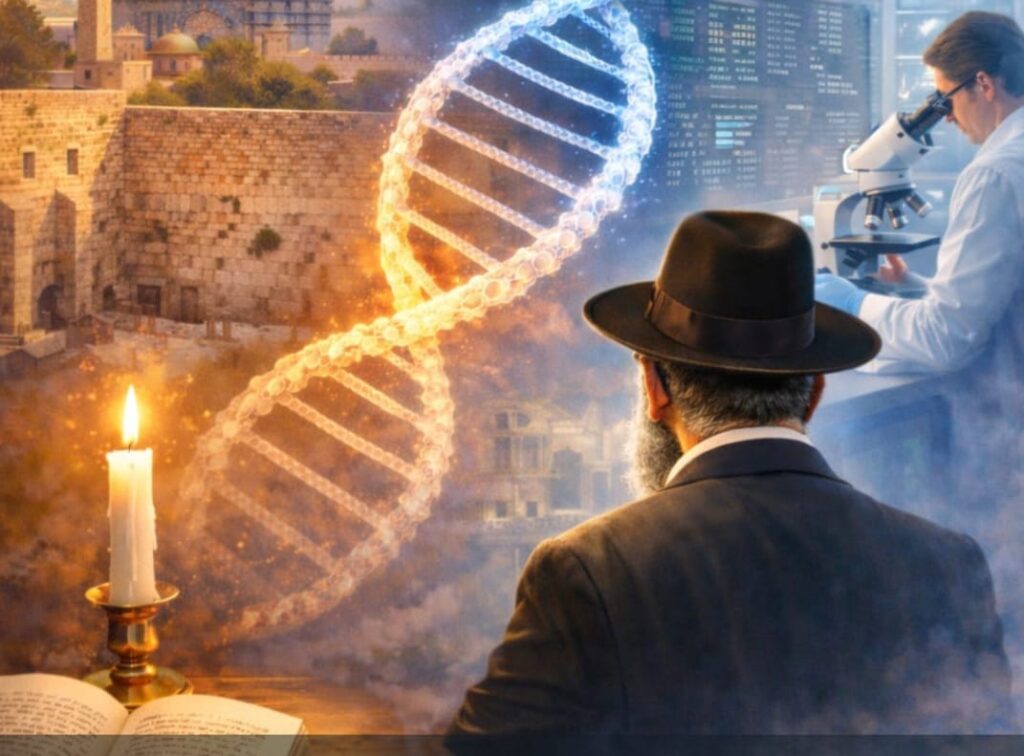
One such issue—now engaging Rabbanim around the world—is the growing use of genetic technology. What was once considered science fiction has quietly become part of mainstream medicine, raising profound halachic and hashkafic questions that Refuah B’Halacha is actively addressing.
________________________________________
Not long ago, genetic engineering sounded like something from a science fiction novel. But today it is quietly becoming part of mainstream medicine.
Through genetic screening and testing, doctors can now identify inherited illnesses long before symptoms appear. Couples can discover whether they are carriers of serious genetic diseases, and in certain cases, medical intervention can prevent a child from inheriting a devastating condition altogether. What once belonged to futuristic novels is now discussed in doctors’ offices—and increasingly, in batei midrash and halachic forums.
A Brief Scientific Background: How Did We Get Here?
Modern genetic engineering did not appear overnight. Its roots go back more than 70 years.
In 1953, James Watson and Francis Crick identified the double-helix structure of DNA, revealing that every human cell contains a genetic “instruction manual” made up of genes. Over the following decades, scientists learned how specific genes are linked to inherited traits and diseases.
By the 1970s and 1980s, researchers developed techniques to identify mutations responsible for certain illnesses. This led to genetic testing, allowing doctors to detect whether a person carries genes for diseases such as Tay-Sachs or cystic fibrosis—even if the person is completely healthy.
In the 1990s, the Human Genome Project mapped the entire human genetic code, dramatically accelerating medical genetics. From that point on, doctors were no longer just diagnosing illness—they were predicting it.
Genetic Engineering Today
Currently, genetic technology is used primarily for diagnosis and prevention. Carrier screening helps couples identify risks for illnesses such as Tay-Sachs, cystic fibrosis, and hemophilia. In some cases, advanced fertility techniques allow doctors to select embryos that do not carry the disease, thereby preventing lifelong suffering.
One well-known halachic discussion appears in Shulchan Shlomo (vol. 3), where Rav Shlomo Zalman Auerbach zt”l addresses hemophilia, a genetic condition that primarily affects males. Rav Shlomo Zalman ruled that when necessary, selecting an embryo with an X chromosome—in order to prevent the disease—is permitted, as it is clearly an act of refuah and prevention of serious illness.
In such cases, genetic intervention is widely viewed as a continuation of medicine’s mandate to heal.
But the horizon is rapidly expanding.
The Near Future: Beyond Illness
Scientists are now working on technologies that could go far beyond preventing disease. The possibility of altering or selecting genes that influence eye color, hair color, intelligence, personality traits, or even a predisposition to addiction is no longer theoretical.
This raises a profound question: Even if something is scientifically possible, should it be halachically permitted?
Chazal teach that there are three partners in the creation of a child: the father, the mother, and HaKadosh Baruch Hu. While Torah recognizes the legitimacy—and obligation—of medical intervention, do we have the right to shape every aspect of a child’s future?
The Gemara teaches:
Rabbi Yehoshua says: One who is accustomed to giving charity merits children who possess wisdom, wealth, and the ability to teach and transmit Torah. (Bava Basra 9b)
If those actions are acceptable, is genetic engineering fundamentally different?
Or does it cross a line?
What Our Rabbanim Say
These questions were presented to the Rabbanim of the Refuah B’Halacha Center, who are already grappling not only with today’s medical-halacha questions, but those looming just ahead.
Rav Noach Isaac Oelbaum shlita, Senior Posek of the Refuah B’Halacha Center, explained:
“From a purely halachic standpoint, there is no clear issur. However, there is a very serious hashkafic concern. The remedies and segulos mentioned by Chazal work within the natural order. Genetic engineering is something entirely different—it fundamentally changes the process.”
Rav Baruch Hirschfeld shlita, Senior Mental Health Posek at the Center, said:
“Such tools should be limited strictly to preventing or treating serious, chronic disease. Creating ‘designer babies’ is not what this technology was meant for.”
Rav Shmuel Fuerst shlita, Senior Posek at the Center, quoted Rav Moshe Feinstein zt”l:
“Don’t play around with what Hashem created.”
Rav Daniel Neustadt shlita, Senior Fertility Posek of the Refuah B’Halacha Center, emphasized:
“From a halachic perspective, there is no inherent problem with genetic intervention itself. The key question is how and why it is being used.”
Looking Ahead
Genetic engineering is still in its early stages, but its rapid development ensures that these questions will only become more urgent. Where halacha draws the line between healing and redesigning will require deep Torah wisdom and ongoing dialogue.
________________________________________
Our Rabbanim
R’ Yaakov Forchheimer shlit”a
R’ Noach Isaac Oelbaum shlit”a
R’ Shmuel Fuerst shlit”a
R’ Uri Deutsch shlit”a
R’ Micha Cohen shlit”a
R’ Moshe Zev Feldman shlit”a
R’ Baruch Hirschfeld shlit”a
R’ Daniel Neustadt shlit”a
R’ Avrohom Yaged shlit”a
Areas We Specialize In
• Mental Health
• Shabbos
• Medical Treatment Questions
• Hospital Stays
• Fertility
• Kashrus
For guidance on medical-halacha questions—big or small—visit www.refuahbhalacha.org or call the Refuah B’Halacha Hotline: 732-755-0851.

 Join the official YWN WhatsApp status