
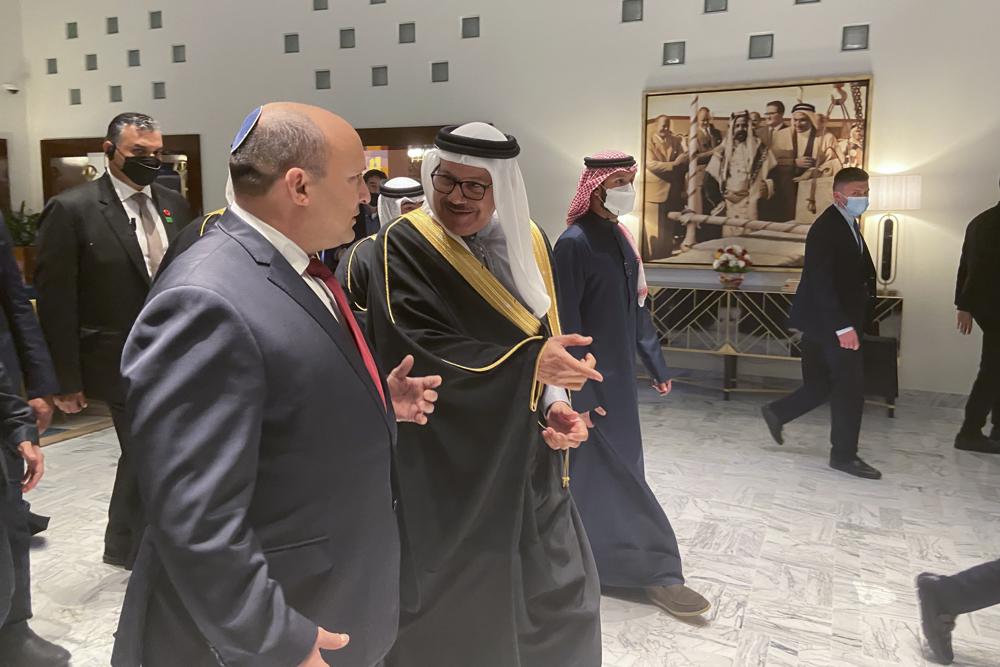
Israel’s prime minister Tuesday said Israel and its Arab allies were forging a regional “ring of stability” as he wrapped up a lightning visit to Bahrain that sought to send a powerful message of solidarity against their shared archrival Iran.
During the 24-hour visit, Bennett was warmly welcomed by Bahrain’s king and crown prince and also visited the U.S. Navy’s 5th Fleet. Shared concerns about Iran and its nuclear program served as the backdrop to the visit, the first ever by an Israeli prime minister.
“What we’re all trying to do is form a new regional architecture of of moderate countries,” Bennett told reporters. “This architecture will provide stability, economic prosperity and be able to stand strong against the enemies who are fomenting chaos and terror. So it’s sort of a ring of stability.”
Israel and Bahrain established full diplomatic relations in 2020 as part of the U.S.-brokered “Abraham Accords,” a series of diplomatic deals between Israel and four Arab countries.
Bennett was greeted by Crown Prince Salman bin Hamad Al-Khalifa, who also serves as the kingdom’s prime minister, and a military color guard at Manama’s Gudaibiya Palace. Later, he met King Hamad bin Isa Al-Khalifa.
He told the crown prince that he came “with a spirit of goodwill, of cooperation, of standing together against mutual challenges.”
“We must do more to get to know one another and build upon the Abraham Accords, which have been such a historic agreement,” the crown prince said, referring to the meeting as “cousins getting together.”
Bennett traveled with around two dozen Israeli and foreign journalists, but most of his visit was closed to the media. Bennett and Al-Khalifa’s remarks were transmitted to journalists in a video statement.
Bennett did not explicitly mention Iran in his public comments. But the context was clear. Bahrain is located on Iran’s doorstep in the Persian Gulf, and both countries are deeply concerned about Iran’s nuclear program and its military activities across the region.
In a statement before his departure late Tuesday, Bennett’s office said the leaders discussed “expanding strategic and security relations to address regional challenges, including nuclear threats, terrorist activity, religious extremism, poverty, and social challenges.”
In recent months, as tensions with Iran have soared, the two countries have intensified military cooperation.
Early this month, they signed a defense pact, and last week, Bahrain announced that an Israeli naval officer would be stationed in Manama, which is also home to the U.S. Navy’s 5th Fleet. The Israeli military confirmed it will have a naval representative attached to the 5th fleet.
Bennett met with the fleet commander, Vice Adm. Brad Cooper, during his stop in Manama. Bennett’s office said the fleet “is a significant element in maintaining regional stability in the face of various security threats.”
Israel has stepped up its naval presence in the Red Sea after a series of attacks on commercial ships with links to Israel, which it blamed on Iran.
Earlier this month, Israeli ships took part in a massive naval exercise in the Gulf, which included ships from Oman and Saudi Arabia, with whom Israel does not have formal diplomatic ties. Israeli warships also participated in U.S.-led naval drills with the United Arab Emirates and Bahrain in the Red Sea in November.
Israel and Bahrain established formal diplomatic ties after years of clandestine security cooperation over their shared enmity of Bahrain’s neighbor, Iran.
Israel and Bahrain have exchanged ambassadors and signed trade and defense agreements since they signed a normalization agreement on the White House lawn, alongside the United Arab Emirates, Sudan and Morocco, in September 2020.
Bennett’s visit came as negotiations between world powers and Iran to reach an international agreement to curb Tehran’s nuclear program continued in Vienna. Israel has said it would not be bound by any such agreement and that it would take whatever action necessary, including a military strike, to prevent Iran from obtaining nuclear arms.
Iran insists its nuclear program is solely for peaceful purposes.
(AP)
 Join the official YWN WhatsApp status




One Response
I just have one question: how does Bennett keep that shekel-sized yarmulkah on his bald head?
And why does he even bother wearing one (based on his actions since becoming PM)?
OK, so it’s 2 questions.