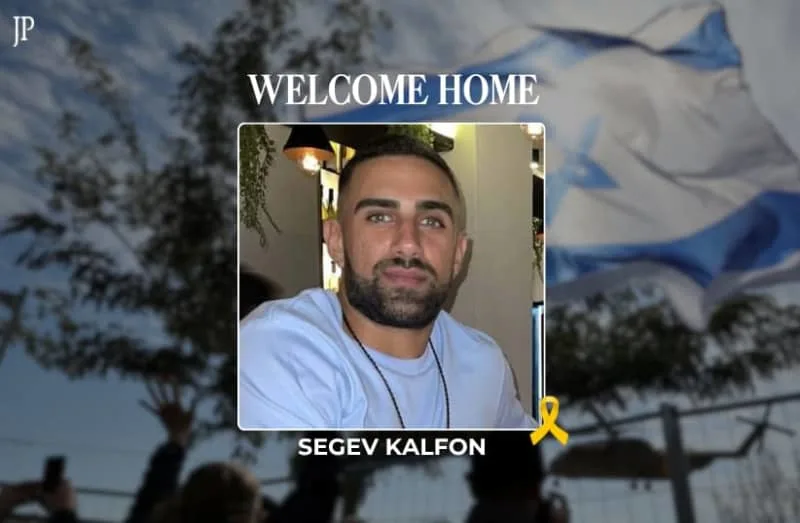
A newly surfaced account from former Gaza hostage Segev Kalfon reveals harrowing details of his two years in Hamas captivity, marked by constant beatings, starvation, psychological torment, and repeated pressure from a Hamas battalion commander to convert to Islam.
Kalfon, a 27-year-old baker from Dimona kidnapped from the Nova Music Festival on October 7, spoke to The New York Times from a rehabilitation center in Ramat Gan, describing a captivity so brutal that he eventually became numb to violence.
Kalfon said terrorists assaulted him immediately upon abduction. Blindfolded and bound, he recited Shema Yisrael as terrorists
repeatedly struck him. “I became numb to the blows,” he said.
Conditions deteriorated further after Israel’s National Security Minister Itamar Ben-Gvir publicly touted harsher treatment for Palestinian prisoners. Hamas guards responded with even more abuse, Kalfon said — a pattern reported by multiple hostages.
Kalfon said his captors routinely played with live grenades to terrorize the hostages. In one chilling incident, terrorists forced the captives into what they called the “execution game.” When the hostages refused to choose which three among them should die, a Hamas guard drew lots to decide who would be killed.
The execution was halted only when commander Bayan Abu Nar claimed Islam forbids killing prisoners. Abu Nar then insisted the captives had been “saved by Islam” — and began aggressively pressuring them to convert.
He forced them to listen to Quran recitations and repeatedly lectured them about adopting Islam, Kalfon said.
Kalfon described being kept in filthy, rodent-infested rooms where hostages were forbidden from speaking to one another. Three men shared a single used toothbrush.
Food was scarce. “At one point I survived on a can of beans for two days,” he said.
Hostages were sometimes given only a quarter of a tomato and a bowl of rice to split. Meanwhile, the terrorists guarding them “looked well-fed,” Kalfon noted — despite Hamas’ claims that food shortages in Gaza dictated what captives received.
Kalfon said he lived in terror of both his captors and Israeli strikes. One Israeli attack hit the building where he was being held with Yosef-Chaim Ohana and Maxim Herkin. “All I could think about was how to survive another day,” he said.
Later, while in a tunnel, he survived another blast that killed a Hamas guard’s family above ground. “I was scared to death of what he might do to me,” he said.
As conditions worsened deep into the second year, Kalfon contemplated escaping. He abandoned the plan after hearing his mother, Galit, speak on the radio about missing him. Hearing her voice, he said, felt like “an ocean of hope.”
Kalfon also heard the firefight during Operation Arnon, when Israeli forces rescued four hostages from Nuseirat. Hamas guards locked him in a bathroom; he believed he was about to be killed. Instead, he was eventually moved to Hamas’s underground tunnel system, where he spent another 16 months and met captives Bar Kupershtein, Elkana Bohbot, and Ohad Ben-Ami.
In the final 10 weeks of his captivity, Kalfon was held alone under the guard of Abu Nar. He said the Hamas commander engaged him in lengthy personal conversations, during which Abu Nar claimed Hamas would not have carried out the October 7 massacre had they understood the consequences.
Even on the day of his release, terrorists continued to torment him. “They told me I was the only one who would be sent back to the tunnels,” he recalled, believing the announcement of his release had been a trick.
Kalfon is still undergoing rehabilitation, but his testimony adds to a growing body of evidence describing systematic abuse, starvation, indoctrination attempts, and psychological warfare used by Hamas against Israeli hostages.
(YWN World Headquarters – NYC)
 Join the official YWN WhatsApp status