
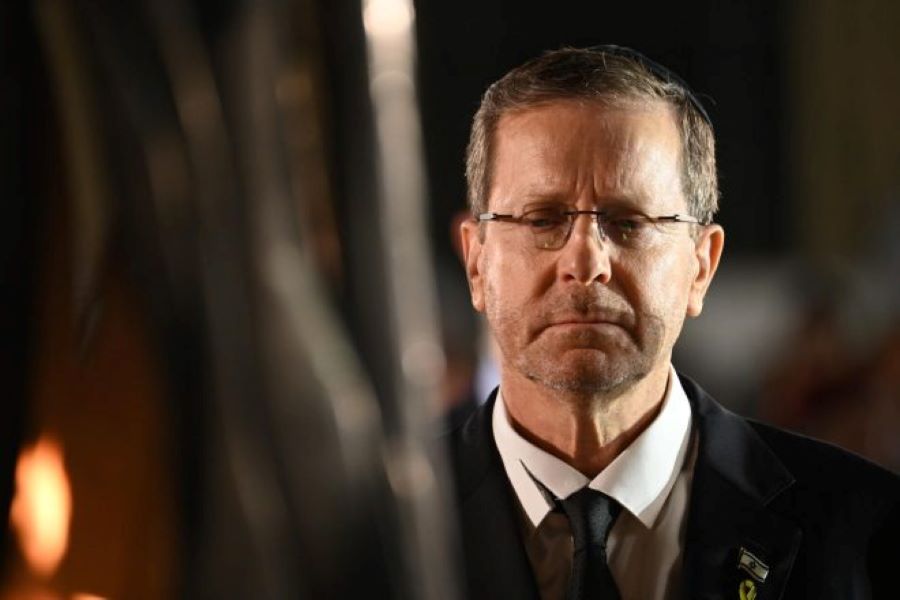
Israeli President Yitzchak Herzog has publicly broken with Israel’s governing coalition over its plan to establish a politically appointed commission of inquiry into the failures that led to the October 7 massacre, warning that such a body would erode public trust and fail to deliver real accountability.
“The terrible disaster of October 7, and the failure that led to it, must be investigated in depth and in a national manner,” Herzog said during a Torah learning session to mark Asarah B’Teves. Herzog stressed that any investigation must be independent and free of political influence, adding that the commission “must not include political elements as members, as it could significantly harm this important process and trust in it.”
Herzog’s remarks amount to one of the clearest warnings yet from Israel’s head of state against the coalition’s legislative push to bypass the traditional state commission-of-inquiry framework in favor of a Knesset-controlled body.
Herzog’s intervention comes days after the coalition advanced a bill to establish a new, politically appointed commission to examine the intelligence, security, and decision-making failures surrounding the October 7 Hamas-led massacre.
The bill, submitted by Likud MK Ariel Kallner, passed its first reading last week following a tense and often chaotic debate in the Knesset plenum. The vote was marked by shouted interruptions, symbolic walkouts, and vocal protests from opposition lawmakers.
Under the proposed framework, the commission would be created outside the existing mechanism laid out in Israel’s 1968 Commissions of Inquiry Law. That law provides for a state commission appointed by the president of the Supreme Court–long considered the gold standard for independence and credibility in national investigations.
Instead, the new proposal would establish a six-member commission appointed by the Knesset. Lawmakers would be given a limited window to reach a supermajority agreement on all appointments. If no agreement is reached, the coalition and opposition would each appoint three members. If the opposition refuses to cooperate, the Knesset speaker would be empowered to fill the remaining seats.
Critics say the structure virtually guarantees political deadlock–or worse, a commission dominated by coalition appointees.
The coalition’s move has sparked fierce backlash from bereaved families and relatives of former hostages, many of whom have publicly warned that a politically appointed commission would amount to a whitewash rather than a genuine reckoning.
Opposition lawmakers staged a dramatic walkout during the preliminary vote, accusing the government of attempting to control the narrative of one of the gravest failures in Israel’s history. They argue that only an independent state commission can restore public confidence and provide answers to the families of victims and the wider public.
(YWN World Headquarters – NYC)
 Join the official YWN WhatsApp status





One Response
That’s ridiculous. Herzog is just being political here, which is against the law. Remember he was leader of the Labor Party (alav hashalom).
Any commission appointed by the judiciary, and especially by the supreme court president, would have absolutely no credibility whatsoever. NOTHING it concluded would be of ANY value, and the government should refuse to cooperate with any such commission.