
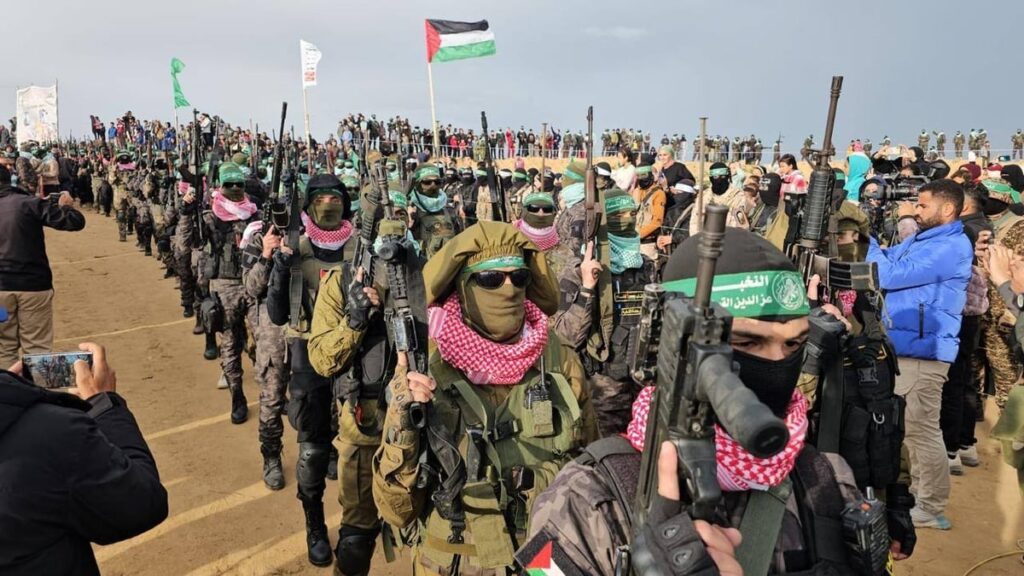
Israel’s defense establishment believes Hamas is accelerating efforts to rebuild its capabilities and recover from the damage inflicted over two years of fighting, according to Hebrew-language media reports Sunday citing senior security officials.
The assessment, delivered in recent closed-door briefings to Israel’s political leadership, concludes that Hamas does not view Washington’s emerging post-war plan for Gaza as a threat to its survival. On the contrary, Israeli intelligence believes the terror group sees the Trump administration’s framework as an opportunity–one that could allow it to entrench itself politically and militarily while avoiding formal responsibility for governing the Strip.
At the same time it rebuilds, Hamas is expected to resume attempts to target IDF troops operating on the Israeli-controlled side of the so-called Yellow Line, security sources warned, signaling that the organization intends to pursue a familiar dual strategy: armed resistance alongside political maneuvering.
The intelligence assessment comes just days after Trump announced the launch of Phase Two of its Gaza plan, which envisions the creation of international and regional panels to govern the Strip in place of Hamas following the war.
Rather than interpreting the plan as an effort to dismantle it, Hamas has “welcomed” the initiative, according to Israeli officials, because it believes Gaza can be reshaped into a model resembling Lebanon, where the state is weak, governance is fragmented, and the terror group Hezbollah wields decisive influence behind the scenes.
A November 2024 ceasefire agreement between Israel and Lebanon formally required Hezbollah to disarm, but Israeli officials say the Iran-backed group has instead dragged out the process while quietly rebuilding its military infrastructure in the south. Israel now believes Hamas intends to follow the same playbook in Gaza: delay, obfuscate, and exhaust international actors while reconstruction proceeds in practice and weapons remain in place.
“Hamas will do everything it can to stretch out the process and wear down all parties, even as rebuilding begins on the ground,” Channel 12 quoted Israeli officials as saying.
Central to Hamas’s renewed confidence, Israeli intelligence assesses, is Washington’s decision to include Turkey and Qatar in the post-war management of Gaza. Both countries maintain close ties to Hamas and host senior figures from the organization.
“The inclusion of Turkey and Qatar gives Hamas long-term hope and short-term courage,” security sources said, warning that the move could ultimately undermine Israel’s military achievements in the war.
The Gaza Executive Board–tasked with overseeing post-war management as the operational arm of a UN-mandated framework–includes Turkish Foreign Minister Hakan Fidan and senior Qatari diplomat Ali Thawadi. Israel has repeatedly objected to their participation, arguing that both governments are sympathetic to Hamas and incapable of acting as neutral overseers.
Trump, however, has publicly praised his relationships with Ankara and Doha, crediting their leaders with pressuring Hamas to accept the October ceasefire. Israeli officials now fear that those same relationships could shield Hamas politically as it seeks to regroup.
The tension burst into the open over the weekend, when Benjamin Netanyahu made a rare public break with Washington. His office said the makeup of the executive board had not been coordinated with Israel in advance and directly contradicted Israeli policy regarding post-war Gaza.
Netanyahu instructed Foreign Minister Gideon Sa’ar to raise Israel’s objections with U.S. Secretary of State Marco Rubio and convened a series of urgent meetings with the war cabinet, the full government cabinet, and coalition party leaders to assess Israel’s response.
Joining the Turkish and Qatari representatives on the executive board are officials from Egypt and the United Arab Emirates, along with former British prime minister Tony Blair, U.S. envoy Steve Witkoff, senior Trump adviser Jared Kushner, Apollo Global Management CEO Marc Rowan, Israeli-Cypriot businessman Yakir Gabay, and several former senior United Nations officials.
Former UN envoy Nickolay Mladenov has also been appointed high representative for Gaza and will serve as the board’s on-the-ground liaison to the new Palestinian technocratic government.
Intelligence officials warn that unless Hamas is forced to disarm early and decisively, international reconstruction efforts–however well-intentioned–could end up stabilizing a terror organization determined to survive, rearm, and strike again.
In that scenario, Israeli officials caution, the war may end on paper, while laying the groundwork for the next one.
(YWN World Headquarters – NYC)
 Join the official YWN WhatsApp status





2 Responses
Knowing that Trump stabs friends in the back such us Denmark (the country that contributed the most per capita to the NATO war in Afghanistan in response to the 9-11 attack on the US), or the pro-democracy groups in Venezuela and Iran – should Israel trust Trump, and the United States? Perhaps it is time for the Zionists to get their act together and work for national unity and self-reliance instead of depending on the Americans, and trying assimilate American culture.
If Biden had forced this deal on Israel FRUMAGA would be throwing a fit. Instead by Trump he can invite his Turkish and Qatari friends and all is fine. Trump can encourage protesters to take to the streets in Iran with an explicit promise to have their back and when thousands become canon fodder FRUMAGA is silent. Oh and threatening Greenland, more tariffs, threats to Canada and letting ICE run loose unaccountable is all par for the game for the mindless MAGA minions