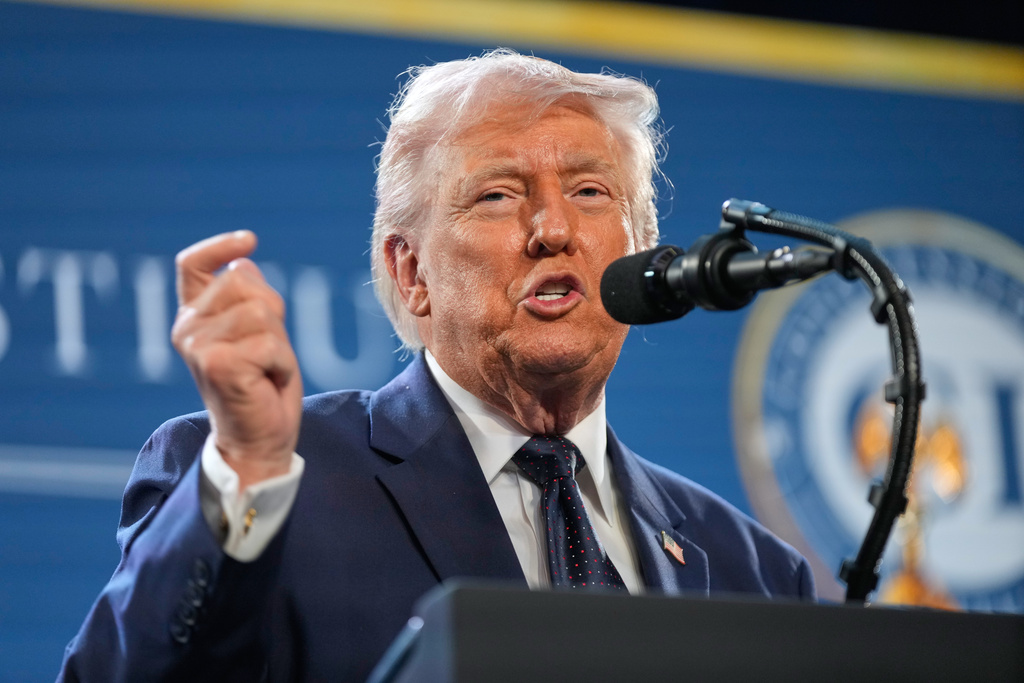
President Trump said Monday that the United States is engaged in “serious discussions” with Iran to end the war, while threatening to obliterate the country’s energy infrastructure and close off its oil exports if a deal is not reached quickly and the Strait of Hormuz is not reopened.
In a post on his Truth Social account, Trump said negotiations are moving forward with what he described as “a new, and more reasonable, regime” – though there has been no formal regime change in Iran, and it remains unclear which Iranian officials the administration is dealing with. Trump has previously argued that U.S. and Israeli strikes on Iran’s top leadership effectively constitute regime change.
“Great progress has been made,” Trump wrote, “but, if for any reason a deal is not shortly reached, which it probably will be, and if the Hormuz Strait is not immediately ‘Open for Business,’ we will conclude our lovely ‘stay’ in Iran by blowing up and completely obliterating all of their Electric Generating Plants, Oil Wells and Kharg Island.”
Trump added that desalination plants could also be targeted.
Trump wrote that the destruction would be “in retribution for our many soldiers, and others, that Iran has butchered and killed over the old Regime’s 47 year ‘Reign of Terror.'”

Kharg Island handles the vast majority of Iran’s crude oil exports. Strikes on its facilities, along with Iran’s power grid and water desalination infrastructure, would constitute a dramatic escalation.
The Strait of Hormuz, a narrow waterway at the mouth of the Persian Gulf, is one of the world’s most critical oil transit chokepoints. Iran has threatened to close it in response to U.S. military operations, a move that would disrupt global energy markets.
Trump’s post came as the U.S. continues deploying thousands of troops to the region following the president’s announcement last week that talks were underway. The buildup has been widely interpreted as preparation for a potential ground operation, giving Trump expanded military options as negotiations proceed.
The administration has not disclosed which Iranian officials it is in contact with or through what channels. Pakistan, Turkey, and Egypt have previously served as intermediaries between Washington and Tehran.
(YWN World Headquarters – NYC)
 Join the official YWN WhatsApp status