

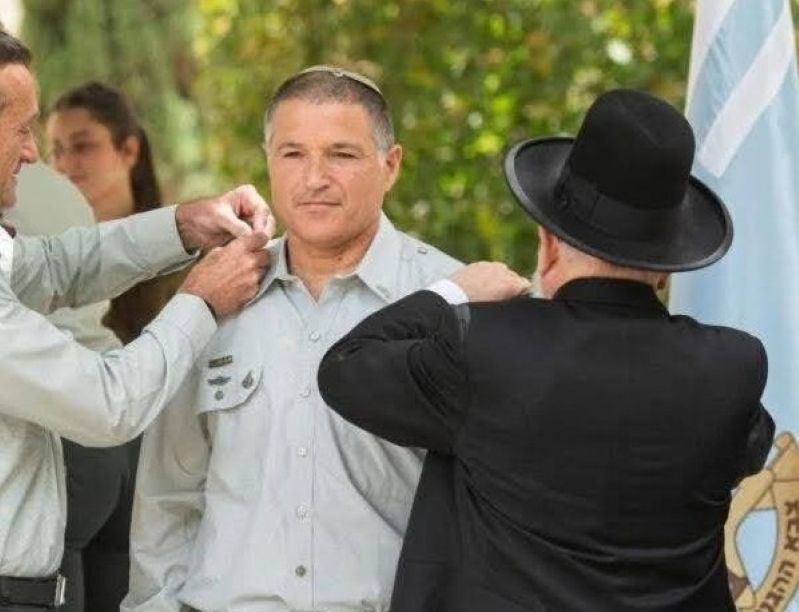
Arutz Sheva spoke with Rabbi Dr. Eliyahu Rachamim Zini, the Nasi of the Yeshivas Hesder in Haifa, ahead of Yom HaShoah, which falls out this year on Monday night and Tuesday.
Dr. Zini spoke about his mother, Rochel, a’h, the grandmother of Shin Bet chief David Zini, an Auschwitz survivor who endured forced labor alongside her own mother and displayed extraordinary courage amid unimaginable conditions.
“Like any Jew who finds himself facing deep challenges, she demonstrated spiritual greatness,” Rabbi Zini said, describing his mother’s complex family background. On one side were Talmidei Chachamim and Bnei Torah; on the other, her father, who became a legal advisor to the prime minister of Czechoslovakia but distanced himself from Judaism after negative experiences with members of the Jewish community.
However, despite this, when offered escape to London with the prime minister and government members, he boarded the plane, saw that all the passengers were non-Jews, and chose to disembark-preferring to share the fate of his fellow Jews. “That trait was ‘genetic,'” Rabbi Zini said, “and it passed to my mother.”
Her father was later sent to Theresienstadt. From the train window, he told his family: “Whatever my brothers suffer, I will suffer with pride.”
“Even those who were not Shomrei Torah u’mitvos understood the historical responsibility placed upon them,” Rabbi Zini emphasized. “That is what leads one to sacrifice themselves for Kiddush Hashem-and it’s something we must restore.”
Upon his mother’s arrival at Auschwitz, an SS officer asked who spoke German, Hungarian, and other languages. Her mother encouraged her to respond, hoping it might earn her a piece of bread. She did, but when the officer ordered her to beat Jewish prisoners who could not keep up with forced labor, she refused and fled.
Later, she was assigned to inspect parts for Messerschmitt aircraft. She deliberately approved faulty parts, risking her life to sabotage the German war effort.
His mother endured extreme hardship in the camp, sharing barracks with many women. For nearly a year, she risked her life daily by stealing food from the officers’ kitchen to feed others. “Anyone caught would be killed,” he said. “The struggle to survive, even under such conditions, came from a deep faith in the Jewish people.”
He also recounted unimaginable horrors his mother witnessed, including the killing of her sister, who, after arriving at the camp visibly pregnant, was attacked and killed by a dog at a Nazi’s command.
Toward the end of the war, when the Germans began releasing those who were not visibly injured, his mother concealed a wound under her arm with cloth. Though one officer noticed it, she managed to escape into the crowd and survive.
After the war, she initially did not want children, believing there was no point in bringing life into a world capable of such horrors. “Fortunately, she met my father, who convinced her otherwise and demonstrated hope to her. That’s how she became not only the wife of a Rav but a woman who brought children, grandchildren, and great-grandchildren into the world.”
He then described the incident in which his mother (or some say it was his grandmother) slapped a Nazi officer after witnessing him brutally assault an elderly Jewish man. The officer drew his gun to shoot her, but it malfunctioned. Instead, he ordered her beaten severely. She lay wounded for a week, and when she recovered, she said, “It was worth it.”
Finally, Rabbi Zini addressed the date of Yom HaShoah. He noted that the Rabbanut had originally designated Asara B’Teves as the memorial day, but the date was later changed to align with the anniversary of the Warsaw Ghetto uprising.
He criticized this decision, noting that the uprising began on April 19-the birthday of Adolf Hitler. “The Nazis intended to present the destruction of the Warsaw Ghetto as a birthday gift to Hitler,” he said. “Instead, the resistance lasted far longer. Yet Israel commemorates the Holocaust on that same date. Where is the logic in that?”
He concluded: “The survivors of the camps can’t agree to this. We must not portray these people as sheep led to the slaughter. They had no choice or ability to resist in many cases, yet they fought beyond what any nation in history has endured.”
(YWN Israel Desk-Jerusalem)







1 Response
Great men have done many grave things during the Holocaust, some did all the mitzvos that there is, even learning Torah in very bad conditions, but with all the great spirit that these individuals had, i don’t believe you can say that it was something extra than passing a test, we might not see it possible, but for these individuals it was passing a test from God rather then doing something extra, that is how much good spirit they had. Now we are living when there isn’t so much great spirit, but God should give us the those that can pass the test that we are facing in our thinned minds, and to know that to hurt somebody spiritually could par with physically, and only with true spirit can God help