

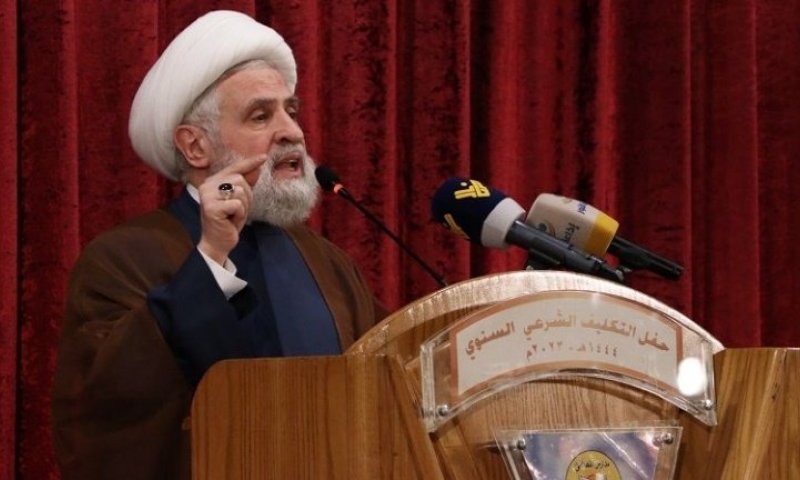
Hezbollah leader Naim Qassem delivered a long and rambling speech from a bunker on Monday night, a day before an historic meeting between Israeli and Lebanese officials is scheduled to take place in Washington.
In his speech,? Qassem threatened to capture IDF soldiers. He stressed that “surrender” is not part of Hezbollah’s vocabulary and that its fighters will remain in the field until their last breath. He emphasized that Hezbollah views itself as acting in self-defense rather than as an aggressor, and claimed that despite the heavy toll and numerous casualties, the organization is on a path to victory. He also warned: “At every opportunity we have, we will capture prisoners.”
Qassem said that victory is not defined by a conventional military defeat of Israel, but by the ability to inflict sustained damage and deny it strategic gains. He stated that success lies in preventing the IDF from entrenching itself on Lebanese soil and vowed to exploit every opportunity to “take captives and strike Israeli forces from all directions.”
Addressing internal and international criticism that Hezbollah initiated the current escalation, Qassem contended that the conflict has actually minimized potential losses that would have resulted from inaction. He described Israel as trapped in a “dead-end entanglement,” claiming that despite Lebanon’s suffering, Israel is also absorbing significant economic and military blows. The greater the pressure, he said, the more vital the mission of the “resistance” becomes.
Israel’s response was swift and unambiguous. Katz dismissed Qassem’s threats and hinted at a similar fate to his predecessor, saying that Qassem “will soon understand what Nasrallah understood in his final hours.”
The Associated Press spoke with a senior Hezbollah official on Monday, who said that the terror group will not abide by any agreements that may result from the direct Lebanon-Israel talks in the United States.
Wafiq Safa, a high-ranking member of Hezbollah’s political council, spoke on the eve of the talks expected in Washington between Lebanese and Israeli ambassadors to the U.S. It will be the first time in decades that envoys from Lebanon and Israel, which do not have diplomatic relations, meet face-to-face in direct talks.
“As for the outcomes of this negotiation between Lebanon and the Israeli enemy, we are not interested in or concerned with them at all,” Safa told The Associated Press.
“We are not bound by what they agree to,” he added in a rare interview with international media. He spoke next to a cemetery as an Israeli drone buzzed overhead.
Lebanese officials are looking to broker a ceasefire in the Israel-Hezbollah war in the U.S. talks.
Israeli Prime Minister Benjamin Netanyahu, meanwhile, has said the goal is Hezbollah’s disarmament and a potential peace agreement between Lebanon and Israel. Shosh Bedrosian, a spokesperson for Netanyahu, said Monday that there will be no ceasefire with Hezbollah.
Separately, in U.S.-Iran peace talks held last weekend in Pakistan, Iran has sought to include Lebanon in any ceasefire deal of its own with the U.S. Israel and the U.S. have insisted Lebanon would not be a part of it.
Hours after Tehran and Washington announced a truce last Wednesday, Israel launched more than 100 strikes across Lebanon, including in densely packed residential and commercial areas of central Beirut.
And though the U.S.-Iran talks broke up without an agreement, Safa said Hezbollah has been informed that Iran “was able to obtain a cessation of attacks” in the entire administrative region of Beirut, Lebanon’s capital, including Beirut’s southern suburbs – a Hezbollah-strong area known as Dahiyeh.
Israeli strikes on Beirut and its southern suburbs have halted since Wednesday, but intense fighting has continued in southern Lebanon as Hezbollah continues to fire nonstop at Israel.
Israel and Hezbollah have fought multiple wars since the Iran-backed Lebanese terror group was formed in the 1980s as a guerrilla force fighting against Israel’s presence in southern Lebanon at the time.
The latest round began on March 2, two days after Israel and the U.S. launched a war on Iran. Hezbollah entered the fray, firing missiles across the border into Israel. Israel responded with aerial bombardment and a ground invasion.
Since then, the war has displaced more than 1 million people in Lebanon and killed more than 2,000, including more than 500 women, children, and medical workers. Many Lebanese have blamed Hezbollah for pulling Lebanon into the war, accusing it of acting on behalf of its patron, Iran.
Safa said Hezbollah’s actions were preemptive because its leaders believed “Israel was preparing for a second battle with Lebanon” with the aim of destroying Hezbollah.
It was “an appropriate moment for Hezbollah … to rebuild a new equation” and restore deterrence against Israel, he said, denying any prior deals with Tehran that Hezbollah would enter the war if Iran was attacked.
Later Monday in a televised address, Kassem himself urged Lebanon to pull out of direct talks with Israel, calling the negotiations a “free concession” to Israel and the U.S.
Relations between the Lebanese government and Hezbollah – which is not just a terror group but also a political party with a parliamentary bloc – have grown increasingly tense.
The government last year approved a plan to remove all weapons that are not property of the state, its security forces, or military – a mission it failed or was unable to carry out.
After March 2, the government went further, declaring Hezbollah’s armed wing illegal.
Safa said Hezbollah is currently not directly speaking with President Joseph Aoun or Prime Minister Nawaf Salam, but that all its communications are going through Parliament Speaker Nabih Berri, the head of the Hezbollah-allied Amal party.
Safa said that if there is a ceasefire and a withdrawal of Israeli troops from Lebanon, Hezbollah – which calls itself a “resistance” movement against archenemy Israel – is ready to negotiate with the Lebanese government about the fate of its weapons.
“The issue of resistance weapons is a Lebanese matter that has nothing to do with Israel or the United States,” he said.
(YWN Israel Desk-Jerusalem & AP)




1 Response
Do it already! Why wait! Talk is cheap! Show him on whose side Hashem is.