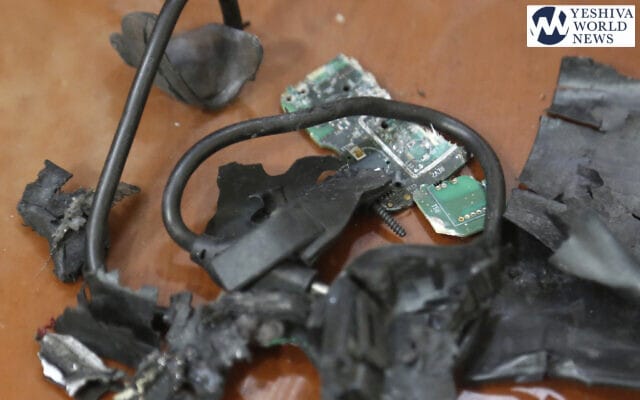
Former Mossad chief Yossi Cohen has revealed new details about some of the most daring covert operations attributed to Israel, including the pager operation against Hezbollah, the theft of Iran’s nuclear archive from Tehran, and sabotage efforts targeting Iran’s supply chains.
In a wide-ranging interview with the French magazine Le Point, Cohen, who led the Mossad from 2016 to 2021, said he was involved in the long-term planning of the pager operation, in which devices used by Hezbollah were allegedly designed to become a vulnerability inside the terror group’s communications network.
According to Cohen, the devices were built to alert users to an encrypted message that could only be opened by pressing two buttons at the same time, forcing the user to hold the device with both hands near the face or chest — increasing the impact when activated.
Cohen also discussed Israel’s 2018 operation to steal Iran’s nuclear archive from Tehran, calling it one of the most important missions of his tenure. He said the Mossad learned after the 2015 nuclear deal that Mohsen Fakhrizadeh, considered the father of Iran’s military nuclear program, had gathered sensitive documents from across Iran and moved them to a secret location.
After becoming Mossad chief in 2016, Cohen said he ordered the agency to locate the archive, study the site, and bring the original documents and disks to Israel. The operation was carried out in January 2018.
Cohen said the archive exposed previously unknown nuclear sites, enrichment activities outside declared facilities, and information about enriched uranium, fundamentally changing the world’s understanding of Iran’s nuclear program. He added that President Donald Trump relied in part on the archive when withdrawing from the Iran nuclear deal in May 2018.
Asked whether the archive operation was his idea or Prime Minister Benjamin Netanyahu’s, Cohen said plainly: “The idea was mine.”
Cohen also revealed details about Mossad penetration of Iranian supply chains, saying the agency operated front companies or took control of existing companies that sold sensitive equipment to Iran. Once ordered by the Iranians, the systems could be modified, sabotaged, rigged with explosives, and activated at a time chosen by Israel.
He cited the April 2021 attack at Iran’s Natanz nuclear facility, saying a system connected to centrifuge operations had been sold to the Iranians after explosives were embedded inside it. Cohen said he personally approved the activation of the charge, which caused major damage to the facility.
The former Mossad chief also described his working relationship with Russian President Vladimir Putin, saying the two developed a professional understanding due to their shared intelligence backgrounds. Cohen said Putin made clear during their first meeting that he knew Cohen’s personal history and intelligence career.
Turning to the October 7 massacre, Cohen sharply criticized Israel’s intelligence failure in Gaza, saying the collapse did not surprise him entirely because he had warned for years that Israel’s intelligence capabilities in the Strip were deteriorating.
Cohen said that during his time as national security adviser and later as Mossad chief, he sought responsibility for Gaza intelligence, or at least part of it, arguing that Israel’s ability to operate inside the Strip had weakened since the 2005 disengagement.
“I know exactly what intelligence they had on Gaza,” Cohen said. “Nothing.”
Cohen said Israel’s years of covert operations inside Iran — from sabotage missions and supply chain penetration to the nuclear archive raid — helped prevent Tehran from obtaining nuclear weapons.
(YWN World Headquarters – NYC)
 Join the official YWN WhatsApp status