
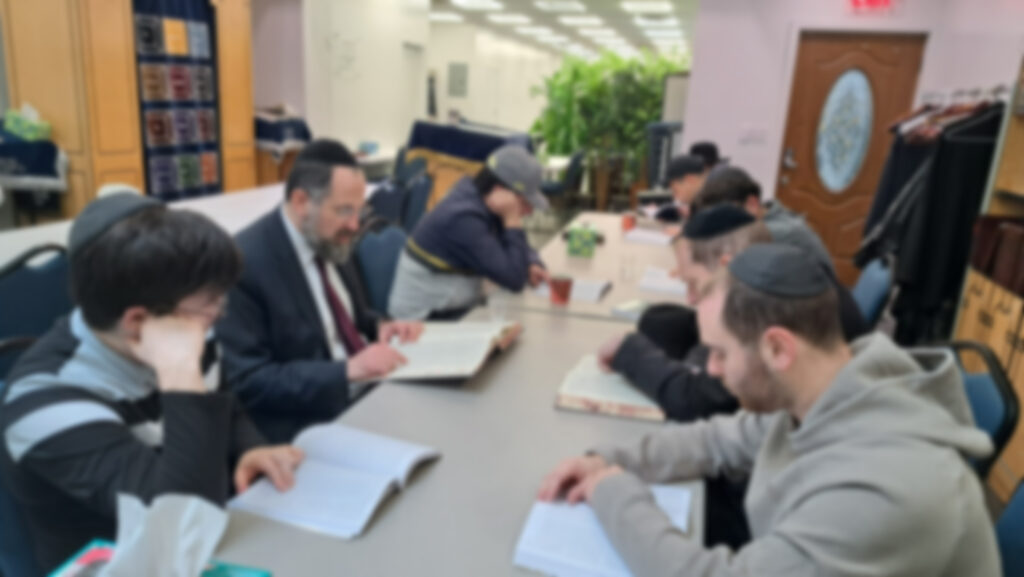
Last week, Chaim, a young man in his mid-20s, from a frum family and strong Yeshiva background, attended a shiur at BJX. He dreaded opening the Gemara. He said that it was the first time he was seeing a Gemara in over seven years. Just a short while later, he was deeply engrossed in the Gemara and didn’t want the shiur to end. He was reinvigorated with his oxygen.
What was different about BJX that motivated him to give Gemara learning a second chance? What was the secret that allowed us to open his heart to Torah learning?
I’ll share with you a story. The Chofetz Chaim was having Shalosh Seudos where he shared deep lessons. Many people flocked to his Shalosh Seudos. Once, an elderly, very distinguished person joined. He tried to get the Chofetz Chaim’s attention, but every time he tried, he realized that the Chafetz Chaim was ignoring him. He was very perturbed. He was after all a rebbi for many years in an important yeshiva and was older than everyone else. Why would the Chofetz Chaim treat him in such bad fashion? He was crying.
After Shalosh Seudos he turned to the Chofetz Chaim. He asked, “Rebbi, why are you not looking at me?” The Chofetz Chaim said he wasn’t looking at the man because he was a murderer. The man was shocked and appalled. He had never physically hurt anyone.
The Chofetz Chaim told the man that there was a bachor many years ago, who attended his yeshiva. His name was Leibele. Leibele Bornstein. You mistreated him. You weren’t nice to him. The man acknowledged having the boy as a student. The Chofetz Chaim said Leibele Bornstein, do you know what became of him? He left yeshivah because of you. Did you hear of the Red Army? Have you ever heard of the Bolshevik Revolution? Communism? Leibele became Leo, Leo Trotsky, the founder. Because you weren’t good to him. Because he didn’t have a good experience in yeshivah. It’s your fault. It’s your responsibility. I can’t look at you.
It’s easy for us to condemn those around us who don’t turn out the way we expected. It’s easy for us to judge others. Sometimes we have to look very deep. We must think about what may have caused them to go astray. People are not evil. Maybe if they only had another chance maybe they wouldn’t have become who they became.
In this week’s Parsha Yaakov Avinu confronts his mortal enemy Esav. Instead of seeing him as a wicked person, he decides to see him as a brother. Yaakov understands that he’s got to get to his brother’s Neshamah. He understood that something may have gone wrong, but as bad as Eisav is, there’s something, there’s a Nitzos, a spark of Kedushah still within him. That’s why the Passuk says, “Vayeshtachu Artzah Sheva Pa’amim, Ad gishto – He prostrated himself seven times until he reached him.” Then the Torah adds on two words that seem to be superfluous – “Ad Achiv – until he gets to his brother.” It says Ad Gishto, until he reached him. Why does it say Ad Achiv?
The Netziv says that Yaakov looked at Eisav and he said I’m going to love him until Ad Achiv, until I reach brotherly love, until I get into his Neshamah and I love him for being a brother and I stop judging him. I understand that there’s some redemptive quality about him. That’s why he goes ad gishto, until he reaches him, Ad Achiv, until he reaches the deepest Neshamah.
Our job in life, whether it’s with our children, or with our students, or with our family members – whomever it is – is to find the Neshamah, to look beyond the veneer and to reach them Ad Achiv, until you reach them as a brother or sister.
That’s precisely the secret of BJX. It is the true love of every Yid and the belief in every Neshama. We don’t rest until we reach every person Ad Achiv – until we reach their pure Neshama, and give them their oxygen.
 Join the official YWN WhatsApp status





4 Responses
What evidence is ther that Leon Trotzky was ever in a Yeshiva? As far as I know, he was born into a very assimilated family and never was Frum in his life.
Mobico, what evidence do you have that he was born into a very assimilated family?
Do a bit of research – all sources say so. His family didn’t even speak Yiddish.
Articles and books I have read state expicitly that he never entered a synagogue in his life.