
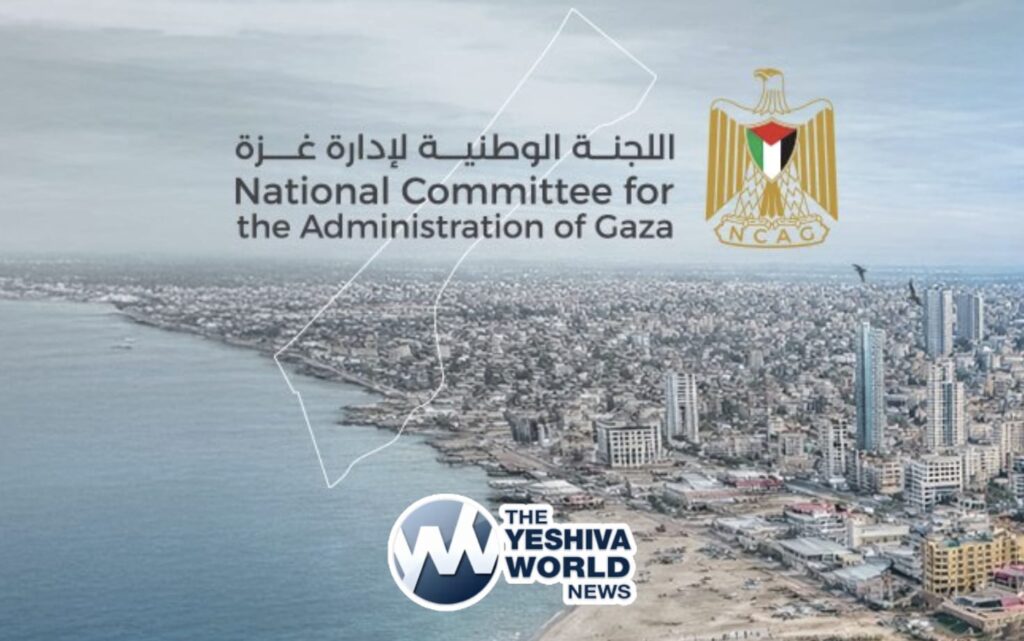
A Palestinian technocratic committee being groomed to manage Gaza’s civilian affairs after the war has quietly shifted its public branding, swapping its own newly minted logo for one that closely mirrors the emblem of the Palestinian Authority.
The National Committee for the Administration of Gaza (NCAG), established last month as a postwar alternative to Hamas, updated its social media accounts on Monday with a new logo that appears nearly identical to the Palestinian Authority’s official seal.
The emblem features a golden eagle facing right with a Palestinian flag on its chest — a long-standing symbol of the PA. The only visible distinction is the shield beneath the eagle: where the PA’s emblem reads “Palestine,” the NCAG version bears the committee’s acronym.
When the committee was launched, it unveiled a separate logo depicting a bird in the colors of the Palestinian flag, signaling its technocratic and ostensibly nonpartisan identity. The switch to PA-style imagery now appears to be a deliberate — if modest — effort to align the committee more closely with the Ramallah-based authority, which governs day-to-day affairs in parts of the West Bank.
That move cuts directly against Israeli policy.
Prime Minister Benjamin Netanyahu has repeatedly and forcefully rejected any role for the Palestinian Authority in governing postwar Gaza, arguing that the PA lacks both legitimacy and the capacity to prevent the resurgence of militant groups.
“The logo of the National Committee for the Administration of Gaza (NCAG) presented to Israel was completely different from the one published this evening,” the Prime Minister’s Office said in a statement. “Israel will not accept the use of the Palestinian Authority’s symbol, and the PA will not be a partner in the administration of Gaza.”
Despite Netanyahu’s opposition, Israel has already made limited concessions involving the PA. Last week, Netanyahu acknowledged that Palestinian Authority representatives would take part in the operational mechanism at the Rafah Crossing between Gaza and Egypt, a narrow but notable opening for PA involvement under international supervision.
The NCAG was designed to manage basic civilian functions — such as utilities, aid coordination and municipal services — without formally restoring Hamas or installing the PA outright. Its technocratic framing was intended to make it palatable to Israel, regional actors and international donors.
The adoption of PA-style symbolism, however, risks blurring that distinction. For Israeli officials wary of a “back door” return of the Palestinian Authority to Gaza, the logo shift may reinforce suspicions that the committee is less independent than advertised. For Palestinian officials and supporters of a unified governance framework, it may be a signal — however subtle — that postwar Gaza is being nudged back into the PA’s institutional orbit.
(YWN World Headquarters – NYC)
 Join the official YWN WhatsApp status





2 Responses
Gaza now belongs to Trump, Kushner, and Witkoff. They will do what they want. Bibi sold Israel to Trump and has no recourse but to hope that he does even more chanifah, then maybe Trump will listen to him. In the meantime, Qatar and Turkey are enjoying their good luck. If Biden had forced this on Israel, the FRUMAGA world would be howling, but if their messiah said this is good, then it must be good. FRUMAGA went from Hamas must be defeated, and hostages come second to “look, Trump got out the hostages and who cares if Hamas hasn’t disarmed and is reasserting control.”
Israelis don�t care. As long as they get kissed by the European low lives. Without Torah the Zionist are our enemy.