
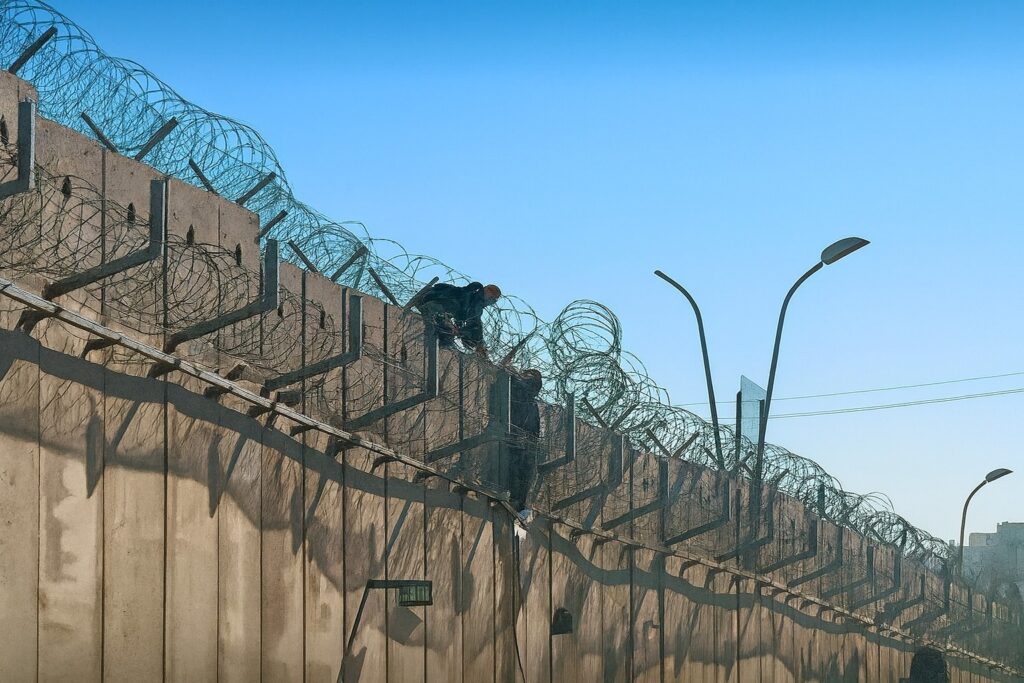
State Comptroller Matanyahu Englman released a scathing report on Tuesday on the condition of Israel’s security barrier and crossings in the Jerusalem area.
The report identifies extensive shortcomings that lead to a grave conclusion: the barrier system and crossings are failing to provide an effective defense against terrorists and illegal Palestinians from entering Israel.
According to the findings, only 61% of the fence route around Jerusalem is protected by a fence or wall, while large sections remain breached or entirely open.
The seam-line barrier and the crossings in the Jerusalem area are a vital layer of security for Jerusalem’s residents and for Israel as a whole, Englman wrote. Their proper functioning is essential to preventing terrorist attacks and infiltrations into Israel.
“After the October 7 massacre and the Iron Swords war, the government and the security establishment were obligated to draw conclusions and prepare properly to defend all sectors,” the report states. “The audit found that sufficient lessons are not being learned by the bodies under review, and similar failures identified in other areas have not been corrected.”
“As a result, a disturbing reality has emerged in which Palestinians can enter Israel without any effective oversight or inspection, endangering Israeli civilians.”
Englman adds that the deficiencies identified in the report are so severe that they “should deprive the political and security leadership of sleep.”
The Jerusalem seam line extends for hundreds of kilometers and includes 16 active crossings. The report finds that police forces are struggling to fulfill their role in preventing illegal infiltration and carrying out inspections at the crossings.
Responsibility for the area is split among the IDF, the Israel Police, the Border Police, and the Shin Bet, yet these bodies operate without close coordination, a clear operational doctrine, permanent command structures, or joint training.
Already in 2005, then-prime minister Ariel Sharon decided that responsibility for managing the crossings should be transferred from the IDF to a single civilian authority. Despite the significant implications such a move could have for daily life and security–both for Israelis, including East Jerusalem residents, and for Palestinians–the decision was never implemented. Other government decisions intended to improve the effectiveness of the barrier were also not implemented.
Among these were Government Decision B/43 on security authority at Jerusalem area crossings; Decision 4784, which addressed transferring certain security responsibilities from the IDF to the police; and Decision 4783, which called for shifting the fence eastward in a specific area. The audit found that the political-security cabinet has not even discussed the implementation status of these decisions, despite nearly two decades having passed since their approval.
Englman wrote that the failure to implement these government decisions carries serious security, diplomatic, and economic consequences.
The audit further revealed that observation command centers remained positioned near the seam line even after the October 7 massacre, a situation that could place the female observer soldiers in the Jerusalem area at risk. In addition, intelligence coverage from observation systems is inadequate and requires significant improvement to enable rapid responses to infiltration attempts.
Another finding shows that the number of vehicle lanes at crossings is inadequate for the heavy traffic entering Israel from Yehuda and Shomron. Severe congestion could turn into a death trap, as seen at the Tunnels Crossing, where six Israelis were wounded in a terror attack in November 2023, and a child was murdered in a terror attack in December 2024.
The report also warns that Border Police manpower assigned to securing the barrier and operating the crossings is insufficient to meet all operational needs.
The murderous attack at the Ramot Junction in September 2025, in which six Israelis were killed and 10 wounded, occurred after the audit period. The attack was carried out by terrorists from Palestinian villages in the Ramallah area who took advantage of the breached security barrier to enter the capital.
Englman stressed the urgency of implementing the report’s recommendations, especially in light of ongoing security threats stemming from terror incidents in Yehuda and Shomron, particularly in the Jerusalem area.
He recommended that the prime minister, the defense minister, and the minister of national security advance the implementation of the plan to civilianize the crossings and called on the police to complete their preparations to respond to a mass infiltration, chalilah, similar to what occurred in the October 7 massacre.
According to the report, fully civilianizing all of the Jerusalem area crossings would require a one-time budget of approximately 600 million shekels, along with an annual operating budget of about 500 million shekels–funding that has yet to be allocated.
“The prime minister, defense minister, minister of national security, IDF chief of staff, police commissioner, Shin Bet chief, commander of IDF Central Command, Jerusalem District police commander, and Border Police commander must immediately correct these failures to avoid placing Israeli citizens at risk of a coordinated terror October 7-style attack in the Jerusalem area,” Englman ominously concluded.
(YWN Israel Desk–Jerusalem)
 Join the official YWN WhatsApp status


