
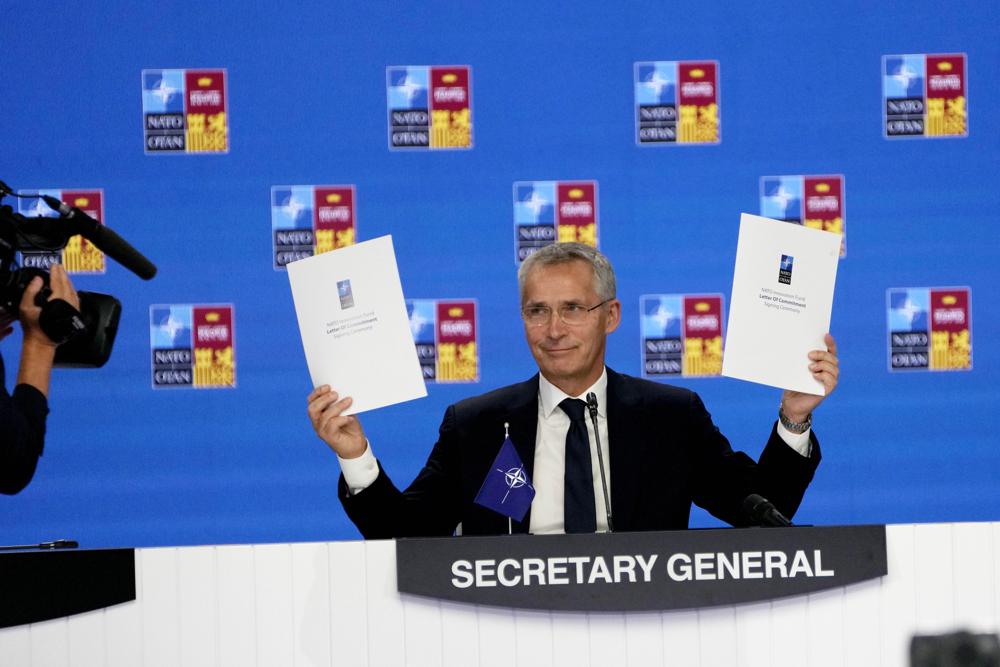
An unstable world could get even more dangerous if NATO does not remain strong and united, the head of the alliance said Thursday at the end of a summit where Western leaders labeled Russia “a direct threat” to the security of their nations.
During their three-day meeting in Madrid, NATO members confronted a geopolitical landscape marked by big-power competition and myriad threats, from cyberattacks to climate change. The leaders cast their sights around the world — drawing a rebuke after accusing China of posing “serious challenges ” to global stability. But Russia’s invasion of Ukraine dominated the summit.
“We live in a more dangerous world and we live in a more unpredictable world, and we live in a world where we have a hot war going on in Europe,” NATO Secretary-General Jens Stoltenberg said. “At the same time, we also know that this can get worse.”
That is why the Western military alliance has a “core responsibility” to keep the war in Ukraine from spilling into other countries while making clear to Moscow that it would “protect every inch of NATO territory,” Stoltenberg said.
That territory is set to grow. At the summit, NATO leaders formally invited Finland and Sweden to join the alliance, after striking an agreement to end opposition from Turkey. However, Turkish President Recep Tayyip Erdogan said he could still block the Nordic countries’ membership, if the Nordic pair do not keep their promises.
If the accession is approved by all 30 member nations, it will give NATO a new 800-mile (1,300 kilometer) border with Russia.
Russian President Vladimir Putin warned he would respond in kind if Sweden or Finland agreed to host NATO troops and military infrastructure. He said Russia would have to “create the same threats for the territory from which threats against us are created.”
Estonian Prime Minister Kaja Kallas said Putin’s threats were “nothing new.”
“Of course, we have to expect some kind of surprises from Putin, but I doubt that he is attacking Sweden or Finland directly,” Kallas said.
NATO leaders turned their gaze south for a final summit session Thursday focused on Africa’s Sahel region and the Middle East, where political instability — aggravated by climate change and food insecurity sparked by the war in Ukraine — is driving large numbers of migrants toward Europe.
The U.S. and other Western nations also are seeking to counterbalance the growing influence of China and Russia in the developing world. Stoltenberg said “Moscow and Beijing are using economic leverage, coercion and hybrid approaches to advance their interests in the region.”
The Beijing government called the alliance a “Cold War remnant” and accused it of “maliciously attacking and smearing” China by including it on NATO’s list of global challenges.
But Stoltenberg said it was Russia’s invasion of Ukraine that had brought “the biggest overhaul of our collective defense since the end of the Cold War.” In response, NATO has poured troops and weapons into Eastern Europe on a scale unseen in decades.
The NATO leaders agreed at the Madrid summit to dramatically scale up military force along the alliance’s eastern flank, where countries from Romania to the Baltic states worry about Russia’s future plans.
NATO announced plans to increase almost eightfold the size of the alliance’s rapid reaction force, from 40,000 to 300,000 troops, by next year — though details of specific troop commitments remained vague.
Most of the troops would be based in their home nations but dedicated to specific countries in the east, where the alliance plans to build up stocks of equipment and ammunition.
Member nations have given Ukraine billions in military and civilian aid to strengthen its resistance. Ukrainian President Volodymyr Zelenskyy, who addressed the summit by video link, asked for more.
He urged NATO to send modern artillery systems and other weapons — or “face a delayed war between Russia and yourself.”
“The question is, who’s next? Moldova? Or the Baltics? Or Poland? The answer is: all of them,” he said.
U.S. President Joe Biden, whose country provides the bulk of NATO’s firepower, announced a hefty boost in America’s military presence in Europe, including a permanent U.S. base in Poland, two more Navy destroyers based in Spain, and two more F35 squadrons in the U.K.
“Before the war started, I told Putin that if he invaded Ukraine, NATO would not only get stronger, but would get more united,” Biden told reporters. “And we would see democracies in the world stand up and oppose his aggression and defend the rules-based order. That’s exactly what we’re seeing today.”
Still, strains among NATO allies have emerged as the cost of energy and other essential goods has skyrocketed, partly because of the war and tough Western sanctions on Russia. There also are tensions over how the war will end and what, if any, concessions Ukraine should make.
Money remains a sensitive issue — just nine of NATO’s 30 members currently meet the organization’s target of spending 2% of gross domestic product on defense.
Britain, one of the nine, announced a further 1 billion pounds ($1.21 billion) in military support to Ukraine on Thursday. Prime MInister Boris Johnson said the U.K. it would increase military spending to 2.5% of GDP by the end of the decade. Host country Spain, one of the lowest spenders in the alliance, aims to hit the 2% target by 2029, Prime Minister Pedro S�nchez said.
The summit also produced a new Strategic Concept, NATO’s once-a-decade set of priorities and goals.
The last such document, in 2010, called Russia a “strategic partner.” Now, NATO accuses Russia of using “coercion, subversion, aggression and annexation” to extend its reach.
The 2010 document made no mention of China, but the new one flagged Beijing’s growing economic and military reach as a a challenge to NATO’s members.
NATO said that China “strives to subvert the rules-based international order, including in the space, cyber and maritime domains” and warned of its close ties with Moscow.
China shot back that NATO was “creating problems around the world.”
“Since NATO positions China as a ‘systemic challenge,’ we have to pay close attention and respond in a coordinated way. When it comes to acts that undermine China’s interests, we will make firm and strong responses,” a statement from Beijing’s mission to the European Union said.
(AP)
 Join the official YWN WhatsApp status




One Response
To be credible the NATO countries have to be willing to increase the size of their military establishments, and probably to raise taxes to pay for it. Trying to look fierce and snarling will not scare a conqust-dreaming wannabee.