
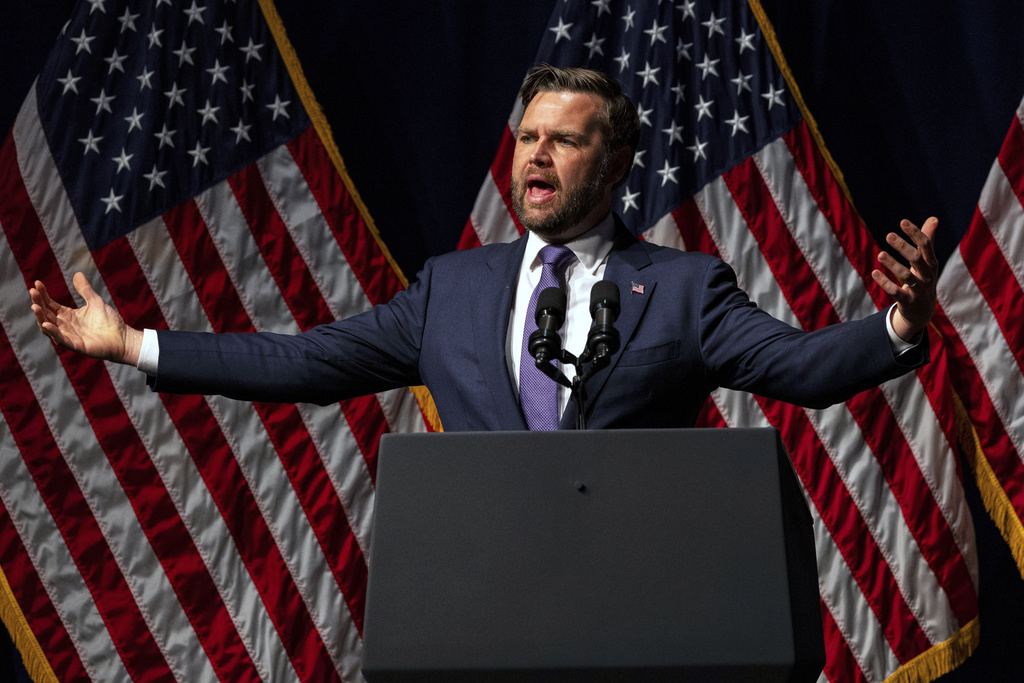
With the 2026 midterm elections still nearly months away, early maneuvering for the 2028 presidential race is already beginning to surface, as potential contenders from both parties make high-profile appearances, test messages, and build relationships in key political circles ahead of the contest to succeed term-limited President Donald Trump.
While party leaders emphasize that the immediate focus remains on next year’s battle for control of Congress, recent developments suggest that the groundwork for the next White House race is quietly being laid.
Republicans: Vance Emerges as Early Front-Runner
On the Republican side, Vice President JD Vance is widely viewed as the early favorite should he choose to run. That perception was reinforced last month when he received a high-profile endorsement at the annual summit of Turning Point USA, a politically influential conservative organization with a strong grassroots network, particularly among younger voters.
The endorsement came from Erika Kirk, who assumed leadership of the organization following the September assassination of her husband, conservative activist Charlie Kirk. In her opening remarks at the summit, she explicitly endorsed Vance’s potential candidacy, signaling that the group’s political infrastructure could be mobilized behind him in 2028.
Despite Vance’s strong positioning, other Republicans appear to be laying markers. Sens. Ted Cruz and Rand Paul, both of whom challenged Trump in the 2016 GOP primary, have recently been more vocal in expressing differences with the administration. Additional figures frequently mentioned as possible 2028 contenders include Florida Gov. Ron DeSantis, Virginia Gov. Glenn Youngkin, Georgia Gov. Brian Kemp, and Secretary of State Marco Rubio.
Whether Republicans face a competitive primary in 2028 may hinge on the success of Trump’s second term, the state of the economy, and GOP performance in the 2026 midterms.
Democrats: A Wide-Open Field Takes Shape
For Democrats, the 2028 nomination contest is expected to be far more crowded. Former Vice President Kamala Harris, the party’s 2024 nominee after then-President Joe Biden exited the race, drew attention with a forceful speech at the Democratic National Committee’s winter meeting in December. In her remarks, Harris criticized the political status quo and urged Democrats to begin articulating a vision beyond the midterms and the Trump presidency.
Harris is expected to maintain a visible national presence in the coming year as she campaigns for Democratic candidates ahead of the midterms. She has also expanded her book tour for 107 Days, her account of the 2024 campaign, with scheduled appearances in early-voting primary states, including South Carolina.
California Gov. Gavin Newsom also attracted attention at the DNC winter meeting, which was held in Los Angeles. While he did not address the general session, Newsom held meetings with delegates and party leaders, including chairs from New Hampshire and Nevada–two states central to the Democratic presidential nominating calendar.
Newsom’s profile within the party has risen over the past year, driven by his high-visibility confrontations with Trump and his role in California’s response to Republican-led congressional redistricting efforts. Still, both Newsom and Harris face skepticism from some Democrats who question their general election viability in 2028.
They are unlikely to have the field to themselves. Illinois Gov. JB Pritzker was also active at the DNC meeting, and more than a dozen other Democrats are widely viewed as potential contenders. That list includes Govs. Josh Shapiro, Andy Beshear, Wes Moore, and Gretchen Whitmer; Sens. Cory Booker, Amy Klobuchar, Ruben Gallego, Mark Kelly, and Chris Murphy; Reps. Alexandria Ocasio-Cortez and Ro Khanna; as well as former Transportation Secretary Pete Buttigieg and former White House chief of staff and Chicago mayor Rahm Emanuel.
With competitive midterm races expected nationwide in 2026, political observers anticipate that many of these potential contenders will remain active on the campaign trail, balancing efforts to help their parties win congressional seats while positioning themselves for a possible 2028 run.
(YWN World Headquarters – NYC)
 Join the official YWN WhatsApp status



One Response
Rubio clearly stated that if JD were to run in 2028 he would proudly support him