
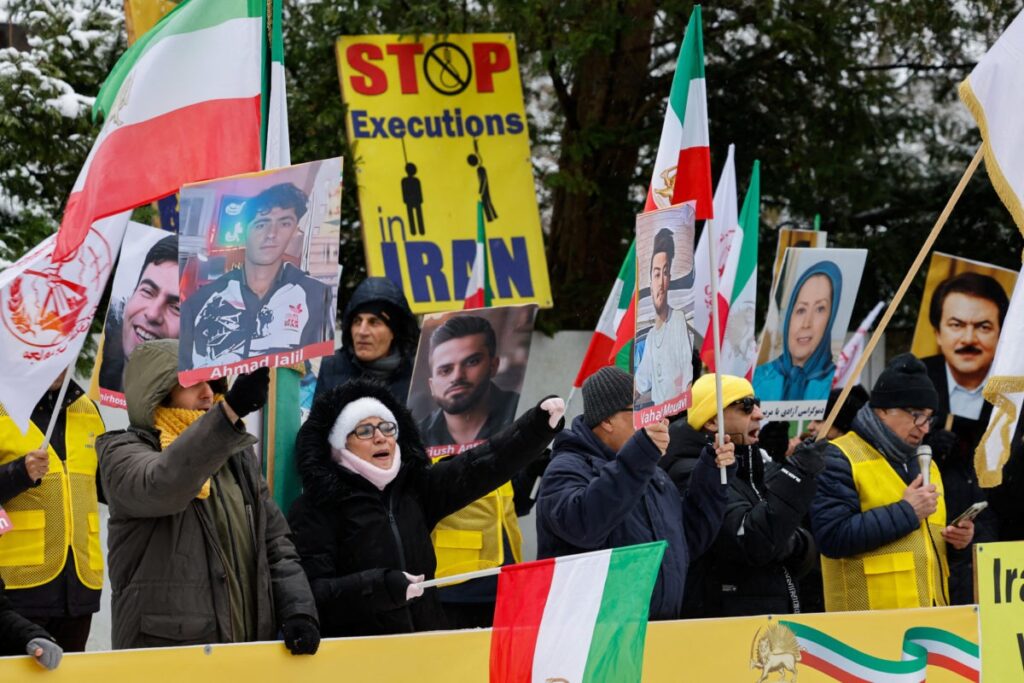
Thousands of Iranians poured back into the streets Tuesday as the country’s largest protest movement in years surged into its 10th day, with a government announcement of a token monthly cash payment instead intensifying public fury rather than easing it.
Demonstrations erupted across Iran after officials revealed that roughly 80 million eligible citizens would receive 10 million Iranian rials per month–worth about $7.70 at real exchange rates–in what authorities called an emergency stimulus to blunt the impact of inflation and a collapsing currency. The announcement was widely mocked by protesters struggling to afford food, rent, and basic necessities.
Government spokeswoman Fatemeh Monajerani announced the plan on state television, saying the payments would be delivered by direct deposit as credits usable for essential household goods to help “reduce the economic pressure on the people.” But on the streets, the announcement was seen as a provocation.
Clashes between protesters and security forces continued nationwide, with smoke filling major thoroughfares in Tehran and other cities as police deployed tear gas to disperse crowds. According to the Human Rights Activists News Agency, at least 36 people have been killed since the unrest began–34 protesters and two members of the security forces–while more than 1,200 people have been detained and at least 60 injured.
The protests, which began Dec. 28, have been fueled by a rapidly deteriorating economy. Iran’s currency, the rial, fell to a record low of roughly 1.46 million to the dollar on Tuesday, compared with about 430,000 to the dollar in 2002. Inflation has surged to at least 42.2% year over year, while prices for food and other essentials have skyrocketed beyond the reach of much of the population.
The government’s new subsidy plan would redirect an estimated $10 billion previously spent on import subsidies in an effort to stabilize food prices, according to reporting by The New York Times. Economists, however, say the measure barely scratches the surface.
“It’s a small amount for the middle class and will not meaningfully improve their standard of living,” said Esfandyar Batmanghelidj, founder of the U.K.-based Bourse & Bazaar Foundation. “It may help the poorest households slightly, but what the government can afford is nowhere near enough to alleviate the pressures most Iranians are facing.”
The unrest has drawn heavy participation from traders, shopkeepers, and university students, particularly in Tehran’s Grand Bazaar, where businesses have shuttered amid rolling strikes. Protesters have increasingly chanted slogans calling for the removal of Supreme Leader Ali Khamenei, escalating the political stakes of what began as an economic uprising.
Security forces have responded aggressively, at times firing tear gas and plastic bullets into crowds. The scale and intensity of the protests mark the most serious challenge to the Islamic Republic since the death of Mahsa Jina Amini in 2022, which sparked months of nationwide demonstrations after she died in police custody.
International pressure on Iran has mounted as well. New United Nations sanctions imposed in September have further strained the economy, compounding the effects of long-standing U.S. restrictions and limiting access to foreign currency and trade.
U.S. President Donald Trump weighed in last Friday with a stern warning, saying the United States was “locked and loaded” to support Iranian protesters if the government continues to use lethal force.
“If Iran violently kills peaceful protesters, which is their custom, the United States of America will come to their rescue,” Trump said, without elaborating on what such support would entail.
Despite the mounting death toll and mass arrests, there were no signs Tuesday that the protests were slowing. For many demonstrators, the government’s $7-a-month promise has become a symbol of how far removed Iran’s leadership is from the daily reality facing its people–and why they are refusing to leave the streets.
(YWN World Headquarters – NYC)
 Join the official YWN WhatsApp status


4 Responses
Wow what an embarrassment they give billions to Hamas and Hezbollah but they’re only offering their people $7 a month. Just for that alone they should be slaughtered from the same cranes that they hung so many innocent people
Who decides which articles you guys carry? This is total nonsense. The people of Iran are revolting against Islamic rule. It has very little to do with economics except for the fact that things are so bad there�s not much to lose.
They are offering $7.70. Is anyone out there triggered by 770? Come on, start howling.
Let’s face it Iran and there “friends”are literally gonna