
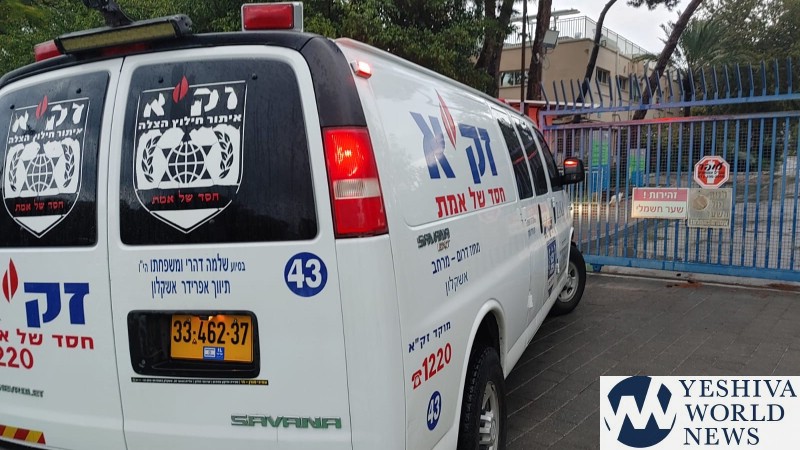
The Jerusalem Magistrate’s Court on Monday approved a police and prosecution request to carry out autopsies on the bodies of two infants who died in the devastating daycare tragedy in Jerusalem — Leah Tzipora Golubentzitz A”H, three months old, and Aharon Katz, four months old.
During the hearing, the families were represented by Shenir Elmalich of the legal department of ZAKA. At the conclusion of the session, the court accepted the police request and authorized the autopsies.
Following the ruling, attorneys for the parents requested a stay of execution in order to file an appeal. ZAKA’s legal department announced it will submit an appeal to the High Court of Justice, seeking to exhaust all legal avenues to protect the kavod hames of the infants and to minimize harm as much as possible.
[NEW INFO: Infants May Have Died From Dehydration Caused by Extreme Heat From Air Conditioner]
Michael Gutwein, coordinator of ZAKA’s legal department, said: “We have been accompanying the families from the very first moment and are acting with all legal tools available to us. We will continue to fight in the highest courts to preserve the dignity of the infants.”
In an unusual and rare statement, it was reported that HaGaon HaRav Moshe Shternbuch instructed his talmidim that there is an obligation for each individual to go out and protest against autopsies and the desecration of the deceased.
Earlier in the day, reports indicated that authorities were considering limiting the procedure to an external CT scan at the Institute of Forensic Medicine in order to avoid a full autopsy. However, as of this evening, the prosecutor’s demand for a complete postmortem examination remains in place.
At the same time, and following instructions from the Badatz of the Eidah HaChareidis, hundreds of demonstrators blocked Shmuel HaNavi Junction in Jerusalem in protest of the planned autopsies.
Protesters blocked buses and set trash bins on fire, while police responded using batons and deployed a water cannon at the scene.
The situation remains tense as the families prepare to pursue their appeal to the High Court.
[MKs Blame Attorney General: “Children Of Avreichim Were Expelled From Supervised Daycares!”]
[Degel HaTorah: We Warned Repeatedly — Decision-Makers Bear Responsibility for Romema Daycare Tragedy]
(YWN World Headquarters – NYC)
 Join the official YWN WhatsApp status




11 Responses
The high court is going to have sympathy for religious sensitivities? What a joke
how about demonstrating against unsafe facilities?
Nazi Zionists.
Infant daycare; 2 dead, many hospitalized, exposure to hazardous materials ruled out.
Is this sort of violent protest against autopsies, arguing desecration of the suspiciously deceased in such mysterious situations principled? Seems necessary to me to investigate to prevent further deaths, such as of the surviving babies. Peaceful protest, let alone blocked buses and set trash bins on fire seems wrong to me. In Orthodox Judaism autopsies are to be allowed when required by law, as in this case because preserving life is a higher value, though with strict guidelines for minimal invasion and proper handling to maintain respect, no?
The Gemara discusses specific limited circumstances where autopsies are not only allowed, but are required. As I recall, one such situation is where there were two patients with the same illness, and one died – and performing an autopsy may help with detemining the exact cause, which may help determine treatment that might save the life of the other patient.
Is that possibly the case here? There are Rachmana Litzlan, two dead infants – and 53 who were exposed to the same thing. If there’s even a chance that doing the autopsies may help in determining the treatment of even one of the 53 survivors, wouldn’t that meet the Gemara’s exception?
I don’t have enough detail to know the answer – but that at least seems to be a reasonable possibility, and needs to be considered before taking to the streets.
an Israeli Yid
Years ago in the 1970s they used to have forced autopsies in Israel. Anyone that died the police would grab the body and cut them up. Satmar and others here would protest all the time.
Readers might pause to think for a moment – why are they requesting an autopsy? I�m guessing that most readers, and protestors, don�t even know what is involved in these minimally invasive autopsies. These autopsies often involve basic blood work, and the propose is to understand what happened so that this never happens again, to your child or to any other child.
It’s not pashut that the autopsy isn’t mutar assuming it’s to save others who are currently in danger. Here’s a quote from an article with ???? ?????? on the bottom, it’s from wwwDOTaishDOTcom/48959971/
The accepted opinion was composed by Rabbi Yechezkel Landau, 22 an 18th century scholar, who was asked a question by several British physicians. They had operated on a child with “bladder stones” 23 who subsequently died. A rabbi in London had written to Rabbi Landau to inquire whether he ruled properly in allowing a post mortem examination of the child to discover whether they had operated appropriately so that future patients might benefit from their increased knowledge. He disagreed with his interlocutor and responded that autopsy is only permitted to save the life of a critically ill patient who is in front of us (l’fanenu), but not for the advancement of medical science per se. He argued that there is no end to the prohibitions that might be justified by the reasoning of “possible future gain.”
Practical outcome
The operative question is what constitutes “l’fanenu” � in front of us — in the modern world. The clearest case would be an epidemic, such as the mysterious Legionnaires Disease epidemic in Philadelphia in 1976, where one person dies and others are critically ill from the same unknown cause. If an autopsy might determine the etiology of the illness and save the other patients, then autopsy should be permissible. Similarly, if a patient with a life-threatening disease dies following a new or experimental treatment, autopsy to evaluate for toxicity that might affect others with the same disease would be indicated. 24 As a rule an autopsy that might realistically result in saving the life of a currently ill person is indicated. 25 In today’s world of instant communication that person may be anywhere in the world. Additionally if a child dies of a genetic disease, an autopsy may be performed to clarify the nature of the illness if that might save the lives of other children in the same family despite the fact that no other children may yet have been born or even yet conceived. 26
A more difficult case was brought to the Israeli Chief Rabbinate in the 1980’s during the Israeli war in Lebanon. Many soldiers were suffering severe burns and needed skin grafts. While skin grafts may be life-saving, skin requires time to culture before it may be grafted. Skin taken from a dead person would have to be used later for a person who was not yet burned at the time of the skin harvesting! Is this considered “in front of us”? The Chief Rabbinate ruled that it was permissible because, while we do not know who will need the skin, unfortunately the odds were very high that someone would need it. 27 Similarly, for solid organ transplants, having a transplant list is sufficient even if we do not know which patient will get the organ when we harvest it.
Interestingly, minimally invasive diagnostic procedures which are routinely performed on the living, such as percutaneous biopsy and blood drawing, 28 as well as endoscopies and laparoscopies, 29 are permitted on a dead body, and are not considered to be a desecration of the corpse.
22)Responsa Nodeh Beyehuda, (Medura Tinyana) 2, YD 210
23)While it is likely that the child suffered from urinary bladder stones, they may possibly have been gallstones.
24)”Autopsy in Jewish law is permitted only to answer a specific ques�tion. The knowledge gained would then contribute to the immediate improvement of care of patients. Autopsy would for, example be allowed where a patient received experimental chemotherapy for a neoplastic disease, or where a patient received an experimental antibiotic or an untested vaccine for the treatment or prophylaxis of an infectious disease, or where a patient underwent an operation in which a new or experimental surgical technique was employed. In each of these situations, it is imperative to ascertain whether or not the drug or vaccine or surgical technique contributed to the patient’s death. In addition, the effectiveness, or lack thereof, of the experi�mental drug, vaccine or operation may be learned. Such information concerning the possible toxicities or benefits to the now deceased patient is critical in the physician’s decision-making process for existing patients.” Rabbi M.D. Tendler, Ph.D, Medical Ethics, 5th edition (1975) with addendum (1981), Federation of Jewish Philanthropies of New York, p. 59.
25)Rav Eliezer Yehuda Waldenberg (Tzitz Eliezer 4:14 ) allows a post mortem examination on a patient with an uncommon disease even if no other patients are currently present with the same disease, if the deceased consented to it before death or sold his body for such a purpose. However, “Jewish bodies may not be dissected for the study of medicine even if the deceased consented or sold his body for such purposes” (which is an act which he is halachically forbidden from doing.) (Cited in A. Steinberg, MD, Concise Medical Law, Beit Shammai Publications, 1989, p. 153).
26)See Rabbi Y Arieli, Torah Shebe’al Peh, Vol. 6 (1964), pp. 40-60 and Noam, Vol. 6, 5723 (1963), pp.82-103. See also Fred Rosner, MD, Biomedical Ethics and Jewish Law (2001), Ktav Publishing House,, p.376.
27)See Rabbi Shalom Meshash, “Banking skin for the treatment of burn patients,” Techumin 7(1986), 193-205 and Rabbi Shaul Yisraeli, “The treatment of burns by skin transplantation from the dead,” Techumin (Winter 5740/1980), pp. 237-247 See also the excellent chapter in Biomedical Ethics and Jewish Law (Rosner 2001) entitled “Grafting Skin and Skin Banks,” pp. 355-365.
28)Rabbi Moshe Feinstein, Igros Moshe, Yoreh Deah II:151 (last paragraph), Rabbi Shlomo Zalman Aurbach, cited in Nishmat Avraham, Yoreh Deah, ibid. (Hebrew edition, Yoreh Deah 349:2, note 121).
29)Rabbi Moshe Feinstein, Noam , vol. 8, 5725 (1965), p. 9 (cited in Encyclopedia of Jewish Medical Ethics, p. 87).
Unfortunately for all the modern fakers you can’t modify the Torah to say autopsies are okay except in situations where you decided that it is, it’s forbidden end of story. Keep your emotions at Bay
An autopsy would be halachically permissible if there were no indicia of the cause of death. But, they already know the cause of death to reasonable certainty. A minimally invasive toxicology panel may be indicated to ensure the deaths were not assisted by drugging the kids. In any event, the parents in conjunction with their rabbi have to make the decision, not the government. As far as I can tell, sitting here in New York and getting my information solely from the news media, these deaths were accidental (although probably very negligent) and the need for an autopsy cannot be justifiable died halachically. I hope the court asks all the right questions and
An autopsy would be halachicly permissible if there were no indicia of the cause of death. But, they already know the cause of death to reasonable certainty. A minimally invasive toxicology panel may be indicated to ensure the deaths were not assisted by drugging the kids. In any event, the parents in conjunction with their rabbi have to make the decision, not the government. As far as I can tell, sitting here in New York and getting my information solely from the news media, these deaths were accidental (although probably very negligent) and the need for an autopsy cannot be justifiabled halachicly. I hope the court asks all the right questions and issues a decision based on Halacha and the facts of this case.