
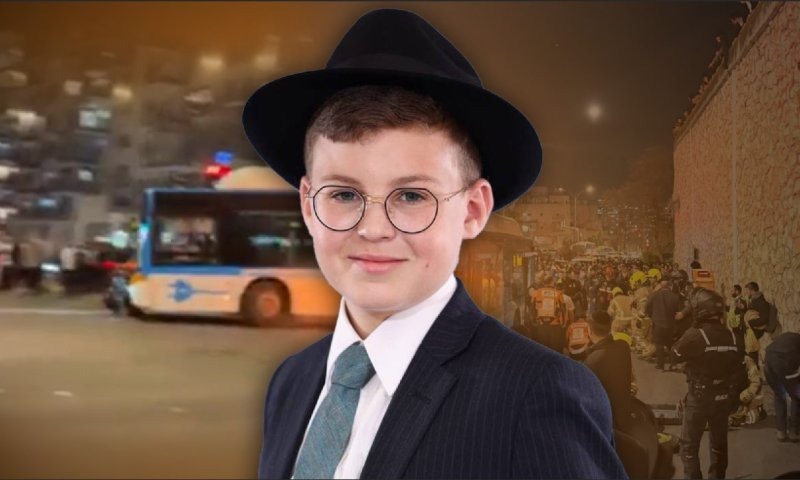
Rabbi Dror Aryeh, a Dati Leumi Rav in Yeshivas Sderot, warned of the “dehumanization of Chareidim” in an article published in Arutz Sheva following the silence from the media in the wake of the killing of Yosef Eisenthal, z’l, by an Arab bus driver.
Sadly, the messages in the article bear repeating following the shocking responses to the tragic deaths of two Chareidi babies in a daycare earlier this week and the apathy toward the death of a yeshivah bochur near Komemiyut on Tuesday.
“The tragic death of the teen, Yosef Eisenthal, z’l, under the wheels of a bus is not only a heartbreaking tragedy–it is a blazing warning signal for Israeli society as a whole,” Rabbi Aryeh wrote.
“Beyond the pain over the loss of a young life, a heavy cloud of media and public silence hovers over the incident, raising a piercing question: has the value of human life become dependent on one’s sectoral affiliation amid the Israeli political struggle during an election year?”
“It is difficult to separate this painful incident from the toxic public atmosphere that dominates Israel. When protest groups such as Brothers in Arms and the Kaplan protesters, backed by megaphones in media outlets, conduct a harsh campaign of delegitimization against the Chareidi and religious public, the result is a dangerous erosion of basic empathy. When an entire public is portrayed as an ‘enemy of democracy’ in order to topple a right-wing government and shatter sectoral unity, the distance between verbal incitement and apathy to human life shrinks. The blood of a Chareidi teen, it seems, ‘cries out’ less loudly in the newsrooms than the blood of those belonging to the ‘correct’ camp.
“To understand the magnitude of the injustice, it is enough to apply a simple hypothetical test–if the circumstances were reversed. Imagine a Chareidi, settler, or right-wing bus driver striking a prominent Kaplan protester. Would anyone have moved on as if nothing happened? The answer is clear: the ground would have shaken. Headlines would have screamed about the ‘collapse of democracy,’ and the outrage would have filled every airwave. Similarly, if an Arab from the Negev or Yehudah and Shomron had been run over under similar circumstances, the media would have responded with horror, and the country would have burned over the disregard for human life. But when the victim is a Chareidi teen, the weak condemnation and burial of the story at the bottom of the news broadcasts expose an appalling hypocrisy. This silence is not accidental–it is the result of dehumanization that causes people to forget that we are all Jews and all brothers.
“Amid rising hostility and attempts to turn the Chareidi public into a target, it’s important to remember that our Chareidi brothers are the spiritual and moral backbone of Am Yisrael. As the prime minister said, it is the koach of Torah learned with mesirus nefesh throughout the generations that we are here today in the State of Israel.
“We must remember that those who now seek to portray the blood of a Chareidi teenager as cheap are the same forces that yesterday sought to besmirch an entire sector of settlers and members of religious Zionism. Our partnership is not only political, but a covenant of destiny based on one Torah and eternal values that no campaign can destroy. The resilience of the faith-based public is what has preserved the Jewish flame generation after generation. Continue on your proud and steadfast path, knowing that Am Yisrael exists in the zechus of your deveikus to mesorah and emunah, and that no incitement machine will be able to erase the deep covenant between the parts of our nation.
“Yosef Eisenthal, z’l, was not only a Chareidi teenager; he was a Jew, a son, and a human being. The tragedy of his death must not be buried. Ignoring the tragedy under the cover of a political agenda is a moral disgrace. The time has come to demand one standard of justice and one measure of grief for all Israeli citizens. We must not allow the incitement machine to make us forget the simple truth: we are Jews, and our blood is one.”
It should be noted that, in addition to the points raised in the article, the judges released the Arab bus driver despite video evidence showing him deliberately accelerating toward the group of Chareidi teens, and the prosecution declined to appeal the decision to the Supreme Court.
(YWN Israel Desk–Jerusalem)
 Join the official YWN WhatsApp status


4 Responses
It�s a serious struggle. It�s a battle between the heretics and the authentic Jews. We must fight back.
If Charedim truly valued life, they’d stop flouting laws by blocking roads and endangering their own kids as protest fodder. Sending teens to stand in front of buses isn’t “mesirus nefesh”�it’s reckless child endangerment, bordering on using human shields to shield their own defiance. Hypocrisy much?
and you didn’t know that our blood is cheap in their eyes? Have you been hibernating for the last few millennia?
“Sending teens to stand in front of buses isn�t �mesirus nefesh��it�s reckless child endangerment”
Now do sending teens to Gaza