
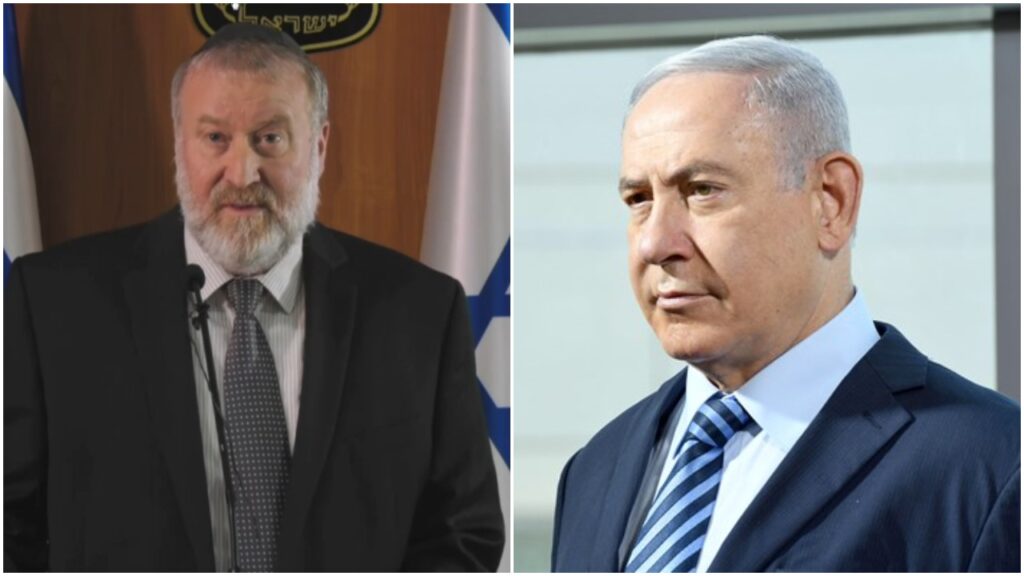
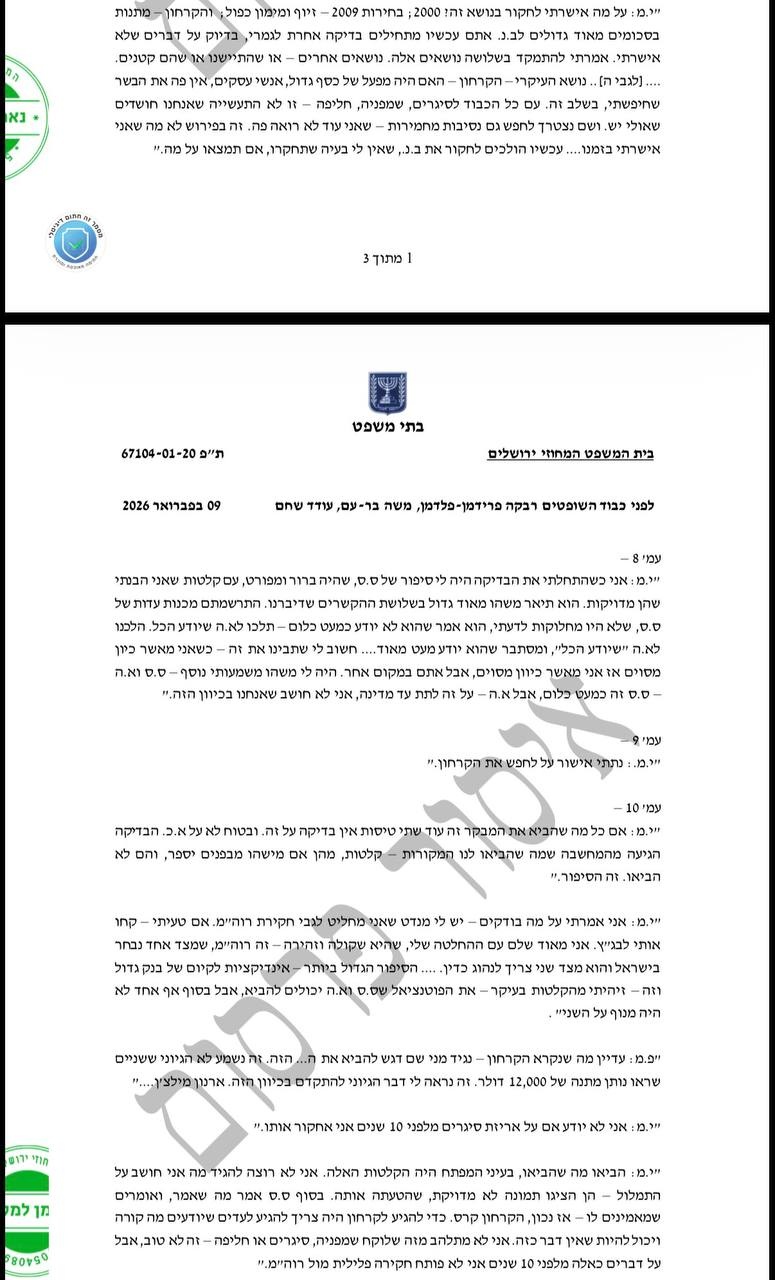
The Jerusalem District Court on Tuesday officially approved for publication a partial transcript of an internal discussion held in July 2016, containing a series of harsh statements by then-Attorney General Avichai Mandelblit toward Lahav 433 investigators regarding illegal actions they took in the probe against Prime Minister Binyamin Netanyahu.
The decision was made after the court reviewed the transcript itself following a report on the matter by i24News on Monday evening. The report revealed that then-Attorney General Avichai Mandelblit informed the police that he would not agree to open an investigation against Prime Minister Binyamin Netanyahu over cigars and champagne he accepted ten years earlier (Case 1000).
But in just one of a series of illegal actions carried out during the investigations against Netanyahu, the Lahav 443 investigators acted contrary to Mandelblit’s order and expanded Case 1000 and obtained wiretapping warrants by misleading the court to believe that they were examining particularly serious suspicions–bribery and money laundering–even though these suspicions were not part of the case and had not been authorized by Mandelblit.
The transcript quotes Mandelblit rebuking the investigators, “With all due respect to cigars and champagne, this isn’t the industry we’re suspecting might exist. This is clearly not what I authorized at the time.” He also later clarified regarding the suspicion of financial transfers: “There isn’t the ‘meat’ here that I was looking for, at this stage.”
Mandelblit also described the basis for launching the initial investigation, which he says relied on recordings and testimonies that initially seemed significant. But later, he said, the picture changed: “We went to someone who ‘knows everything,’ and it turns out he knows very little.”
Mandelblit clarified the boundaries to the investigators and said, “It’s important to me that you understand this–when I approve a certain direction, I approve a certain direction. But you’re in a different place.”
The transcript also reveals that Mandelblit repeatedly emphasized his exclusive authority regarding the investigations against Netanyahu: “I said what to investigate–I have the mandate to decide regarding the investigation of the prime minister.” He even challenged them: “If I was wrong–take me to the Supreme Court.”
Later in the discussion, Mandelbrot said that what he had referred to as “the iceberg” [proof of wrongdoing by Netanyahu] had not materialized. “At the end, the iceberg collapsed. In order to reach the iceberg, it was necessary to find witnesses who know what’s going on, and it could be that no such thing exists.”
It should be noted that some of these statements have already been revealed in the past by 124News and by witnesses in court hearings but were firmly denied by the State Attorney’s Office.
The gravity of the affair is heightened by the fact that the State Attorney’s Office told the court that the report quoting these remarks was “baseless.” Only after the judges rejected that denial and demanded to review the original protocols did it become clear that the report was accurate.
The transcript directly contradicts an affidavit previously submitted to the court, in which it was claimed that all investigative actions were carried out with Mandelblit’s full knowledge and approval. The exposure raises serious questions about the conduct of law-enforcement authorities and about the gap between orders issued behind closed doors and what the official statements presented to the court.
It should also be noted that in the period prior to the indictments filed against Netanyahu, then-Attorney-General Avichai Mandelblit said that “without a bribery charge, there are no indictments.”
Over the past year, the bribery charges have been disproven over and over in court hearings.
In a court hearing a year ago, the judges scoffed at the charges of bribery against Netanyahu, even snapping at the prosecutor that “the court recommended you drop the bribery charges.” [In June 2023, the Jerusalem District Court recommended that the prosecution drop the bribery charges, warning that a conviction was unlikely.]
 Join the official YWN WhatsApp status





1 Response
They are ALL CORRUPT.
STENCH IS WORSE THAN SWAGE IN US.