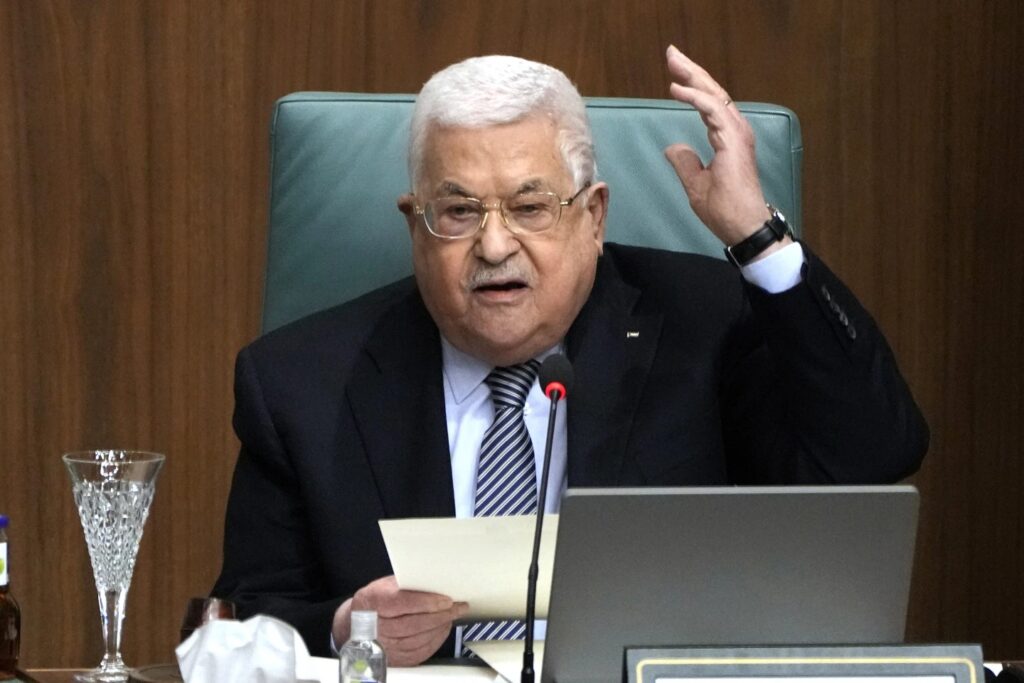
Palestinian Authority President Mahmoud Abbas has ordered the publication of a long-awaited draft constitution for a future Palestinian state, a sweeping document that outlines the contours of sovereignty, religion, security forces — and a deeply contested vision of Jerusalem.
The draft, released through the official PA news agency WAFA, is being presented as a foundational step toward statehood. But its contents are already stirring controversy, both internally and abroad.
Article III of the draft constitution declares Jerusalem the “capital of the State of Palestine,” describing it as the state’s “political, spiritual, cultural, and educational center.” It pledges to preserve the city’s “religious character” and protect its Islamic and Christian sanctuaries.
The text commits the state to defending Jerusalem’s “legal, political, and historical status,” and declares any attempt to alter its identity “null and void according to international law.”
Notably absent from the document: any reference to Jewish historical or religious ties to the city.
Article IV designates Islam as the official religion of the state and identifies Islamic Sharia principles as the “primary source for legislation.” Christianity is granted a “special status” with designated protections, while Article XXVII guarantees equality without discrimination, including on the basis of religion.
Article XXXVII affirms freedom of belief and the right to establish houses of worship for followers of monotheistic religions, but Judaism and the Jewish people are not explicitly mentioned in any section of the draft.
The document also requires that the president swear “by G-d Almighty” upon entering office, and mandates that Sharia and religious courts handle relevant disputes.
Article I frames Palestine as “part of the Arab homeland,” stating that the Palestinian people are part of the broader Arab nation.
Several provisions appear to codify longstanding Palestinian Authority policies that have drawn sharp international criticism. Article XXIV commits the state to protecting and caring for the families of “martyrs, wounded, and prisoners,” including those released from Israeli prisons. Article XLIV calls for “comprehensive care” for those families “in preservation of their national dignity.”
Those clauses effectively constitutionalize the PA’s stipend system for families of Palestinians convicted of terror-related offenses, often referred to as pay-for-slay.
The draft also calls for pursuing perpetrators of crimes “before the judiciary,” though it does not elaborate on enforcement mechanisms.
The constitution’s ninth chapter defines the structure of a future Palestinian state’s security forces. Article CLIII describes them as “regular forces” tasked solely with defending the homeland, maintaining public order and serving the people.
The forces are to be subject to civilian authority and democratic oversight, and members are barred from political party activity during service. The draft explicitly prohibits the establishment of any armed or paramilitary groups outside official security structures.
The document outlines a democratic system with periodic elections and a two-term presidential limit of five years per term.
Candidates for president must be over 40, born to two Palestinian parents, and hold no other nationality — or pledge to renounce any additional citizenship upon election. They must not have been convicted of felonies involving “breach of honor or trust.”
The draft also calls for the establishment of an independent Palestinian Monetary Authority.
In its preamble, the constitution is described as “an extension of the liberation journey from occupation and guardianship” and a bridge between “a besieged present and a future open to freedom and change.”
It asserts that Palestinians face “policies of displacement and ethnic cleansing,” while vowing to achieve sovereignty through democratic struggle and peaceful transfer of power.
Senior Hamas official Bassem Naim denounced the draft as a “failed attempt” by the PA to preserve its authority, arguing that a people “under occupation” should not draft constitutions “according to the standards of the occupier.”
The draft was prepared by a 16-member Constitution Drafting Committee chaired by Mohammad al-Haj Qassem. Abbas’s decree invites citizens, civil society groups and political factions to submit comments within 60 days.
Last year, French President Emmanuel Macron said Paris would assist Abbas in drafting a future constitution following bilateral talks. The published draft makes no mention of French involvement.
For Abbas, the constitution represents an attempt to project institutional readiness for statehood amid mounting regional and diplomatic pressures. But with Jerusalem’s status, religious identity, and security policies front and center — and with Hamas publicly rejecting the effort — the draft risks deepening existing fractures.
(YWN World Headquarters – NYC)
 Join the official YWN WhatsApp status