
Connecting to Greatness: Rav Shlomo Kanievsky Continues Global Campaign in US for Kiryas Melech
Will Spend Shabbos in Passaic
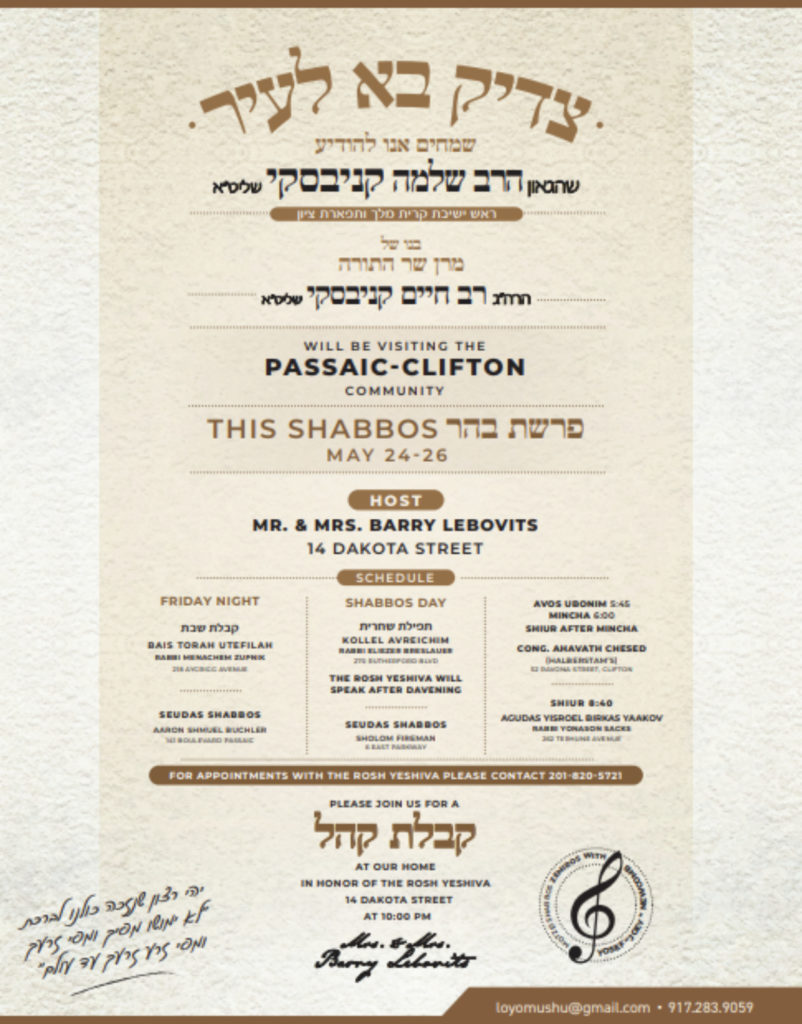
Rav Shlomo Kanievsky, currently on a whirlwind trip to the United States in an effort to save his yeshiva, Yeshiva Kiryas Melech in Bnei Brak, will spend this coming Shabbos, Parshas Behar, in the Passaic, NJ, community.
Yeshiva Kiryas Melech, one of the most respected institutions of higher Torah learning in all of Eretz Yisroel, is the yeshiva gedolah of Yeshiva Tiferes Tzion, which was founded by Rav Shlomo�s great-uncle, the Chazon Ish, in 1936. After the Chazon Ish�s petirah, Rav Shlomo�s grandfather, the Steipler Gaon, became the primary guide of the yeshiva. In 1985, after the petiros of the Steipler and the yeshiva�s menahel, Rav Yaakov Shneidman, Rav Shlomo stepped in to ensure that the yeshiva established by the Chazon Ish with mesirus nefesh would continue to flourish. And indeed it has.
Subsequently, a yeshiva gedolah, named Kiryas Melech, was established and Rav Shlomo served as maggid shiur. He later assumed full responsibility for the financial burden of the yeshiva, following the guidance of his father, Rav Chaim Kanievsky, and his grandfather, Rav Yosef Shalom Elyashiv, to ensure the growth and vitality of Tiferes Tzion/Kiryas Melech. Rav Shlomo then served as rosh yeshiva together with Rav Shmuel Yaakov Borenstein zt�l and presently with ybl�c Rav Yaakov Carp.
The rabbeim and bochurim of the yeshiva benefit from Rav Shlomo�s breadth of Torah knowledge, his boundless ahavas haTorah, his scintillating shiurim, and his personification of the sterling middos for which his forbears have been known. Under Rav Shlomo�s inspiring leadership, the yeshiva has continued to make its mark, educating talmidim with its trademark approach.
But today, the yeshiva is at crossroads. Facing crushing financial realities, funds need to be raised in order to ensure the survival of this Torah citadel. In an effort to rescue the yeshiva, Rav Shlomo is traveling across the world, reaching out to good Jews wherever they may live for their assistance.
Rav Chaim Kanievsky has expressed that he will daven on behalf of those who extend themselves to assist his son in this campaign.
This coming Shabbos, Parshas Behar, Rav Shlomo will be in Passaic, where his hosts will be Mr. and Mrs. Barry Lebovits. Friday night, he will daven at Bais Torah Utefilah, led by Rav Menachem Zupnik, and attend the seudah at the home of Aaron Shmuel Buchler. Shabbos morning, Rav Shlomo will daven at Kollel Avreichim on Rutherford Blvd., which is led by Rav Eliezer Breslauer, and will deliver a drasha after davening. His seudas Shabbos will take place at the home of Sholom Fireman, located at 6 East Parkway. Shabbos afternoon, at Cong. Ahavath Chesed (Halberstam�s), Avos Ubonim will take place at 5:45 p.m. and Mincha at 6 p.m., followed by a shiur from Rav Shlomo. After seudah shlishis, he will deliver a shiur at 8:40 p.m. at Agudas Yisroel Birkas Yaakov, which is led by Rav Yonason Sacks.
On Motzoei Shabbos, a kabbolas kahal will take place at 10 p.m. in honor of Rav Shlomo at the home of Mr. and Mrs. Barry Lebovits, located at 14 Dakota Street. The event will feature zemiros by Yosef Newcomb.
Connecting to Greatness: The Tzaddik of Yerushalayim, Rav Aryeh Levin zt�l
As the American Torah world welcomes Rav Shlomo Kanievsky, rosh yeshiva of Tiferes Zion/ Yeshiva Kiryas Melech in Bnei Brak as part of a global effort to raise the support needed to sustain this renowned bastion of Torah in Eretz Yisroel, we present a series highlighting Rav Shlomo’s illustrious lineage.
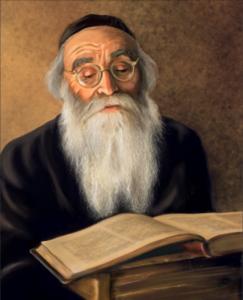
The title by which he is known tells you all you need to know about Rav Shlomo Kanievsky�s great-grandfather, Rav Aryeh Levin�zt�l.��The�Tzaddik�of Yerushalayim� is an appellation appended not to just anyone. Many people have resided in the Holy City over the last century, but only one, Rav Aryeh Levin, earned this unique title.
Rav Aryeh was born in 1885 near Bia?ystok in the Russian Empire to his parents, Reb Binyomin Beinish and Ettil Levin, the youngest of three children. At the age of 12, he left home to study at the�yeshivos�of Slonim, Slutzk, Volozhin and Brisk. At the age of 20, he immigrated to Eretz Yisroel and shortly thereafter married his wife, Rebbetzin Tzipora Chana, a daughter of Rav Dovid Shapiro.
Rav Aryeh served as�mashgiach�at Yeshivas Eitz Chaim in Yerushalayim, where the�rosh yeshivawas Rav Isser Zalman Meltzer. Stories abound of the love for�talmidim�that Rav Aryeh demonstrated and the brilliance he possessed in educating youngsters. A boy from a very poor family once arrived at the�yeshiva�with a pair of shoes in terrible condition. Rav Aryeh called the boy over and gave him a test, knowing that the boy would excel. Afterwards, Rav Aryeh told the boy that as a prize for doing well, he was giving him money to buy new shoes. Thus, he did�chesed�without causing the recipient embarrassment.
One of the areas of�gemillus chassodim�that Rav Aryeh was most well-known for was visiting people in prisons. At the request of Chief Rabbi Rav Avrohom Yitzchok Kook, Rav Aryeh took on the non-paying position of official Jewish Prison Chaplain. In this role, he would walk from his humble home in Nachlaot to visit the Jewish prisoners held in the Russian Compound on charges of arms possession or smuggling. Many of the prisoners were members of Zionist groups fighting the British Mandate. Rav Aryeh did his best to be�mechazek�these individuals and help them in whatever way he could. Every�Shabbos�and�Yom Tov, he would go to the prison to lead the�minyan�there, giving tremendous�chizuk�to the prisoners and relaying messages from them to the outside world.
During one of his weekly visits to Yerushalayim�s central prison, one of the Arab guards entered the room where Rav Aryeh was�laining�from the Torah, indicating that he must speak to Rav Aryeh. Rav Aryeh motioned to the guard to wait until he was finished. The prison captain then summoned Rav Levin, who realized that something was urgent. Outside, his son-in-law was waiting for him. There was an emergency. Not uttering a word, the two walked to the Shaarei Chesed neighborhood, where Rav Aryeh�s daughter lived. As they reached his daughter�s home, Rav Aryeh saw members of the family and medical doctors gathered there. It was then that he learned the news: His daughter had been stricken by paralysis. The only comfort the doctors could give him was that in their opinion, her total incapacitation would likely give way to partial paralysis over the course of time, and perhaps in a number of years she would recover completely.
That night, when�Shabbos�was over, the Arab guard from the prison knocked at his door. Burning with curiosity, the inmates at the jail had bribed him to go to Rav Levin�s home and find out the reason for his sudden departure. Rav Aryeh explained what had happened and told them not to worry.
The next�Shabbos, the prisoners gathered around Rav Aryeh and asked how his daughter was. �As well as can be expected,� he said emotionally.
During�krias haTorah, an unusual thing occurred. As Rav Aryeh recited the�mi shebeirach�for the first prisoner called to the Torah, he was taken by surprise to hear the man announce that he was pledging a day of his life for the recovery of Rav Aryeh�s daughter. When the time came for the�mi shebeirach�of the second�oleh, he announced that he forfeited a week of his life for the sake of the sick woman. The third man called pledged a month of his lifespan, and so it went. At last, it was the turn of the seventh man, Dov Tamari, who later became a professor at the Technion in Haifa.
�What is our life in prison worth,� he cried, �compared to the�rov�s anguish? I pledge all the remaining days of my life to the complete recovery of the�rov�s daughter!�
Rav Aryeh looked at the young man and burst into tears. He was moved beyond words to see how devoted these men were to him and how much affection they bore him.
That evening, after�Shabbos, members of his family informed him that his daughter was beginning to show signs of recovery. She had started to move some limbs. A few days went by and her health returned completely, in utter contradiction to the medical prognosis, which predicted a long period of illness and convalescence.
One prisoner,�Matisyahu�Shmulevitz, whose death sentence was commuted to life imprisonment, wrote in a letter: �There is one person in particular to whom I remain primarily grateful, a dear, precious Jew�who stormed heaven and earth for me, and, more important, brought me closer to my Maker in those fateful days. He couldn�t take us with him out into the free world, but he always brought the outside world in to us.�
Every week, Rav Aryeh would visit the hospitals of Yerushalayim to visit the sick. He would specifically seek out those who had no family, staying at the bedsides of these forgotten souls for hours, imparting words of�chizuk.
Rav Aryeh famously visited hospitals for lepers, even those whose patients were mostly Arab. Rebbetzin Levin would cook meals for them and Rav Aryeh would bring the food to these patients.
Rav Levin was also involved in helping�almanos. In particular, he would visit�almanos�of�rabbonimduring�Chol Hamoed.�This was so that they would remember that this was a happy time when their husbands were alive, as people would visit them. To make sure that the�almanos�wouldn�t feel bad because no one was coming to visit, he specifically visited them during this time.
Rav Aryeh was also known for his ability to give�tochacha, rebuke, in a way that would strengthen the one receiving it. During a visit to a prison, he encountered a person who was in jail due to murder.�The man was in a state of depression due to having committed such a severe crime. Rav Aryeh gave�chizuk�to the prisoner, saying that inherently, he, the prisoner, was a good person, and he had only committed such an act due to a weakness �in�middos. If he would use the time in prison to improve his�middos, said Rav Aryeh, eventually he would be able to lead a normal and successful life.
Rav Aryeh was known for his the ability to look for the good in other people. One time, he helped a prisoner who was a big zealot and refused to look at him, as Rav Aryeh helped prisoners whose ideals and values were unacceptable to this prisoner. When asked how he could help someone who was so impolite, Rav Aryeh was�melamed zechus�that this prisoner continues to act as he feels is correct and doesn�t allow outside factors, like trying to receive help, to affect his conduct.
Rav Aryeh would tell others a story that helped him learn the�middah�of judging others favorably. Rabbi Rivlin and Rabbi Shmuel Kook were very close friends for numerous years. At Rabbi Kook�s�levayah, Rav Aryeh noticed that Rabbi Rivlin was going to buy a flower pot. When he went to tell him that this wasn�t appropriate, it was explained that there was a contagious patient who had just died and the doctors wanted to burn his�tefillin.�The only way to convince them not to do this was to quickly purchase a flowerpot in order to bury the�tefillin�in it. From then on, Rav Aryeh was especially careful to be�melamed zechus.
During the terrible years of famine in Eretz Yisroel during World War I, tragedy stuck. After an epidemic induced illness, on a�Shabbosmorning, Rav Aryeh and Rebbetzin Chana�s 18-month-old son succumbed. Rav Aryeh and the�rebbetzin�were devastated, but until�Shabboswas over, there were no noticeable cries coming from the Levin home. The�Shabbos�meal was accompanied by the regular�zemiros, sung with enthusiasm. The children discussed the�parshaat the table, and Rav Levin and the�rebbetzingreeted their neighbors as if nothing had occurred. Rav Aryeh�s own sister visited on�Shabbos�and left with no inkling of the catastrophe.
When news of the tragedy was revealed after�Shabbos�was over, her neighbors were shocked. “How is it,” they asked, “that you didn’t diminish your normal�Shabbos�cheer in the face of striking tragedy?�
The�rebbetzin�tearfully explained, “On�Shabbos, one is not allowed to mourn. Had we not continued our�Shabbos�in the usual manner, everyone would have realized the end had come. We would have destroyed the�Shabbos�of everyone in the courtyard, as you all would have shared our terrible pain.�
On one visit that Rav Aryeh made to a prison on�Shabbos, one of the prisoners notified Rav Aryeh that he promised to never smoke again on�Shabbos. Rav Aryeh asked him what prompted him to make such a promise. The man explained that that morning, Rav Aryeh had come over to him and greeted him with his typical warm and enthusiastic �Shabbat shalom.�
�I was smoking a cigarette at the time,� said the man, “and one of my hands were being lovingly held by you with such sweetness, while my other hand held a lit cigarette that was hidden behind my back. At the moment that you wished me �Shabbat Shalom��with such love, I felt as if my cigarette was searing through my entire body. I thought to myself, �How can I allow the�rov�to lovingly hold my hand and rejuvenate my soul while my other hand is holding a lit cigarette on�Shabbos?� At that moment, I promised to never again smoke on�Shabbos.�
In 1969, at age 83, Rav Aryeh passed away, leaving behind a legacy of unending devotion to others and remarkable�gemillus chesed. The heart that had been open to every Jew for eight decades ceased to beat.
Rav Shlomo Kanievsky, in discussing his illustrious elter zaide, grows emotional, as that legacy of Torah and chesed has been carried on by Rav Aryeh�s�descendents, including the Elyashiv and Kanievsky families. Rav Shlomo has no doubt that Rav Aryeh continues serving as a meilitz yosher for his grandchildren, while reaping nachas from their efforts to spread Torah and engage in chesed, perpetuating his ideals.
� � � �
Thanks to Dovid Rossoff, Rabbi Mordechai Kamenetzky and Rabbi Binyomin Schonblum for material included in this article.
 Join the official YWN WhatsApp status


