
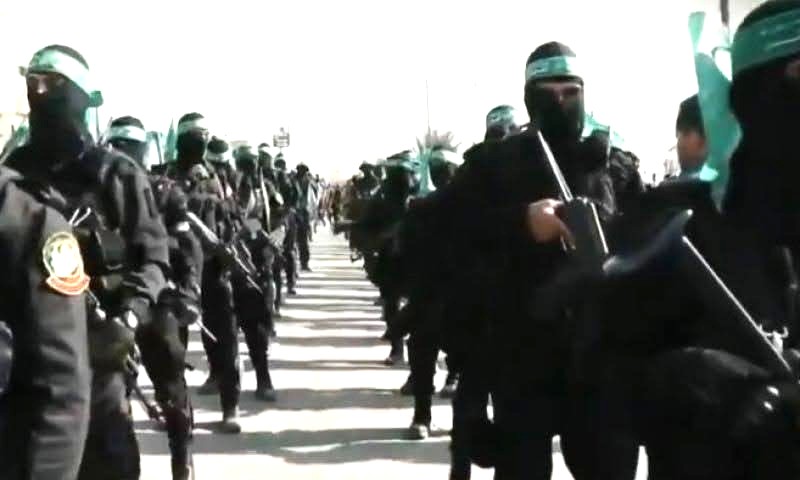
Hamas said Wednesday it is prepared to transfer control of Gaza�s civilian administration to a U.S.-backed technocratic body, while simultaneously demanding the full reopening of the Rafah Border Crossing.
Hamas spokesman Hazem Qassem told AFP that the group has completed internal preparations to hand governance to the National Committee for the Administration of Gaza, or NCAG, a 15-member panel of Palestinian technocrats created under the U.S.-sponsored ceasefire agreement that took effect in October 2025.
�Protocols are prepared, files are complete, and committees are in place to oversee the handover,� Qassem said, adding that the transfer would cover �all sectors� of governance in the Gaza Strip.
The statement marks Hamas� clearest public signal to date that it is willing to step back from day-to-day civilian administration � a central demand of U.S. and regional mediators seeking to separate Gaza�s governance from Hamas� military structure.
At the same time, Hamas is making the reopening of Rafah a central condition.
Qassem said the Rafah crossing, Gaza�s only exit point that does not lead into Israel, must be reopened �in both directions, with full freedom of exit and entry to the Gaza Strip, without any Israeli obstacles.�
Rafah is critical not only for humanitarian access and commerce, but also as the physical gateway for the technocratic committee to enter Gaza and begin operating.
The NCAG is chaired by former Palestinian Authority deputy minister Ali Shaath and is expected to assume responsibility for civilian governance, including basic services, reconstruction coordination and administrative oversight. The body operates under the supervision of President Donald Trump�s Board of Peace, which was created as part of the broader ceasefire framework.
Shaath said last week that Rafah would reopen in both directions this week, setting expectations that the handover process could begin imminently.
Israel, however, has taken a more cautious stance.
Israeli officials have said Rafah would initially reopen only in a limited capacity, allowing pedestrian traffic but restricting broader commercial and administrative movement. That position was tied to the recovery of the remains of the last Israeli hostage held in Gaza, Ran Gvili, whose body was returned to Israel on Monday.
With Gvili�s remains now recovered, attention is shifting to whether Israel will expand access at Rafah, and whether it will permit the technocratic committee to enter Gaza in full.
Hamas says the handover offer is evidence of its commitment to the ceasefire.� �It is clear that Hamas is committed to the agreement to stop the war on the Gaza Strip,� Qassem said.
But the most politically and militarily sensitive phase of the deal still lies ahead.
Under the ceasefire framework, the transfer of civilian governance is meant to be followed by Hamas� disarmament � a step that would in turn trigger a staged Israeli military withdrawal from Gaza.
So far, Hamas has not surrendered its weapons, and Israeli officials have made clear that disarmament remains a non-negotiable requirement for any long-term political arrangement in the territory.
That sequencing � governance handover first, disarmament later � has raised concerns among Israeli officials and some U.S. allies that Hamas could seek to preserve its military capacity while shedding responsibility for Gaza�s civilian burdens.
(YWN World Headquarters – NYC)
 Join the official YWN WhatsApp status



One Response
Can we trust them? What�s their history?