Head-scratching perplexity about U.S. democracy in Australia and Denmark. Disdain for “chaos” and “insults” between America’s presidential contenders in a Chinese Communist Party tabloid. A European market watcher’s warning of a “credibility deficit” in U.S. politics amid fears that a long tradition of peaceful, amicable transfer of power could be in jeopardy.
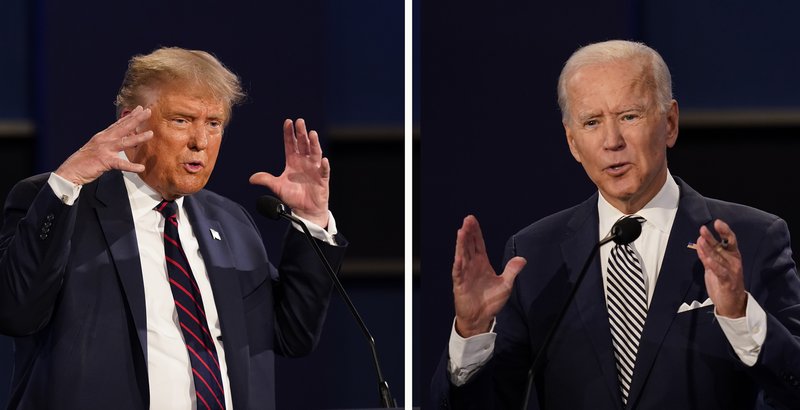
Many across the world looked on largely aghast as the first debate between President Donald Trump and Democratic challenger Joe Biden devolved into a verbal slugfest short on substance but heavy with implications for America’s international image.
Emotions and adjectives ran the gamut but few observers appeared to come away thinking that the last remaining superpower could rise above its bitter partisan rancor as the election looms barely a month away.
“If last night’s presidential debate was supposed to inform and educate, all it did was merely confirm the credibility deficit in U.S. politics, as President Trump, and Democrat nominee Joe Biden, engaged in what can only be described as a fact-free, name-calling contest,” wrote Michael Hewson, chief market analyst at CMC Markets UK.
While many in Europe fondly recalled the more even-keeled America of yesteryear, others in Asia were monitoring the markets — which were little changed mostly. Share prices slipped further in Japan and the dollar weakened against the Japanese yen and the euro. European bourses showed few initial tremors.
But one major worry to emerge from the debate was whether the election results might be challenged or delayed, in part because Trump raised concerns about ballots and possible vote-rigging that his critics say are a ploy to tamp down turnout or scare people away from the polls.
“A highly polarized and possibly legally contested U.S. election is just around the corner,” said Stephen Innes of AxiCorp, a foreign exchange trading services provider. “With mail-in votes likely to be too high (and potentially questioned), there is a chance that we still will not know the result by Inauguration Day, with constitutional chaos ensuing.”
Europe and Africa woke up to reports about the cacophonous showdown overnight.
“The comments I’ve seen from various European press (outlets) is basically: ‘I’m happy I’m not an American voter this year.’ It’s just a mess,” said Jussi Hanhimaki, a Finnish-Swiss professor of International History at the Graduate Institute in Geneva.
“That’s all extremely disturbing for many Europeans, who generally would think the United States would be a symbol of democracy — that’s been the oldest democracy in the world — that has this long, long tradition of, yes, very acrimonious debate, but there’s always been a winner and a peaceful transfer of power,” he said.
Kenyan commentator Patrick Gathara quipped on Twitter: “This debate would be sheer comedy if it wasn’t such a pitiful and tragic advertisement for U.S. dysfunction.”
Danish Prime Minister Mette Frederiksen wrote on Facebook: “An election debate in the States last night, where interruptions and quarrels were allowed to fill up way too much. Fortunately, this is not the case in Denmark. And I never hope it will be like that. The harsh words polarize and split.”
Amanda Wishworth, a lawmaker in Australia’s center-left Labor Party, said: “A lot of people would be scratching their heads, especially here from Australia, where, believe it or not, our politics is a little bit more gentle than the U.S. of A.”
Other government leaders tuned in — but kept their distance.
Steffen Seibert, German Chancellor Angela Merkel’s spokesman, said she was “informed about what took place last night,” but he declined to comment.
“We don’t want to comment on this, don’t want to provide an assessment, because it will be immediately perceived as an attempt to interfere,” said Dmitry Peskov, spokesman for Russian President Vladimir Putin. “The Russian Federation has never interfered in the internal affairs of the United States and never will.”
Walter Veltroni, a columnist for Italian newspaper Corriere della Sera and a former center-left mayor of Rome, said he had seen all the U.S. TV debates since Kennedy vs. Nixon in 1960, but “I have never witnessed a spectacle similar to the one last night.”
He said the debate showed how there are two Americas that appear irreconcilable.
“The impression is that of a country in stalemate, paralyzed by politics and tones that are foreign to its tradition,” Veltroni said.
Hu Xijin, editor of China’s nationalistic Communist Party tabloid Global Times, wrote in the paper’s microblog that the “chaos, interruptions, personal attacks and insults” on display were a reflection of America’s “overarching division, anxiety and the accelerating erosion of the system’s original advantages.”
“I used to admire this kind of televised debate in American politics, but I have much more mixed feelings when (I) watch it again now,” wrote Hu, who personally and through his paper routinely attacks American policies.
The editor-at-large of The Australian newspaper, Paul Kelly, described the debate as a “spiteful, chaotic, abusive, often out-of-control brawling encounter with both candidates revealing their contempt for each other.”
“America faces a dangerous several weeks,” he said.
Leslie Vinjamuri, director of the U.S. and the Americas program at the London think tank Chatham House, said many European observers already had “very low” expectations of Trump, but even so the debate was jarring.
“There’s still just a level of disbelief, just shock, frankly,” that the president and former vice president “were talking over each other, talking over the moderator, in President Trump’s case, telling each other off, going off-topic, off-script,” Vinjamuri said. “So I think it was something extraordinarily upsetting because people want to be able to look to America to lead and to guide and to role model.”
Foreign policy issues were largely absent from the debate, although Trump slung accusations that China had paid Biden’s son Hunter for consulting work and Biden attacked Trump’s trade deals with China for failing to deliver benefits.
Trump also repeatedly blamed China for the coronavirus pandemic that has killed more than 1 million people globally and ravaged economies around the world.
In the Mideast, the largely domestic debate drew raised eyebrows when Biden at one point said “inshallah” as Trump hedged on saying when he would release his tax returns. “Inshallah” in Arabic means “God willing.” It also can be used in a way to suggest something won’t ever happen.
Al-Arabiya, a Saudi-owned satellite channel based in Dubai, and The National, a state-linked newspaper in Abu Dhabi, both published articles noting Biden’s use of the word.
A Emirati political scientist, Abdulkhaleq Abdulla, wrote on Twitter that he saw the debate as a “tumultuous verbal battle.”
“How did America reach this level of political decline?” he wrote.
(AP)
 Join the official YWN WhatsApp status