Inspectors from the United Nations nuclear watchdog found uranium particles enriched up to 83.7% in Iran’s underground Fordo nuclear site, a report seen Tuesday by The Associated Press said.
The confidential quarterly report by the Vienna-based International Atomic Energy Agency distributed to member states likely will renew tensions between Iran and the West over its program.
The IAEA report, which only speaks about “particles,” suggests that Iran isn’t building a stockpile of uranium enriched above 60% — the level it has been enriching at from some time.
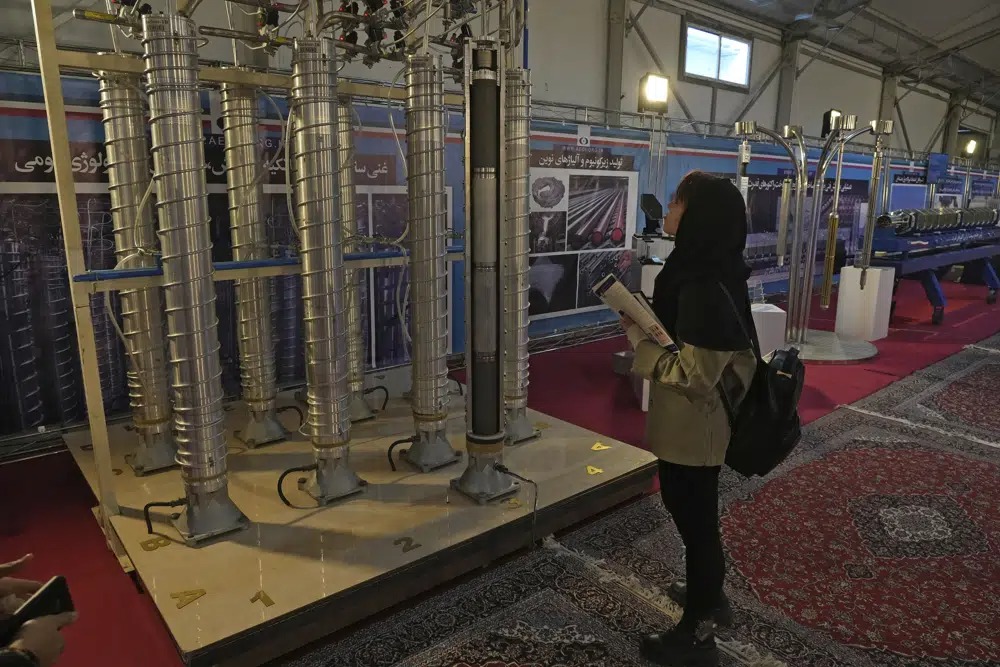
The IAEA report described inspectors discovering on Jan. 21 that the two cascades of IR-6 centrifuges in Fordo had been configured in a way “substantially different” to what had been previously declared. The IAEA took samples the following day, which showed particles up to 83.7% purity, the report said.
“Iran informed the agency that ‘unintended fluctuations’ in enrichment levels may have occurred during the transition period,” the IAEA report said. “Discussions between the agency and Iran to clarify the matter are ongoing.”
Iranian officials could not be immediately reached for comment regarding the report, details of which had been circulating for about a week.
A spokesman for Iran’s civilian nuclear program, Behrouz Kamalvandi, sought last week to portray any detection of uranium particles enriched to that level as a momentary side effect of trying to reach a finished product of 60% purity. However, experts say such a great variance in the purity even at the atomic level would appear suspicious to inspectors.
Iran’s 2015 nuclear deal limited Tehran’s uranium enrichment to 3.67% — enough to fuel a nuclear power plant. The U.S.? unilateral withdraw from the accord in 2018 set in motion a series of attacks and escalations by Tehran over its program.
Iran has been producing uranium enriched to 60% purity — a level for which nonproliferation experts already say Tehran has no civilian use. Any accusation of enrichment higher than that further ratchets up tension over the program.
Uranium at 84% is nearly at weapons-grade levels of 90% — meaning any stockpile of that material could be quickly used to produce an atomic bomb if Iran chooses.
While the IAEA’s director-general has warned Iran now has enough uranium to produce “several” nuclear bombs if it chooses, it likely would take months more to build a weapon and potentially miniaturize it to put it on a missile. The U.S. intelligence community, as recently as this past weekend, has maintained its assessment that Iran isn’t pursuing an atomic bomb.
“To the best of our knowledge, we don’t believe that the supreme leader in Iran has yet made a decision to resume the weaponization program that we judge they suspended or stopped at the end of 2003,” CIA Director Williams Burns told CBS’ “Face the Nation” program. “But the other two legs of the stool, meaning enrichment programs, they’ve obviously advanced very far.”
But Fordo, which sits under a mountain near the holy Shiite city of Qom, some 90 kilometers (55 miles) southwest of Tehran, remains a special concern for the international community. It is about the size of a football field, large enough to house 3,000 centrifuges, but small and hardened enough to lead U.S. officials to suspect it had a military purpose when they exposed the site publicly in 2009.
Any explanation from Iran, however, likely won’t be enough to satisfy Israel, Iran’s regional archrival. Already, Israel’s recently reinstalled Prime Minister Benjamin Netanyahu has threatened military actions against Tehran. And Israel and Iran have been engaged in a high-stakes shadow war across the wider Middle East since the nuclear deal’s collapse.
Meanwhile Tuesday, Germany’s foreign minister said both her country and Israel are worried about the allegations facing Iran over the reported 84% enriched uranium.
“We are united by concern about the nuclear escalation on Iran’s part and about the recent reports about the very high uranium enrichment,” Baerbock said. “There is no plausible civilian justification for such a high enrichment level.”
Speaking in Berlin, Israel’s visiting foreign minister, Eli Cohen, pointed to two options to deal with Iran — using a so-called “snapback” mechanism in the Security Council resolution that enshrined the 2015 nuclear deal to reimpose U.N. sanctions, and “to have a credible military option on the table as well.”
“From our intelligence and from our knowledge, this is the right time to work on these two specific steps,” he said.
(AP)
 Join the official YWN WhatsApp status