
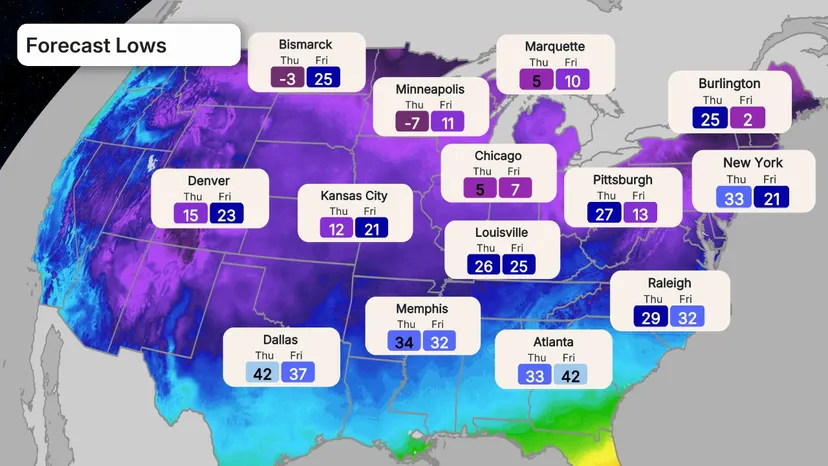
A punishing Arctic blast is barreling across the United States this week, threatening to plunge more than 200 million Americans into life-threatening cold and potentially rewrite the record books across 15 states.
Meteorologists warn that over 40 record lows could fall between Thursday and Friday alone, as a destabilized polar vortex and an early-season La Ni�a combine to deliver what experts are calling “February temperatures in early December.”
This latest surge of Arctic air is even more severe than the frigid blast that gripped the country earlier in the week. On Monday, wind chills in northern Montana plummeted to 20 to 30 degrees below zero, prompting cold weather advisories across the northern tier.
But that was only the preview.
According to the FOX Weather Center, the real punch arrives Wednesday and intensifies through Friday as the Arctic front sweeps from the northern Rockies all the way to the I-95 corridor, leaving vast stretches of the country frozen solid.
“Millions have already felt the first edge of this Arctic air,” forecasters said. “What’s coming next is even more extreme.”
The High Plains and Upper Midwest will take the first and hardest hit. Cities like Chicago and Minneapolis may not rise above freezing for the rest of the week, while widespread morning lows on Thursday are expected to sit between 10�F and well below zero.
Iowa could be the epicenter of record-breaking cold, with Des Moines, Cedar Rapids, Sioux City, and Waterloo all projected to challenge or shatter their December records.
By Friday, the Arctic blast is expected to expand rapidly eastward, slamming the I-95 corridor with dangerous cold that is 15-25 degrees below normal for early December.
Major cities — including New York, Pittsburgh, Indianapolis, and Baltimore — are on alert as forecasters warn of new record lows.
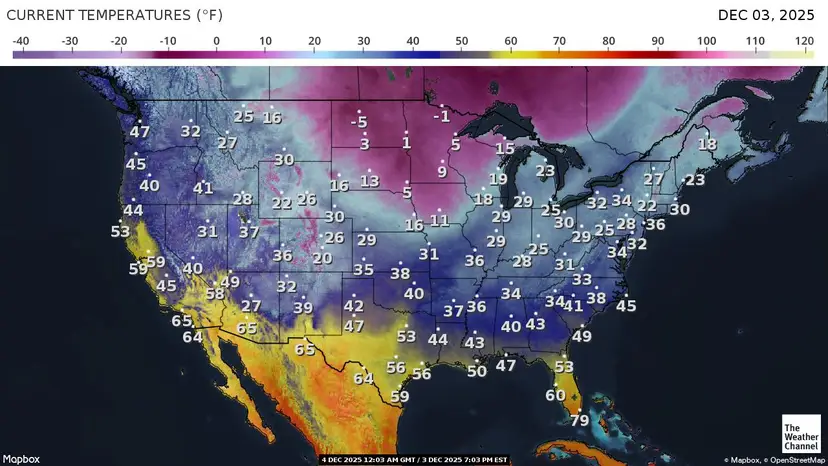
Wind chills will make the cold feel even more severe, raising concerns about frostbite, hypothermia, and dangerous conditions for commuters, the elderly, and those without adequate shelter.
At the heart of this extreme cold is a disrupted polar vortex, the high-altitude system that normally keeps frigid Arctic air pinned near the North Pole. When that vortex weakens, as it has now, it unleashes that air southward — straight into Canada and the United States.
Combined with an early-season La Ni�a pattern, the atmospheric setup is primed for unusually harsh and persistent cold.
Even once the immediate blast passes, forecasters say the nation isn’t done.
Below-average temperatures are expected to linger across several regions through mid-December, setting up what could be one of the coldest early-winter stretches in recent memory.
(YWN World Headquarters – NYC)
 Join the official YWN WhatsApp status






4 Responses
So sad. I had thought that Trump would support global warming. Instead he has found some way to “win” the battle against global warming (unlike the Democrats who enacted onerous and expensive laws, which had no impact on global warming). Cooler temperatures mean spending more on winter heating, more traffic accidents and health problems due to the cold and the snow, and potential food shortages due to shorter growing seasons. On the bright side, it makes the green “climate alarmists” look rather silly.
How do all those Somali desert marauders deal with the freezing Minneapolis weather? Hope Ilhan Omar turns into a pillar of ice or something like that.
This is exactly why the Rabbi at our Shul Paskened, that this year, this evening, we should commence ??? ?? ???? ????? rather than ??? ??? ???? ?????
RE: How do all those Somali desert marauders deal with the freezing Minneapolis weather?
CENTRAL HEAT (plus most of the Somali Americans in Minnesota were born there, and most of the others have already spent most of their life their)