
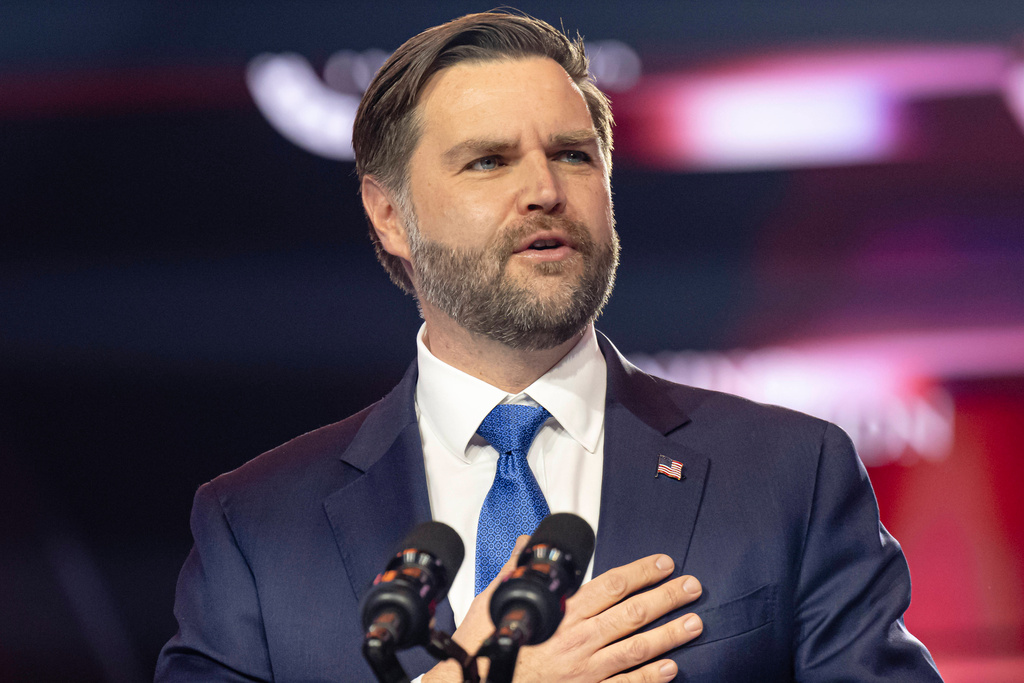
Vice President JD Vance said Monday that rising criticism of Israel in American political discourse should not be conflated with antisemitism, arguing instead that it reflects a broader backlash against long-standing U.S. foreign policy consensus, and warning that invoking fringe antisemites risks shutting down legitimate debate.
In an interview with UnHerd, Vance pushed back on claims that growing skepticism toward Israel among some Americans signals widespread antisemitic sentiment, even as openly antisemitic figures gain online attention.
“Because 99% of Republicans, and I think probably 97% of Democrats, do not hate Jewish people for being Jewish,” Vance said when asked why figures such as white nationalist influencer Nick Fuentes have attracted followers. “Most Americans aren’t antisemitic. They’re never going to be antisemitic, and I think we should focus on the real debate.”
Vance argued that what is being labeled as antisemitism in some quarters is, in reality, “a real backlash to a consensus view in American foreign policy,” particularly regarding U.S. policy toward Israel. He said the tendency to frame criticism of Israel as inherently antisemitic can be used to deflect from substantive policy discussions.
“What is actually happening is that there is a real backlash to a consensus view in American foreign policy,” Vance said. “I think we should have that conversation and not try to shut it down.”
The vice president also described Fuentes as a “useful foil” for pro-Israel conservatives, suggesting that the prominence of overt antisemites allows political actors to avoid engaging with more mainstream critiques of U.S.-Israel relations.
“Frankly, it’s overstated by people who want to avoid having a foreign policy conversation about America’s relationship with Israel,” Vance was quoted as saying.
At the same time, Vance stressed that his comments should not be interpreted as hostility toward Israel itself. He reaffirmed U.S. support for Israel as a key ally, while signaling that disagreements are inevitable — and, in his view, healthy.
“I think Israel is an important ally,” Vance said. “We’re also going to have very substantive disagreements with Israel, and that’s OK.”
(YWN World Headquarters – NYC)
 Join the official YWN WhatsApp status





11 Responses
Troubling? Gut morgen.
Mr. Vance (and Mr. Mamdani),
Let me explain something to you .
Saying �I�m not antisemitic, only anti-Zionist � is the equivalent of saying �I have nothing against black people, I�m only anti emancipation �.
He’s pandering to the antisemites in his party, like Trump before him. Like Trump, he will allow antisemitism to become acceptable discourse.
Your headline is once again way off the mark, as is often the case when it involves the idol.
The Vice President stated his assessment that the vast majority on the right – as opposed to the “Open Antisemites” that you wrote in the headline – are not antisemitic.
He also said – very accurately and very fairly – having any questions about the alliance between this country and that paradise does not at all make anyone into an antisemite.
Hes ? percent correct!
Nothing troubling about what he said. The headline is misleading.
There are raging anti-semites like NF.
Then there are people that don�t understand why the US supports other countries, especially when there is so many problems here. The second group which we hope is the larger group needs to be educated on the importance of foreign policy and allies and how funding allocations work.
With all due respect to the editor: American policy and interests are not always 100% aligned; And that would not qualify as antisemitic (imho)
lmk remind the oylom about 2 incidents when USA and Israel where at odds
1.- the bombing of Irak’s reactor (Begin Govt)
2.- The Liberty ship incident (during the 6 days war , when Moshe Dayan was the Defense Minister)
(from google search:)
When Israel bombed Iraq’s Osirak nuclear reactor in 1981, President Reagan’s administration was caught off guard but condemned the act, suspending F-16 fighter jet deliveries to Israel and publicly criticizing the “sneak attack,” though internally divided on the severity of punishment, with Defense Secretary Weinberger favoring stronger sanctions and Secretary of State Haig arguing for restraint, ultimately leading to a milder response focused on nonproliferation efforts and IAEA relations, despite initial anger at Israeli misrepresentations.
Key Reactions & Actions:
Initial Shock & Anger: Reagan privately expressed dismay, writing in his diary he thought “Armageddon is near,” and his team dealt with diplomatic fallout, including UN condemnation of Israel.
Internal Debate: A split emerged between Defense Secretary Caspar Weinberger (favoring more sanctions) and Secretary of State Alexander Haig (advocating restraint), notes cafe.com.
Suspension of Jets: The U.S. temporarily halted the scheduled delivery of four F-16s to Israel.
Criticism of Justification: The administration challenged Israeli Prime Minister Begin’s false claims about Iraqi President Saddam Hussein’s statements, leading to formal retractions from Israel.
Shift in Policy: The incident highlighted the fragile nonproliferation regime, prompting the administration to abandon plans to revise the Nuclear Non-Proliferation Act and focus on strengthening the International Atomic Energy Agency (IAEA) (IAEA).
Milder Strategy: The “political strategy” involved suspending and then resuming the F-16 delivery, showing a move towards diplomacy over severe punitive measures, though the U.S. briefly withdrew from the IAEA in protest of its harsh stance on Israel.
—
The USS Liberty incident was an attack on a United States Navy technical research ship (a spy ship), USS Liberty, by Israeli Air Force jet fighter aircraft and Israeli Navy motor torpedo boats, on 8 June 1967, during the Six-Day War.[2] The combined air and sea attack killed 34 crew members (naval officers, seamen, two marines, and one civilian NSA employee), wounded 171 crew members, and severely damaged the ship.[3] At the time, the ship was in international waters north of the Sinai Peninsula, about 25.5 nautical miles (47.2 km; 29.3 mi) northwest from the Egyptian city of Arish.[1][4]
JD Vance isn’t ths sharpest tool in the shed. Ron DeSantis would make a much better president.
The US doesn’t owe Israel its friendship or allegiance any more than the US owes it to Denmark.
In principle there’s nothing any more wrong for any American to challenge America’s relationship with Israel than to question the same American relationship with Denmark.
(And until Denmark turns over Greenland to the US, they are in hot water.)
@Truthteller,
Unfortunately, that group (for the most part) you�re talking about is not as naive as you are.
Their issue with support for other countries begins and revolves around Israel.
@Hakatan,
You should realize (though I doubt you would allow yourself), that Vance, Mamdani, Taylor Green, etc etc have never learned Kesubos 111
Speaking of idols�
He’s right… All antisemitism mongers will be obsessed with this now, and that’s gonna cause real antisemitism. Just stop it, please!