
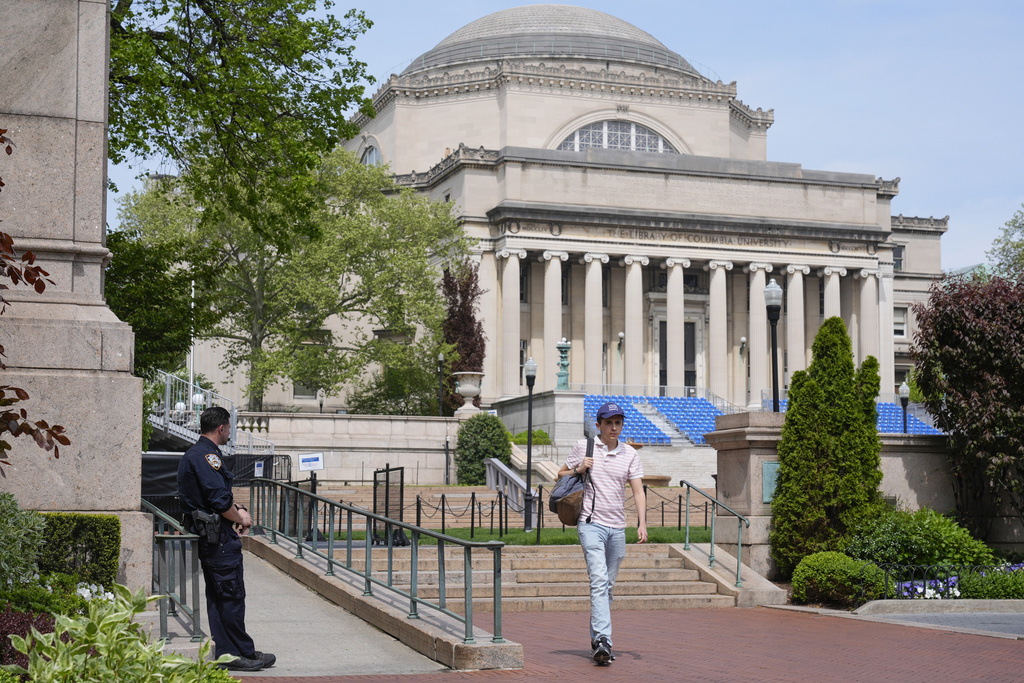
Columbia University is facing a full-scale credibility crisis after its own Task Force on Antisemitism released a blistering assessment of entrenched discrimination, politicized teaching, and a pattern of faculty behavior that pushed Jewish and Israeli students to the margins of campus life.
The report, the most detailed internal accounting to date, reads less like a bureaucratic review and more like an indictment. According to the authors, Columbia’s core academic values “broke down” across multiple departments, with instructors turning classrooms into ideological battlegrounds, singling out students because of their identity, and injecting anti-Israel rhetoric into courses that had nothing to do with the Middle East.
Columbia, in other words, wasn’t just struggling to maintain neutrality during a volatile political moment. It was drifting into activist pedagogy, and Jewish and Israeli students were often in the crosshairs.
At the center of the report is an unmistakable warning: academic freedom at Columbia is faltering not due to external political pressure, but because internal norms, guardrails, and expectations have collapsed. Faculty members, empowered by an atmosphere of political fervor, routinely crossed lines that university policy explicitly forbids.
One section recounts instances in which Israeli students were publicly confronted in class and forced to “account” for their nationality. In one case, a student who had served in the IDF was called “one of the murderers” by an instructor. Another Jewish student said a professor told her it was “a shame your people survived in order to commit mass genocide.” In another incident, a student watched a professor read aloud his private email to the entire class and mock it line by line.
These aren’t small lapses in judgment; they’re direct violations of Columbia’s own rules governing professional conduct in the classroom. They’re also the type of incidents federal civil-rights investigators have taken an interest in at other campuses over the past year.
Perhaps the most dramatic example came when protesters stormed a class taught by a visiting Israeli professor and attempted to shut it down mid-lecture. The course, one of the few Columbia offerings presenting Zionism as a legitimate topic of academic study rather than a political indictment, became a lightning rod for activists determined to delegitimize it.
The task force called the disruption “the most flagrant violation of academic freedom” on campus in recent memory. To many Jewish and Israeli students, it signaled that Columbia could no longer guarantee their ability to learn without intimidation.
The report also reveals that professors across the university repurposed class time to funnel students toward anti-Israel protests, canceled sessions in favor of walkouts, and even relocated classes to encampments where “Zionists” were explicitly declared unwelcome. One professor told the New York Times that he moved his class into a protest space despite knowing his Israeli students would feel unsafe attending.
Elsewhere, the task force found evidence of a softer but widespread form of bias: instructors shoehorning political commentary into unrelated fields. Astronomy classes opened with denunciations of Israeli military actions. An Arabic instructor used “The Zionist lobby is the most supportive of Joe Biden” as a vocabulary sentence. Photography, architecture, Spanish, and feminist theory courses all featured unsolicited condemnations of Israel, blindsiding students who believed they were signing up to study something else entirely. Columbia’s own Faculty Handbook explicitly prohibits this type of politicized digression.
Even basic religious accommodations weren’t always respected. One student seeking an exam rescheduling for Yom Kippur was advised that taking a leave of absence might be easier than Columbia adjusting the course calendar.
Layered over these individual incidents is a bigger structural problem: the ideological imbalance in Columbia’s Middle Eastern studies offerings. Students seeking to study Israel or Zionism from a scholarly perspective found few courses that allowed for it. Instead, the curriculum leaned heavily toward anti-Zionist frameworks, a disparity the task force says Columbia must address by hiring senior scholars who can bring genuine intellectual diversity to the subject.
The task force’s bottom line is blunt: Columbia cannot claim to defend academic freedom while allowing faculty to weaponize the classroom or discriminate against students based on identity or political assumptions. The university’s vaunted commitment to open inquiry, the report argues, has been compromised by the very people tasked with preserving it.
The recommendations are sweeping. Enforce existing policies. Train faculty on the limits of politicized teaching. Add intellectual diversity to the curriculum. Intervene when classrooms become hostile environments. And above all, restore the principle that students come to Columbia to learn how to think, not to be told what to think.
(YWN World Headquarters – NYC)
 Join the official YWN WhatsApp status


