
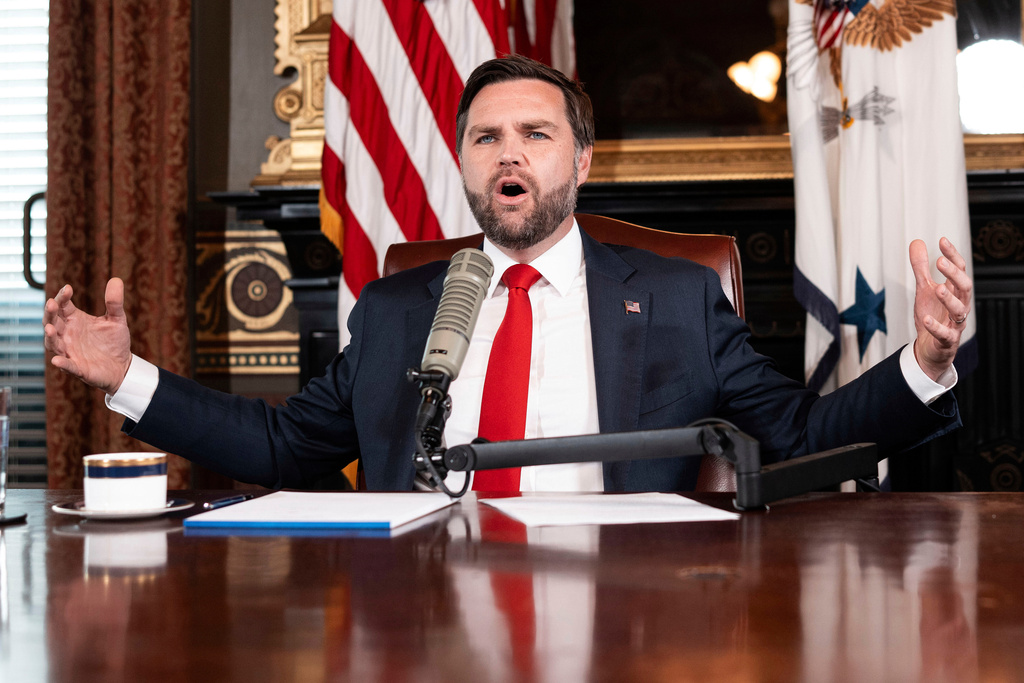
Vice President JD Vance said Monday that the most effective way to combat antisemitism in the United States is to sharply reduce immigration. In a series of posts on X, Vance argued that rising antisemitism, particularly among younger Americans, is being misdiagnosed by journalists and critics who focus on generational attitudes rather than demographics.
“The single most significant thing you could do to eliminate anti-semitism and any other kind of ethnic hatred is to support our efforts to lower immigration and promote assimilation,” Vance wrote, referring to immigration policies pursued by President Donald Trump’s administration.
The comments came in response to an essay by Jewish journalist Yair Rosenberg in The Atlantic, which warned that antisemitism is increasing among younger Americans — a trend Rosenberg said contradicts the long-held assumption that prejudice fades with older generations. Rosenberg’s article cited research suggesting antisemitic attitudes are more prevalent among young people than among older Americans.
Vance rejected that, calling mainstream journalism “profoundly uninteresting and lame” and accusing it of ignoring what he views as the real driver of antisemitism. “To write an article about the ‘generational divide’ in anti-semitism without discussing the demographics of the various generations is mind-boggling,” he wrote.
In a follow-up post, Vance argued that immigration has imported unresolved ethnic conflicts into the United States. “We imported a lot of people with ethnic grievances prior generations didn’t have. We celebrated this as the fruits of multiculturalism. Now we’re super surprised that the people we imported with ethnic grievances still have those ethnic grievances,” he wrote.
Vance cited research from Charles Fain Lehman of the conservative Manhattan Institute, who has argued that foreign birth and immigrant background are stronger predictors of antisemitic sentiment than age or ideology. Lehman reiterated that claim online, writing that “foreign origin is a much better predictor of antisemitism than ideology or age.”
The Manhattan Institute released a report earlier this month finding that while most Republicans reject antisemitism, 17 percent met researchers’ criteria for being “anti-Jewish Republicans.” The report found higher levels of antisemitic sentiment among Republicans under 50 and among “New Entrant” Republicans — voters who have only recently begun supporting the GOP in national elections. Those respondents were more likely to be male and college-educated.
Vance has repeatedly resisted calls to push back against antisemitism in the Republican Party, describing offensive statements by younger conservatives as immaturity rather than ideology. On Monday, he again dismissed concerns about right-wing antisemitism as misplaced.
Vance also clarified his position on Israel, writing that opposition to Israeli policies should not automatically be labeled antisemitic. “I would say there’s a difference between not liking Israel (or disagreeing with a given Israeli policy) and anti-semitism,” he wrote — his clearest statement to date separating anti-Israel sentiment from antisemitism.
That position reflects a growing divide within the GOP, where polls show younger Republicans are increasingly skeptical of Israel, fracturing a party long unified in its strong support for the Jewish state. Vance’s stance is likely to draw attention as he is widely viewed as a potential presidential contender in 2028.
(YWN World Headquarters – NYC)
 Join the official YWN WhatsApp status





2 Responses
Jewish Council for Public Affairs the collective body of political Jewish organizations and HIAS are calling to increase immigration and to give amnesty to the undocumented.
JD doesn’t give two hoots about antisemitism. JD validated blatant antisemitic questions at TPUSA. JD is best buddies with Tucker and supports him even after his grotesque Fuentes interview. JD downplayed and made light of young GOP NY chapter members praising Hitler. JD publicly denies that there is growing antisemitism on the right and JD purposely put his Chanukah invites and party under general Christmas party festivities. JD has done nothing in support of Jews or in the fight against antisemitism. JD is a populist coward who is trying to use antisemitism for his own sick anti immigration crusade.