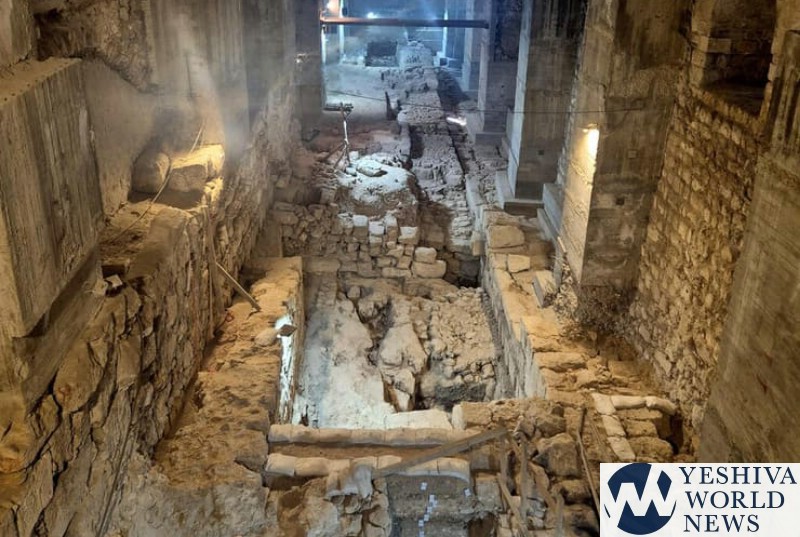
A remarkable archaeological discovery in Yerushalayim is offering clarity on an ancient episode described by Chazal and recorded by Josephus. The Israel Antiquities Authority (IAA) announced that a massive section of a Chashmonaim-era fortification wall–larger and wider than the current Old City walls–has been uncovered beneath the Migdal Dovid complex.
The newly revealed section, over 40 meters long and five meters wide, was found in the Kishle area, near today’s Sha’ar Yaffo. That site was famously used during the British Mandate as a prison for members of the Jewish underground. But archaeologists now say that beneath its modern layers lies an extraordinary remnant of Yerushalayim’s fortifications from the second century BCE.
The timing of the wall fits a dramatic moment in Jewish history: about 134 BCE, just decades after the neis of Chanukah. According to Josephus, Antiochus VII once again besieged the city. To save Yerushalayim, the Chashmonaim agreed to two demands: dismantle the city’s defenses and pay 3,000 talents of gold–funds Hyrcanus reportedly withdrew from the kever of Dovid HaMelech.
Josephus writes: “He broke down the fortifications that encompassed the city. And upon these conditions, Antiochus broke up the siege, and departed.”
Dr. Amit Re’em, chief archaeologist for the IAA Jerusalem District, told reporters that the excavation findings match this account precisely.
“What we saw was deliberate destruction–down to the very base,” he explained. “This was no battle damage. Someone intentionally dismantled this enormous wall. Josephus gives us a very compelling explanation.”
But the archaeologists offered a second theory as well. Since the wall lies directly beneath the foundations of King Herod’s later palace, built about a century after the Chashmonaim, it may have been Herod who ordered its removal.
Herod’s palace occupied the area of today’s Sha’ar Yaffo, Migdal Dovid, and parts of the Armenian Quarter. Dr. Re’em suggested that Herod may have demolished the Chashmonaim’s structure to send a political message: “No more Chashmonean kings. I am the new ruler.”
Herod, whose lineage traced to Idumaean converts and an Arab mother, is well known in Chazal as a ruler deeply insecure about his legitimacy. Removing visible Chashmonean symbols of power would have been consistent with his behavior.
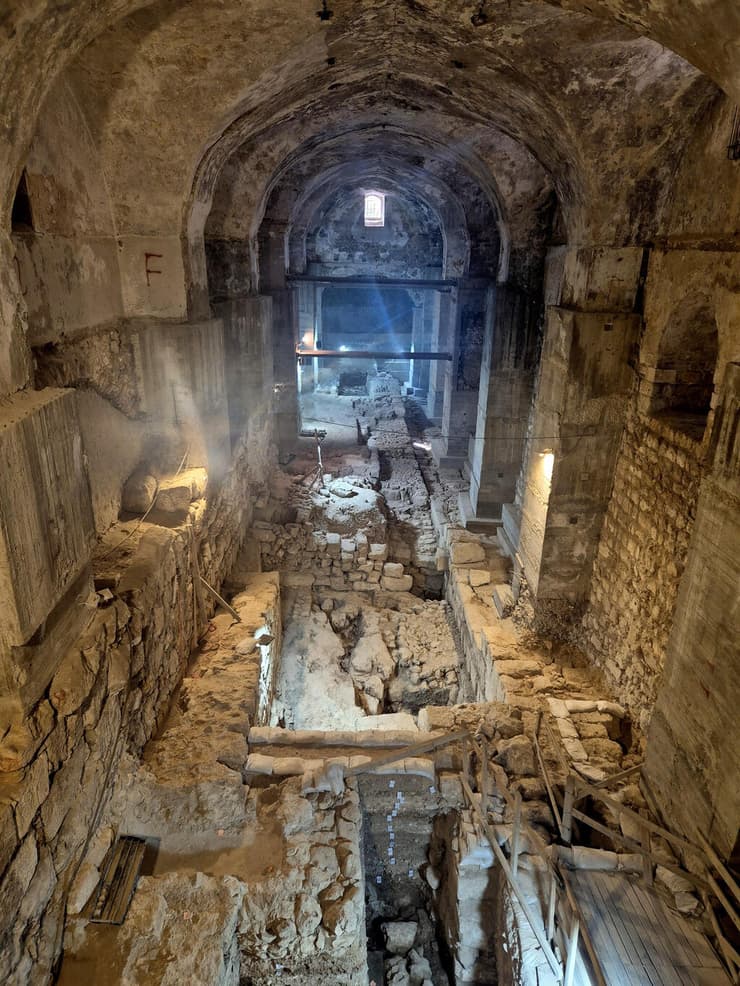
Findings from earlier digs in the area also support the historical backdrop. In the 1980s, excavators uncovered hundreds of arrowheads, slingstones, catapult stones, and lead projectiles–clear signs of a military assault. Researchers had long attributed them to the campaign of Antiochus VII.
Dating the wall precisely is difficult because it was built using dry construction–stone without mortar–leaving no organic material for radiocarbon analysis. But Chashmonaim-period pottery and coins found near the wall, combined with its distinctive building style, strongly point to construction beginning no earlier than around 140 BCE.
Amazingly, the wall may once have been even taller than the Ottoman walls visitors see today.
The discovery comes as the Tower of David Jerusalem Museum prepares to open its new Schulich Wing of Archaeology, Art, and Innovation. Visitors will soon be able to stand on a transparent platform directly above the ancient stones.
“We want the public to feel this tangible link to the history of Yerushalayim,” said museum director Eilat Lieber. “These stones span thousands of years of Jewish presence, struggle, and renewal.”
Archaeologists also uncovered remains of an even earlier wall–possibly from the First Beis HaMikdash era. Radiocarbon testing for that structure is still underway.
(YWN World Headquarters – NYC)
 Join the official YWN WhatsApp status