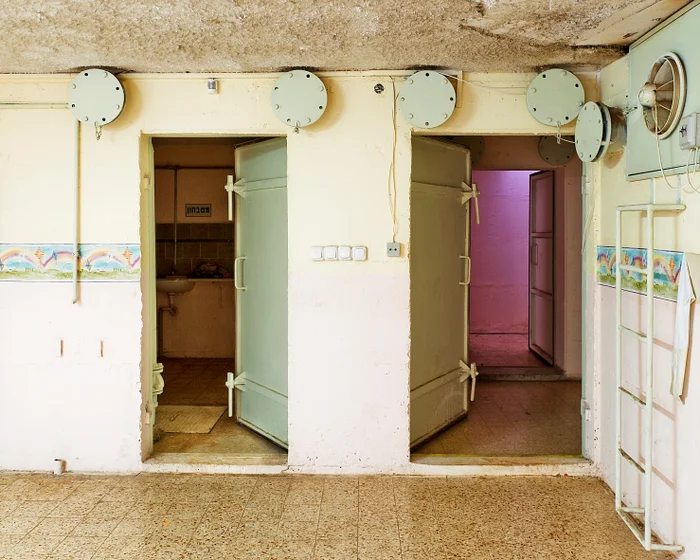
The IDF Home Front Command is preparing to impose stricter construction standards for bomb shelters in Israeli homes, following lessons learned from the recent war and past terror attacks that exposed dangerous weaknesses in civilian protection.
The updated regulations, expected to take effect next year, are aimed at addressing the evolving threats facing Israel’s home front, from long-range ballistic missiles to close-range terrorist assaults. The new standards will apply to future construction and, in certain cases, allow for upgrades to existing homes.
Among the most immediate changes is a new requirement for bomb shelter doors to clearly indicate whether they are fully locked. New shelter doors will be fitted with a red-and-green visual system showing locked or unlocked status, a response to incidents during the 12-day war with Iran in June.
During that conflict, civilians in multiple locations believed they had secured their shelter doors, only to discover — too late — that the doors were partially unlocked. In several cases, the force of nearby explosions blew the doors inward, injuring those sheltering inside.
Another significant update involves thickening the internal walls of shelters. Damage assessments conducted after Iranian ballistic missile strikes found that when a missile hits a building, interior walls often function like external walls, absorbing far greater force than engineers had previously assumed. The finding overturned long-standing design assumptions and prompted a reassessment of shelter construction standards.
A third change stems directly from the Hamas-led Oct. 7, 2023, massacre. IDF investigations revealed that standard shelter doors are not resistant to small-arms fire. In several cases, terrorists fired into shelters, with bullets penetrating the doors and wounding civilians inside.
Under the new regulations, shelter doors will be required to meet ballistic protection standards. The Home Front Command will also allow retrofit solutions that can be installed on existing shelter doors, enabling homeowners to add bullet-resistant protection without replacing the entire structure.
The changes focus primarily on the mamad — the apartment-based protected space mandated in Israeli homes since the early 1990s. Designed to allow civilians to reach shelter within seconds of an air-raid siren, a mamad includes thick reinforced concrete walls, a heavy steel door, and a sealed window.
(YWN World Headquarters – NYC)
 Join the official YWN WhatsApp status