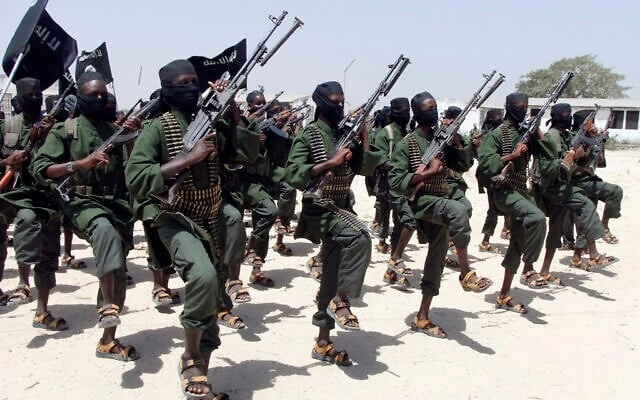
Somalia’s Al-Qaeda-linked terror group Al-Shabaab has issued an explicit threat against Israel, vowing to fight any Israeli involvement in Somaliland following Jerusalem’s decision to formally recognize the breakaway territory as a sovereign state.
“We will not accept it, and we will fight against it,” the group said in a statement, framing Israel’s recognition as a hostile act against what it called Somali lands.
Al-Shabaab spokesman Ali Dheere claimed Israel’s move proved it had “decided to expand into parts of the Somali territories,” accusing Jerusalem of backing what he described as “the apostate administration in the northwest regions,” a reference to Somaliland’s government.
The threat marks the first direct response from the jihadist organization since Israel announced Friday that it was officially recognizing Somaliland, becoming the first country in the world to do so. Somaliland unilaterally declared independence from Somalia in 1991 following the collapse of the central government, but has never been internationally recognized until now.
Somalia’s federal government in Mogadishu immediately condemned Israel’s move as a “deliberate attack” on its sovereignty. Egypt, Turkey, the Gulf Cooperation Council, and the Saudi-based Organization of Islamic Cooperation also denounced the recognition, warning it could destabilize the Horn of Africa.
Al-Shabaab, which has waged a brutal insurgency against Somalia’s internationally backed government for more than 17 years, has little operational presence in Somaliland itself. The group’s core battlefield remains southern and central Somalia, where it continues to stage deadly attacks despite improved security in Mogadishu.
In the past year alone, Al-Shabaab carried out a suicide bombing and shooting at a Mogadishu beach that killed 32 people, detonated a car bomb that killed five in the capital, and launched an hours-long siege of a hotel that left three dead and 27 wounded.
Despite its limited reach in Somaliland, analysts view the group’s statement as an attempt to broaden its ideological war by tying Israel’s recognition to its global jihadist narrative.
“It is humiliation of the highest level today, to see some Somali people celebrating a recognition by the Israeli Prime Minister [Benjamin] Netanyahu,” Dheere said, calling Israel “the biggest enemy of the Islamic society.”
Regional analysts say Israel’s recognition of Somaliland carries major strategic implications. Somaliland sits along one of the world’s busiest maritime corridors, linking the Indian Ocean to the Red Sea and the Suez Canal.
Closer ties could give Israel improved access to the Red Sea basin, potentially easing surveillance and operational pressure on Iran-backed Houthi forces in Yemen, which have repeatedly targeted Israeli-linked shipping since the Gaza war began.
Residents in Somaliland’s capital, Hargeisa, were seen waving Somaliland flags in public celebrations following the announcement, underscoring the territory’s eagerness for international legitimacy after decades of diplomatic isolation.
Somaliland — roughly a third the size of France — maintains its own currency, military, police force, and functioning democratic institutions, and is widely regarded as one of the most stable territories in the Horn of Africa. Yet the lack of recognition has left it economically constrained despite its location along a critical global trade route.
Following Israel’s announcement, Somaliland officials said the territory hopes to join the Abraham Accords, the U.S.-brokered normalization framework launched during President Donald Trump’s first term.
Channel 12 reported that Somaliland President Abdirahman Mohamed Abdullahi made a secret visit to Israel in October, meeting with Netanyahu, Mossad chief David Barnea, and Defense Minister Israel Katz. The report said ties deepened as Israel explored potential destinations for Gazans it sought to relocate during the war — an effort that ultimately collapsed amid fierce international opposition.
Neither Israel nor Somaliland has publicly confirmed those discussions.
Israel, increasingly isolated diplomatically over the Gaza war, has made expanding ties in Africa a strategic priority. In August, Jerusalem reopened its embassy in Zambia after more than five decades, signaling a broader push to counter regional hostility through new alliances.
(YWN World Headquarters – NYC)
 Join the official YWN WhatsApp status