
In Israel, some dismissed the move announced on Friday by Prime Minister Binyamin Netanyahu, when he announced Israel’s recognition of Somaliland. In reality, the move was set in motion by outgoing Mossad chief Dedi Barnea–driven by clear and deliberate strategic considerations.
Anyone who has tracked Israeli Air Force operations against the Houthis in Yemen over the past two years has seen the operational difficulty up close: striking targets from Israel entails flights lasting several hours over a distance of about 2,200 kilometers. For some time, the need for closer, more accessible, and more secure operating areas has been obvious.
To confront this challenge, Barnea is said to have cultivated close and friendly ties several years ago with Somaliland’s president, Abdirahman Mohamed Abdullahi. Those ties developed into both professional and personal relationships, laying the groundwork for Israel’s recognition of Somaliland–making Israel the first UN member state to do so.
Somaliland’s location on the Horn of Africa, adjacent to one of the world’s most critical commercial shipping lanes, gives it significant strategic value not only for Israel but also for Western countries and their allies. Its geographic position, together with its large airstrips–among the most substantial in Africa–could in the future allow far more efficient and convenient operations for the Israeli Air Force and for Western militaries engaged in regional frameworks.
With Yemen effectively just across the water, Somaliland’s strategic importance is self-evident.
According to Ynet, contacts leading up to Israel’s recognition of Somaliland were conducted discreetly over many months. The effort was led by Foreign Minister Gideon Saar, the Mossad, and former national security adviser Tzachi Hanegbi, who managed the dialogue, sent joint delegations for visits, and hosted Somaliland delegations on several occasions. Hanegbi chaired the final discussions, with the participation of Netanyahu, who approved the move in October.
Israel and Somaliland jointly drafted the declaration and waited for the right moment to release it. Somaliland asked for additional time to prepare, citing the need to brace for possible hostile actions by the Houthis in Yemen, its northern neighbors. Those preparations were recently completed, clearing the path for mutual recognition.
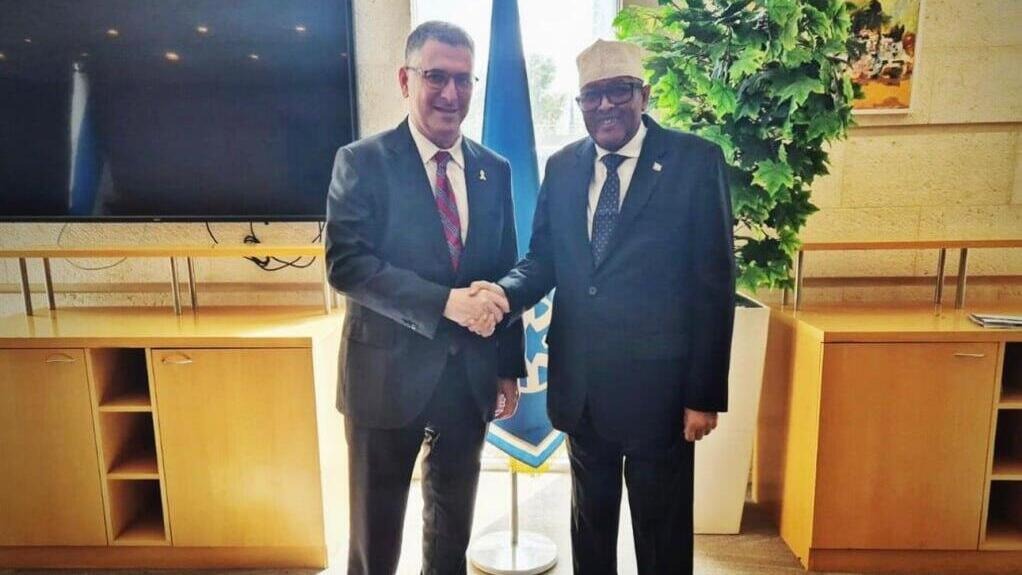
Saar also revealed on Motzei Shabbos that Somaliland’s president paid a secret visit to Israel last summer, during which he met with Netanyahu, Saar, Defense Minister Yisrael Katz, and Mossad chief Dedi Barnea. Saar later shared a photograph of himself with President Abdirahman Mohamed Abdullahi.
Ynet quoted a senior Israeli political source who explained the logic behind the decision: “Look at their strategic location and you’ll understand everything.”
Addressing the wave of Arab condemnations, the source added: “They take the moral high ground when it comes to recognizing a Palestinian state. Here, when a state that emerged from terrorism and from a desire to destroy another people is involved, they object. But recognizing Palestinians who seek Israel’s destruction–that’s acceptable.”
Prof. Uzi Rabi, a senior researcher at the Dayan Center for Middle Eastern Studies, said in an interview with Radio 103FM. “People turned this into a joke–they simply don’t know the reality. You’re going down to a very important place, six times the size of Israel. What’s the point here? You have, in a hornet’s nest of a region, a state that wants something different–like Azerbaijan in the Caucasus. It wants to move westward.”
He dismissed the many condemnations of the mutual recognition between Somaliland and Israel. “Are you really afraid of condemnation by the United Nations Security Council?” he said with a laugh, adding that one should also note who did not condemn Israel–the United Arab Emirates.
“If you ask me, this is a move with American approval. They’re supporting anti-Houthi forces in Yemen and heading toward Bab el-Mandeb, which is a very central area. That’s what Israel needs to do.”
For Israel, recognition of Somaliland serves multiple interests. From a strategic and security perspective, Somaliland’s position opposite Yemen and near Houthi-controlled areas could help prevent a renewed Red Sea crisis–especially after Iran-backed Houthis paused maritime attacks following an understanding with U.S. President Donald Trump and in the aftermath of the ceasefire between Israel and Hamas in Gaza. The move also offers Israel added intelligence value in monitoring Houthi activity.
On the diplomatic front, deepening ties with a relatively pro-Western actor in the Horn of Africa could expand Israel’s influence in a region where Iran, Turkey, and Egypt–among many other countries that condemned the recognition–remain influential players.
(YWN Israel Desk–Jerusalem)
 Join the official YWN WhatsApp status


