
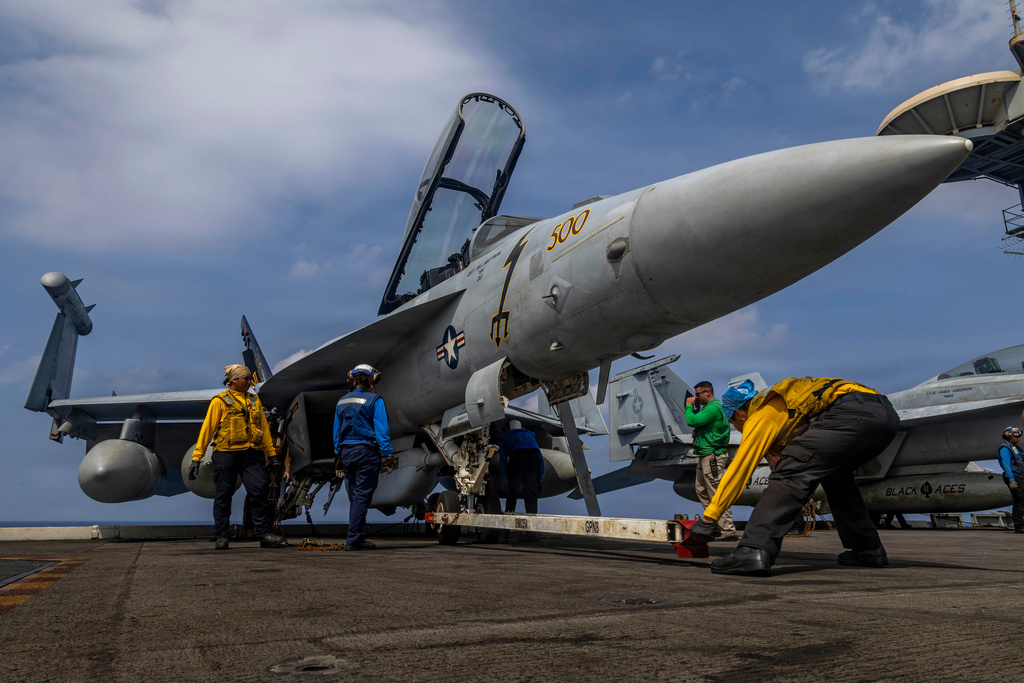
Senior Israeli officials believe the United States is increasingly moving toward a direct confrontation with Iran, as negotiations between Washington and Tehran once again appear to be approaching a dead end.
Israeli leadership is concerned that an American strike could weaken the grip of the ayatollah regime, potentially triggering mass public unrest and bringing angry crowds into the streets.
According to Israeli assessments, the American president is still expected to strike Iran, based on the assumption that talks with Tehran are likely to fail.
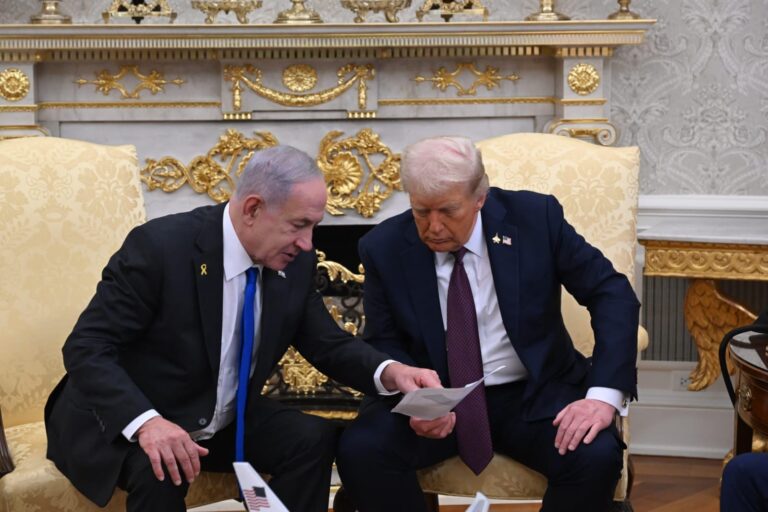
Israel’s Chief of Staff and Mossad chief are scheduled to meet tomorrow with President Trump’s special envoy Steve Witkoff, ahead of renewed negotiations with Iran being led by the senior American official.
Kan 11 reported that disagreements remain over the scope of the talks — including whether they will address issues beyond Iran’s nuclear program, whether Iran will be required to completely halt uranium enrichment on its own soil, and whether enrichment might instead take place outside Iran or not at all.
According to Axios, President Trump’s son-in-law and senior adviser Jared Kushner is also expected to participate in Friday’s summit between the United States and Iran in Istanbul.
Officials from several regional countries, including Saudi Arabia, the United Arab Emirates, Oman and Egypt, are expected to take part in the meeting.
A senior American official said the summit will focus on achieving a “package deal” aimed at preventing war with Iran, and that the Trump administration hopes Tehran will arrive prepared to make significant concessions.
Israel Hayom reported that Prime Minister Netanyahu will present Israel’s red lines to Witkoff, which include a complete ban on uranium enrichment inside Iran, halting Iran’s missile program, and ending its support for terror organizations.
A senior U.S. official said last week that Iran is already familiar with Washington’s conditions. “The terms are known and have not changed since this administration took office.”
Meanwhile, Reuters reported that Iran’s leadership is deeply worried that an American strike could shatter the regime’s hold on power and ignite mass protests.
In discussions with Supreme Leader Ali Khamenei, senior Iranian officials reportedly warned that public anger following the crackdown on recent protests has reached a point where fear of the regime no longer deters citizens.
Officials cautioned that even a limited American attack could embolden demonstrators and cause irreversible damage to the regime’s stability.
“A strike combined with public unrest could lead to the collapse of the ruling system. This is the main fear among senior officials, and exactly what our enemies want,” one source told Reuters. It was not reported how Khamenei responded.
Iranian parliamentary spokesman Ebrahim Rezaei said there is little optimism that negotiations will succeed.
“Iran has always negotiated, but experience shows the Americans carry out aggression even during talks. If negotiations take place, they will only be on the nuclear issue and only if they lead to the removal of sanctions and economic relief for the people. Otherwise, Iran will not accept negotiations from a position of weakness,” he said.
He warned that countries hosting American bases would “bear responsibility” if Iran is threatened.
U.S. Senator Rick Scott said Iran is facing growing internal pressure and called on Washington to intensify its campaign against Tehran. “Iran is wobbling. The regime is terrified, and the people are demanding freedom. The United States must apply maximum pressure. The ayatollah’s time is up,” Scott wrote on X.
On the other side, Iranian hardline MP Amiri Hossein Sabati criticized the government for negotiating with Washington and claimed the Iranian public is waiting for a “preemptive strike against Israel and American bases.”
Senior Iranian military commander Kioumars Heidari warned that Iran would respond forcefully. “The region cannot remain safe if Iran is not safe. We will never accept a situation in which Iran is insecure while the region is secure.”
He added that if the United States threatens Iran, “the Zionist regime and other countries assisting America will not be safe,” and urged Washington to act rationally or face a response that would “cause deep regret.”
(YWN World Headquarters – NYC)
 Join the official YWN WhatsApp status





5 Responses
It seems mamish as if you (YWN) are bringing every few hours new contradictory “predictions” about what the coming days hold for us. I really have no idea what to take seriously over here.
Why do you say that Israeli leadership is concerned that an American strike could weaken the grip of the ayatollah regime? Isn’t this the desired outcome?
It doesn’t make any sense at this point for the US to get involved for anything less than regime change. The playing out of the obviously doomed negotiations and the contradictory spins every few hours are (??????) to create as much as possible an element of surprise. Exactly like last time, only this time Israel (hopefully) is less likely to be directly involved in attacking.
Levi,
Ywn�s business is to put out �news� and get clicks which it�s doing well
Why do you say: “Israeli leadership is concerned that an American strike could weaken the grip of the ayatollah regime”? Isn’t this the desired outcome?