
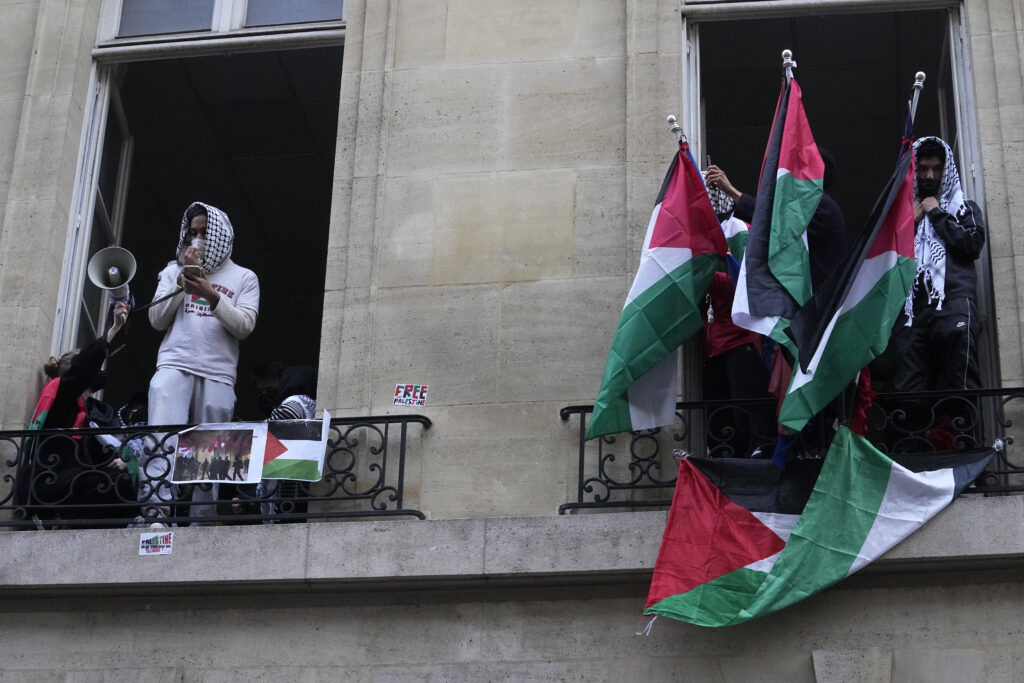
Activists on New York City college campuses are helping funnel propaganda directly from Hamas onto mainstream American platforms, amplifying messaging that openly encourages violence against Jews, according to a new study released by the Anti-Defamation League�s Center on Extremism.
The report, titled Digital Couriers: How U.S. Anti-Israel Activists Amplify Terror Propaganda on Mainstream Platforms, concludes that some anti-Israel protest movements have crossed a critical line, moving beyond rhetoric and into the active dissemination of official materials produced by Hamas.
�Protestors and activists are not merely praising the activity of terror groups; they are actively sharing their official propaganda, disseminating communiqu�s, videos, and other materials directly onto mainstream platforms,� the report states.
According to the study, the circulation of Hamas-produced content across Telegram, X, Instagram and other social media platforms has accelerated since the group�s October 7, 2023 massacre in Israel. Researchers warn that the trend reflects a growing normalization of terror rhetoric that explicitly endorses violence against both Israel and Jewish communities worldwide.
�This shared material, which openly praises violent actions and actors, comes at a time of heightened danger for Jews worldwide,� the report notes, pointing to record levels of antisemitic incidents in the United States. �American Jews specifically have been navigating an unprecedentedly high threat landscape.�
The ADL found that propaganda originating from Hamas� official Arabic-language channels is often translated into English by intermediary accounts before being repackaged and shared by U.S.-based activist groups. One of the most prominent hubs cited in the report is Resistance News Network, a radical English-language Telegram channel with more than 150,000 subscribers that routinely promotes violence against Israel.
From there, the material has spread into activist ecosystems tied to American cities and campuses.
The study documents multiple cases involving groups and individuals in the city sharing or distributing Hamas material. In March 2025, the Bronx Anti-War Coalition reposted a Hamas propaganda poster accompanied by a caption from antisemitic rapper Jonathan Azaziah celebrating the destruction of Israel and using hashtags such as �#WeAreAllHamas.� The same group also reshared a Hamas military post praising a Houthi missile attack on Israel�s Ben Gurion Airport that injured civilians.
The report also highlights in-person dissemination. At Barnard College, activists distributed an English-language document authored by Hamas� media office that explicitly justified the October 7 attacks. Similar incidents were identified at other institutions nationwide.
On social media, campus-based chapters of Students for Justice in Palestine were repeatedly cited. The SJP chapter at CUNY John Jay College shared a Hamas Al-Qassam Brigades graphic in July 2024 featuring militant imagery and militant slogans in Arabic. At the University of Illinois at Chicago, the SJP chapter posted video footage that appeared to show a Hamas gunman filming himself inside an Israeli family�s home during the October 7 assault. And at University of California, Davis, activists marked the one-year anniversary of the attack by quoting a Hamas spokesperson praising it as a historic military operation.
�These are not abstract expressions of solidarity,� the report notes. �They are direct reproductions of terrorist messaging, presented without context, condemnation, or disclaimers.�
The ADL warns that such activity risks radicalizing audiences, legitimizing terrorist violence, and eroding the guardrails that once kept extremist propaganda off major platforms. It urged social media companies to aggressively enforce existing policies that already prohibit content produced by designated terrorist organizations.
The group also called on Congress to pass the Stopping Terrorists Online Presence and Holding Accountable Tech Entities Act, which would compel platforms to better police terrorist content they currently claim to ban.
College administrators, the ADL said, have a separate responsibility. The report urges universities to clarify when distributing terrorist propaganda violates campus rules or state and federal law, and to hold registered student organizations accountable when they cross that threshold.
�More broadly,� the report concludes, �it is incumbent upon the general public to engage in due diligence when consuming and sharing content online and associating with activist groups and individuals.�
(YWN World Headquarters – NYC)
 Join the official YWN WhatsApp status


