Iran has started removing 27 surveillance cameras installed by U.N. inspectors at nuclear sites around the country, widening a dispute over Tehran’s program as it enriches uranium closer than ever to weapons-grade levels.
Here’s a timeline of the major events involving Iran’s atomic program, which first came to the country under American aspirations of peaceful energy but later found itself the target of Western fears over the Islamic Republic’s intentions.
EARLY DAYS
1957 — Under Iran’s ruling Shah Mohammad Reza Pahlavi, Tehran signs a civilian nuclear cooperation arrangement with its ally, the United States.
1967 — Iran takes possession of its Tehran Research Reactor under America’s “Atoms for Peace” program.
1974 — Amid its oil boom, the shah announces plans to build 23 nuclear reactors while also having full control of the nuclear fuel cycle — opening the door to being able to build atomic weapons. That rattles U.S. officials, who limit American companies from selling to Iran. The shah lends $1 billion for the construction for the Eurodif enrichment facility in France to be able to purchase 10% of its product.
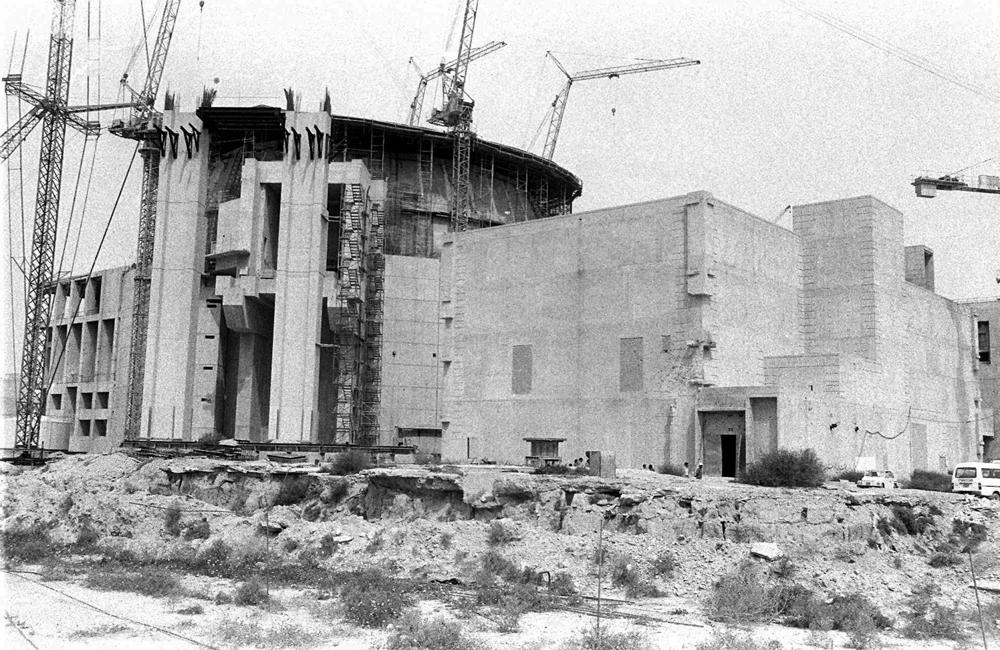
1975 — German firm Kraftwerk Union begins construction of Busher nuclear power plant as part of $4.8 billion deal for four reactors. The shah tells an interviewer: “Honestly, I am not really thinking of nuclear arms. But if 20 or 30 ridiculous little countries are going to develop nuclear weapons, then I may have to revise my policies.”
1979 — The shah, fatally ill, flees Iran amid rising popular protests against him. Ayatollah Ruhollah Khomeini returns to Tehran and the Islamic Revolution sweeps him to power. Students seize the U.S. Embassy in Tehran, beginning the 444-day hostage crisis. Iran’s nuclear program goes fallow under international pressure.
1980s — During its bloody war with Iran, Iraq repeatedly attacks stalled construction at Bushehr nuclear power plant.
1987 — Iran makes a deal with Pakistani nuclear scientist and black-marketeer A.Q. Khan for centrifuge designs, which ultimately become the program’s workhorse IR-1 units.
DIPLOMATIC CONFRONTATIONS
August 2002 — Western intelligence services and an Iranian opposition group reveal Iran’s secret Natanz nuclear enrichment facility.
June 2003 — Britain, France and Germany engage Iran in nuclear negotiations. Washington refuses to join.
October 2003 — Iran suspends uranium enrichment.
February 2006 — Iran announces it will restart uranium enrichment following the election of hard-line president Mahmoud Ahmadinejad. Britain, France and Germany walk out of stalled negotiations.
June 2006 — The United States, Russia and China join Britain, France and Germany to form the P5+1 group of world powers trying to persuade Iran to curb its nuclear program. The U.S., however, stays away from negotiations.
December 2006 — The U.N. Security Council imposes the first set of sanctions on Iran, banning the sale of sensitive nuclear technology. Five more Security Council resolutions follow by 2010, tightening sanctions on the Islamic Republic.
November 2007 — The number of uranium-enriching centrifuges assembled by Iran reaches about 3,000 and its stockpile of low-enriched uranium grows, increasing fears among nuclear nonproliferation experts.
July 2008 — Under President George W. Bush, the United States joins the nuclear talks for the first time.
June 2009 — Iran’s disputed presidential election sees hard-liner Ahmadinejad re-elected despite fraud allegations, sparking Green Movement protests and violent government crackdown.
September 2009 — Western leaders reveal Iran’s covert construction of its Fordo enrichment facility, built under a mountain to protect it from possible airstrikes.
October 2009 — Under President Barack Obama, the U.S. and Iran open a secret backchannel for messages in the sultanate of Oman.
February 2010 — Iran begins enriching uranium to near 20%, a technical step away from weapons-grade levels of 90%.
May 2010 — Brazil and Turkey announce their own nuclear deal with Iran, but the arrangement quickly falls apart.
January 2011 — Negotiations between Iran and the six world powers break off for what becomes a 15-month hiatus.
May 2011 — After Russian assistance, Iran’s Bushehr nuclear power plant begins operations.
November 2011 — The IAEA says Iran had a “structured” military nuclear weapons program that ended in 2003. Iran denies that, though Western governments including the U.S. also say it.
January 2012 — The IAEA says Iran is enriching to 20% at Fordo. The European Union freezes the assets of Iran’s Central Bank and halts Iranian oil imports.
April 2012 — Public negotiations restart between Iran and the six world powers but go nowhere.
July 2012 — U.S. and Iranian officials hold face-to-face secret talks in Oman.
August 2013 — Hassan Rouhani, a relatively moderate cleric and former nuclear negotiator, becomes Iran’s president. He declares his country ready for serious nuclear talks.
September 2013 — Rouhani and Obama speak by telephone, the highest-level exchange between the two countries since the 1979 Islamic Revolution. U.S. Secretary of State John Kerry and Iranian Foreign Minister Mohammad Javad Zarif begin diplomatic exchanges.
November 2013 — Iran and the six powers announce an interim agreement that temporarily curbs Tehran’s nuclear program and unfreezes some Iranian assets. The deal sets the stage for extended negotiations on a comprehensive nuclear accord.
April 2015 — A framework nuclear deal is announced after months of negotiations, outlining long-term restrictions on Iran’s nuclear program and the removal of many international sanctions.
July 14, 2015 — World powers and Iran announce a long-term, comprehensive nuclear agreement.
THE DEAL COLLAPSES
January through February 2017 — Tensions escalate after President Donald Trump’s inauguration. His administration bans Iranians and citizens from several Muslim-majority countries. Iran conducts a ballistic missile test, triggering American threats of reprisals.
May 2018 — Trump unilaterally withdraws the U.S. from the nuclear agreement, calling it the “worst deal ever.” He says he’ll get better terms in new negotiations to stop Iran’s missile development and support for regional militias. Those talks don’t happen.
August 2018 — The Trump administration re-imposes the first round of sanctions on Iran that were lifted under the nuclear accord, targeting a range of sectors from carpets and pistachios to gold and commercial aircraft.
November 2018 –The U.S. re-enforces the most onerous sanctions on Iran that had been lifted under the deal, targeting Iran’s vital banking and oil sectors.
April 2019 — Trump designates Iran’s Revolutionary Guard as a foreign terrorist organization, marking the first time the U.S. has blacklisted part of another nation’s military in this way.
May 5, 2019 — Citing unspecified Iranian threats, the White House sends the USS Abraham Lincoln aircraft carrier strike group and B-52 bombers to the Persian Gulf in a show of force.
May 8, 2019 — Iran announces it will begin backing away from the accord, setting a 60-day ultimatum for Europe to compensate for American-led sanctions before it will begin enriching uranium to higher levels.
May 13, 2019 — Four oil tankers, including two belonging to Saudi Arabia, come under mysterious attack off the United Arab Emirates. U.S. officials blame Iran.
May 15, 2019 — A drone attack strikes a major oil pipeline running across Saudi Arabia to the Red Sea. Yemen’s Iran-backed Houthi rebels claim responsibility. Riyadh blames Tehran, which denies involvement.
June 13, 2019 — Explosions cripple two oil tankers in the Gulf of Oman. The U.S. blames Iran for the limpet mine attacks, allegations that Iran denies.
June 17, 2019 — Trump orders another 1,000 troops to the Middle East, on top of 1,500 dispatched the month before to surveil Iranian activities and protect American forces.
June 20, 2019 — Iran’s Revolutionary Guard shoots down a U.S. spy drone in the Strait of Hormuz with a surface-to-air missile. Trump announces that he approved retaliatory military strikes on Iran but pulled back at the last minute.
June 25, 2019 — Trump imposes new sanctions on Ayatollah Ali Khamenei, the supreme leader of Iran, and his associates.
July 1, 2019 — Iran announces it has exceeded the nuclear deal’s curbs on its low-enriched uranium stockpile.
July 19, 2019 — Iran’s Revolutionary Guard seizes a British oil tanker in the Strait of Hormuz. The British military had earlier impounded an Iranian tanker near Gibraltar on suspicion of sanctions violations.
Sept. 3, 2019 — The U.S. sanctions Iran’s civilian space agency, alleging the program is cover for testing ballistic missile technology.
Sept. 7, 2019 — Iran begins spinning advanced centrifuges prohibited under the 2015 deal.
Sept. 14, 2019 — Drone attacks strike two key oil installations in Saudi Arabia, halving the supply of oil from the world’s largest exporter. The Iranian-backed Houthi rebels claim responsibility. U.S. and Saudi officials blame Iran, which denies involvement.
Nov. 6, 2019 — Iran injects uranium gas into centrifuges at its underground Fordo facility.
Nov. 15, 2019 — A hike in government-set gasoline prices amid a worsening economic crisis sparks a wave of demonstrations across Iran. Security forces launch a brutal crackdown, with over 300 people believed killed.
December 2019 — A rocket attack on an Iraqi military base kills an American civilian contractor and wounds several troops. American retaliatory airstrikes prompt supporters of Iranian-backed fighters to storm the U.S. Embassy compound in Baghdad.
Jan. 3, 2020 — A U.S. drone strike in Baghdad kills Gen. Qassem Soleimani, Iran’s top general and the architect of Tehran’s proxy wars in the Middle East.
Jan. 8, 2020 — In retaliation for Soleimani’s killing, Iran launches a barrage of missiles at military bases in Iraq that are home to thousands of American and Iraqi troops. More than 100 U.S. service members suffer traumatic brain injuries. As Iran braces for a counterattack, the Revolutionary Guard shoots down a Ukrainian passenger plane shortly after takeoff from Tehran’s international airport, reportedly mistaking it for a U.S. cruise missile. All 176 people on board are killed. Iran initially blames mechanical problems for the crash.
Jan. 14, 2020 — After days of denial, Iran’s announces it was responsible for shooting down the Ukrainian jetliner, sparking anti-government street protests.
April 22, 2020 — Iran’s Revolutionary Guard launches its first satellite into space, revealing what experts describe as a secret military space program.
April 23, 2020 — Following tense encounters in the vital Strait of Hormuz, including the brief seizure of a Hong-Kong flagged tanker, Trump threatens to “shoot down and destroy” Iranian gunboats harassing U.S. Navy ships.
July 2020 — A mysterious explosion tears apart a centrifuge production plant at Iran’s Natanz nuclear enrichment facility. Iran blames the attack on archenemy Israel.
October 2020 — A decade-long U.N. arms embargo on Iran that banned it from purchasing foreign weapons expires as scheduled under the nuclear deal, despite American objections.
November 2020 — Joe Biden beats Trump in the U.S. presidential election. Mohsen Fakhrizadeh, an Iranian scientist named by the West as the leader of Tehran’s military nuclear program, is killed in an ambush on the outskirts of Tehran. Iran blames Israel.
December 2020 — In retaliation for the killing of Fakhrizadeh, Iran’s parliament approves a bill that would suspend U.N. inspections of its nuclear facilities and require the government to boost uranium enrichment.
Jan. 4, 2021 — Iran begins enriching uranium up to 20% and seizes a South Korean-flagged tanker near the crucial Strait of Hormuz.
Feb. 23, 2021 — The IAEA loses access to its surveillance cameras, as well as data from its online enrichment monitors and electronic seals, amid a standoff with Iran. Tehran pledges to hold onto the tapes and give them back when granted sanctions relief.
April 6, 2021 — Iran and the U.S. begin indirect negotiations in Vienna over how to restore the nuclear deal.
April 9, 2021 — Iran frees the South Korean-flagged tanker it earlier seized.
April 11, 2021 — A second attack within a year targets Iran’s Natanz nuclear site, with suspicion falling on Israel.
April 16, 2021 — Iran begins enriching uranium up to 60% – its highest purity ever and a technical step from weapons-grade levels of 90%.
June 2, 20121 — The largest warship in Iran’s navy catches fire and sinks in the Gulf of Oman under mysterious circumstances, a major setback amid confrontations at sea with the West.
June 19, 2021 — Ebrahim Raisi, a hard-line protege of Supreme Leader Ayatollah Ali Khamenei, wins the presidency in a vote that saw polling places largely deserted despite pleas to support the Islamic Republic at the ballot box.
June 23, 2021 — An attack targets a centrifuge workshop in the Iranian city of Karaj, also damaging IAEA cameras at the site.
July 29, 2021 — A fatal drone attack kills two on an oil tanker linked to an Israeli billionaire off the coast of Oman. The U.S. military identifies the drone as Iranian. Tehran denies being involved.
Oct. 26, 2021 — A cyberattack cripples gas stations across Iran.
Dec. 1, 2021 — The IAEA says Iran has begun feeding a cascade of 166 advanced IR-6 centrifuges at its underground Fordo facility.
Dec. 15, 2021 — The IAEA and Iran reach a deal to reinstall cameras damaged at Karaj, although inspectors remain limited on what footage they can access.
March 5, 2022 — Russian Foreign Minister Sergey Lavrov links restoring Iran’s nuclear deal to American sanctions targeting Moscow over its war on Ukraine, further complicating negotiations.
March 8, 2022 — Iran’s paramilitary Revolutionary Guard says it launches a new reconnaissance satellite as U.S. intelligence agencies warn Tehran could seek 90% enrichment if negotiations fail.
March 12, 2022 — Nuclear talks in Vienna break off without an agreement due to Russia’s demand for guarantees that its ties with Tehran be exempt from Western sanctions over Ukraine.
March 13, 2022 — Iran’s Revolutionary Guard claims responsibility for a ballistic missile attack that strikes near the U.S. Consulate in northern Iraq.
May 11, 2022 — In a last-ditch diplomatic push, the European Union sends its envoy for the nuclear talks to Tehran, as negotiations hit a deadlock over Iran’s demand that Washington lift its terrorism designation on the Revolutionary Guard. During the visit, Tehran arrests two French citizens on widely criticized security charges.
May 22, 2022 — A senior member of Iran’s Revolutionary Guard is shot dead in downtown Tehran by unidentified gunmen on a motorbike, a brazen attack echoing previous targeted slayings blamed on Israel.
May 27, 2022 — Iran seizes two Greek oil tankers in the Persian Gulf in retaliation for Greece’s role in the U.S. seizure of crude oil from an Iranian-flagged tanker in the Mediterranean Sea over sanctions violations.
June 8, 2022 — IAEA board of governors censures Iran over failing to provide answers on man-made traces of uranium found at three undeclared sites. Iran disconnects two IAEA surveillance cameras.
June 9, 2022 — Iran begins disconnecting 27 IAEA surveillance cameras at the country’s nuclear sites, further blinding inspectors, as it prepares to install more cascades of IR-6 centrifuges at Natanz.
(AP)
 Join the official YWN WhatsApp status