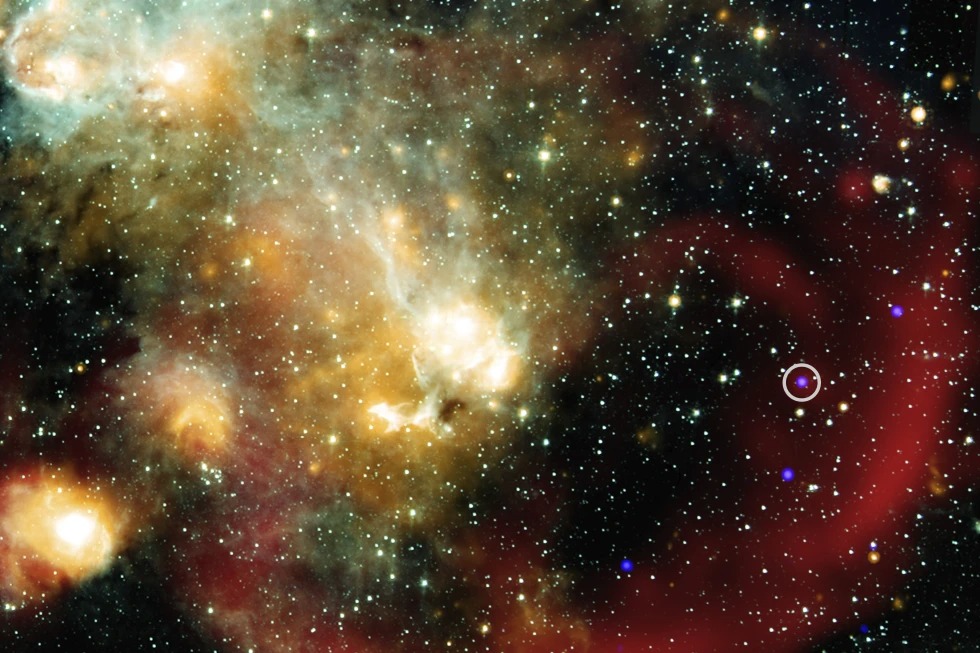
Astronomers have discovered a strange new object in our Milky Way galaxy.
An international team reported Wednesday that this celestial object — perhaps a star, pair of stars or something else entirely — is emitting X-rays around the same time it’s shooting out radio waves. What’s more, the cycle repeats every 44 minutes, at least during periods of extreme activity.
Located 15,000 light-years away in a region of the Milky Way brimming with stars, gas and dust, this object could be a highly magnetized dead star like a neutron or white dwarf, Curtin University’s Ziteng Andy Wang said in an email from Australia.
Or it could be “something exotic” and unknown, said Wang, lead author of the study published in the journal Nature.
NASA’s Chandra X-ray Observatory spotted the X-ray emissions by chance last year while focusing on a supernova remnant, or the remains of an exploded star. Wang said it was the first time X-rays had been seen coming from a so-called long-period radio transient, a rare object that cycles through radio signals over tens of minutes.
Given the uncertain distance, astronomers can’t tell if the weird object is associated with the supernova remnant or not. A single light-year is 5.8 trillion miles.
The hyperactive phase of this object — designated ASKAP J1832?091 — appeared to last about a month. Outside of that period, the star did not emit any noticeable X-rays. That could mean more of these objects may be out there, scientists said.
“While our discovery doesn’t yet solve the mystery of what these objects are and may even deepen it, studying them brings us closer to two possibilities,” Wang said. “Either we are uncovering something entirely new, or we’re seeing a known type of object emitting radio and X-ray waves in a way we’ve never observed before.”
Launched in 1999, Chandra orbits tens of thousands of miles (kilometers) above Earth, observing some of the hottest, high-energy objects in the universe.
(AP)
 Join the official YWN WhatsApp status