
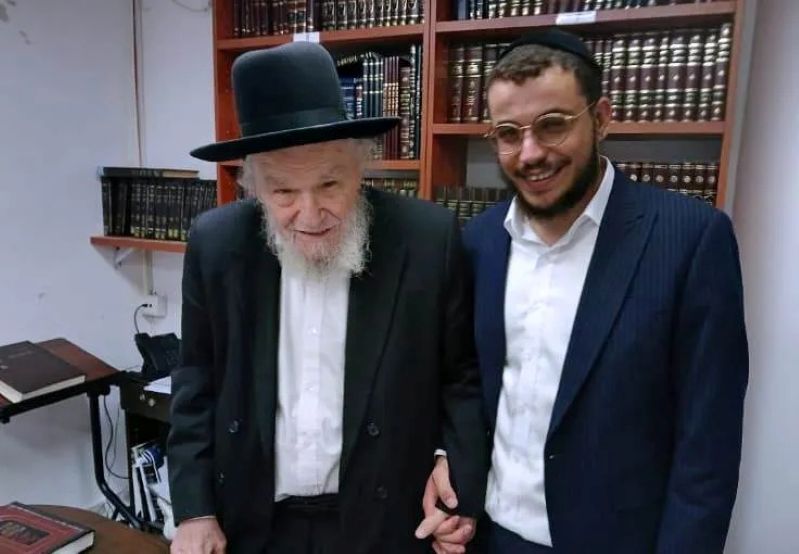
Avremi Malul, a yeshiva student who was arrested on charges of “draft dodging,” spoke with Kol Chai Radio and described the difficult conditions he endured in a separation wing in Prison 10.
“I was arrested on Sunday morning at 10 a.m. I was released on Friday, right before Shabbos. They sentenced me to seven days, and baruch Hashem, Hakadosh Baruch Hu had mercy on me and I wasn’t there on Shabbos.”
Upon arrival, he was searched, forced to put on a prison uniform, and shackled.
Malul explained that the harsh conditions resulted from an innocent answer to a routine intake question. He said, “During the interview, they ask you, ‘Who are you, are you planning to escape?’ and questions like that.”
Malul thought that “if I acted like I’m a broken person, maybe they’ll take pity on me and give me better conditions.” But his idea backfired. “What happened in the end is that it turned against me and unfortunately, I ended up in… it’s called the separation wing–it’s the toughest place in Prison 10. A very, very tough place.”
He describes the separation wing as a place “where there’s no phone, no sefarim, nothing at all. It was me and two other boys who are not yeshiva bochurim,” which made the situation even harder. “I had no common denominator with them.”
Malul had to fight to fulfill the most basic mitzvos in the separation wing. “At five in the morning, of course I asked to daven with a minyan. They didn’t let me. They didn’t let me daven with a minyan. There was no minyan in the separation wing.”
To his dismay, he was also prevented from putting on Rabbeinu Tam tefillin, which is his family minhag, as he had no access to them in the separation wing.
“I begged them; I told the female commander that it’s something I’m makpid on.” But his request was denied: “She told me, You can’t leave because you already went out to meet your lawyer.”
Maul was devastated. “I went to sleep that night without putting them on, after years and years of being makpid to put them on every day.”
He managed to put on Rabbeinu Tam tefillin only one day during his time there, thanks to a Chabad bochur in a nearby wing.
The living conditions were extremely harsh. “You’re allowed outside for only 20 minutes for the entire day.” And even that time was strictly regulated. “You have to walk with your hands behind your back. You can’t move an inch without the commander’s permission.”
The food was meager: “I ate dry bread… a piece of cheese.” Although there were mehadrin meals, they were “in the worst condition you can imagine,” and regarding the IDF’s non-mehadrin food, “you can’t even find a Rabbanut on it.”
He was later moved to a regular wing, which he described as “Gan Eden compared to the separation wing,” where they asked him to do guard duty. “They ask every prisoner to do what they call a guard shift.”
In conclusion, Malul expressed deep pain for the bochurim who remained behind: “I want the public to know that there are so many bochurim there who are trying to strengthen themselves, and they really have no support. It’s important that a Rav come once a day and deliver at least a half-hour shiur.”
He felt mixed emotions upon his release. “On my first step outside the prison, I said the phrase, ‘an eye that weeps bitterly and a heart that rejoices.'” He summed up the experience in one word: “I’m happy I’m out, but I’m in pain for all the yeshiva bochurim still there. Shabbos in there is Gehinnom.”
(YWN Israel Desk–Jerusalem)
 Join the official YWN WhatsApp status


2 Responses
Marwan Barghouti gets to play backgammon and has good pita with olive oil! Antagonize yidden and worship arabs that’s the Medina we know and love
https://www.theyeshivaworld.com/coffeeroom/topic/the-fourth-reich-of-israel