
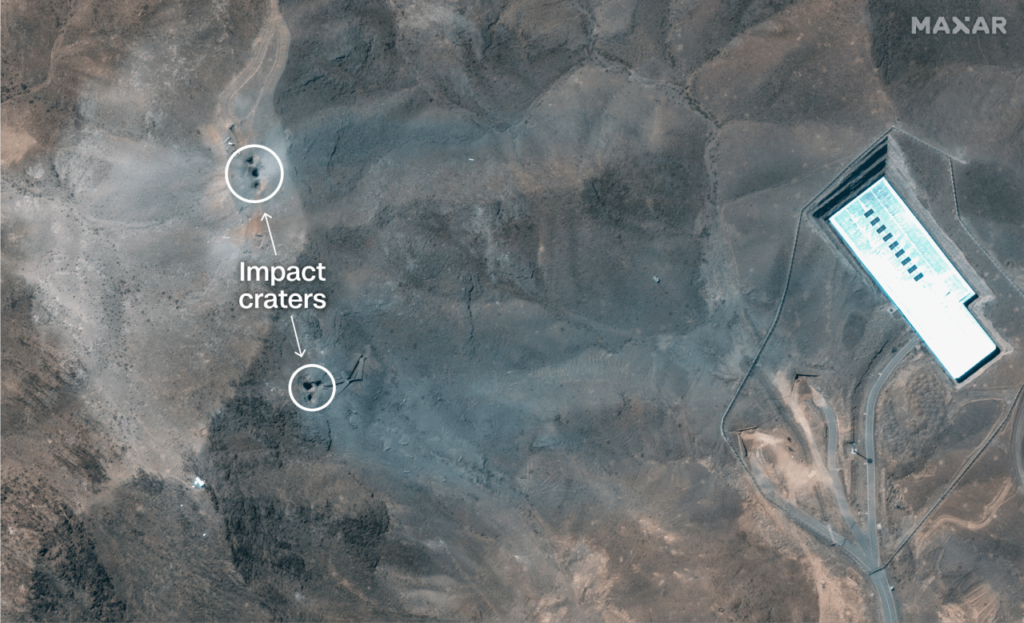
When Israeli aircraft began striking targets across Iran in the early hours of June 13, the operation marked a turning point not only in the scope of Israel’s military campaign, but in how openly it chose to conduct it, a new Washington Post report reveals.
For the first time, Israel publicly acknowledged a coordinated effort to kill senior Iranian nuclear scientists — a move Israeli and U.S. officials viewed as necessary to meaningfully delay Tehran’s progress toward a nuclear weapon, but one that sharply reduced the prospects for renewed diplomacy.
The campaign, part of Israel’s broader 12-day conflict with Iran, unfolded after months of increasingly close U.S.-Israeli coordination and growing concern within Western intelligence agencies that Iran’s nuclear program was approaching a more dangerous phase.
For years, Israeli defense planning focused on disabling Iran’s enrichment facilities, air defenses and missile infrastructure. But by early 2025, Israeli officials concluded that infrastructure strikes alone would not sufficiently set back Iran’s program.
According to current and former Israeli and U.S. officials, intelligence assessments indicated that a small group of experienced scientists — many of them already under international sanctions — played a central role in research related to weaponization, not merely civilian nuclear energy.
In response, Israeli intelligence compiled a list of roughly 100 key figures, eventually narrowing it to about a dozen high-priority targets. Eleven of those scientists were killed in strikes beginning June 13, Israel said.
Among them were Mohammad Mehdi Tehranchi, a physicist linked to explosives research, and Fereydoun Abbasi, a former head of Iran’s Atomic Energy Organization who had survived a previous assassination attempt in 2010.
Israel has targeted Iranian scientists before, but past operations were conducted covertly. This time, the campaign was overt.
Israeli officials say the decision reflected a changing regional environment: Hezbollah had been severely weakened, Syrian air defenses were largely neutralized following the collapse of the Assad regime, and Iran’s own missile and air defense capabilities had been degraded in earlier exchanges.
“We reached a point where the operational conditions were favorable,” said one Israeli air force general involved in planning the strikes.
The approach, however, carried risks. Independent investigations later verified dozens of civilian deaths in strikes on residential buildings where scientists lived. Israeli officials said civilian harm was not the intent and that efforts were made to limit collateral damage.
Iranian officials, for their part, claimed more than 1,000 deaths overall from the conflict, including several hundred civilians.
The scientist-targeting campaign unfolded alongside Israel’s broader military effort — dubbed Operation Rising Lion — which included strikes on enrichment sites at Natanz and Fordow, missile launchers, and Iranian air defenses. U.S. forces later joined with B-2 bomber strikes and cruise missile attacks.
Despite the military preparations, the Trump administration publicly maintained that it preferred a diplomatic resolution.
According to officials familiar with the talks, Washington and Jerusalem continued intelligence sharing and operational planning even as U.S. negotiators gave Iran a final opportunity to reach a deal. A draft U.S. proposal sent through intermediaries in mid-June offered sweeping sanctions relief in exchange for Iran ending enrichment and cutting ties to regional proxy groups.
Iran rejected the offer. Shortly afterward, President Donald Trump authorized U.S. strikes.
U.S., Israeli and international officials broadly agree that the strikes set Iran’s nuclear program back, but not permanently.
The Institute for Science and International Security assessed the damage to several nuclear sites as “extensive,” and IAEA Director General Rafael Grossi said the impact was “very substantial.”
At the same time, Iran retains a large stockpile of uranium enriched to 60 percent purity — close to weapons-grade — and international inspectors have not been allowed access to key facilities since the war.
Western officials say the loss of experienced scientists will complicate Iran’s efforts to weaponize its program, but acknowledge that technical knowledge cannot be eliminated entirely.
“Iran can rebuild infrastructure,” said one U.S. official. “Rebuilding expertise is harder, but not impossible.”
The conflict has likely delayed Iran’s nuclear timeline by years, according to Western intelligence assessments, but it has also hardened Tehran’s stance and effectively ended near-term prospects for a negotiated nuclear agreement.
Iran continues to insist its nuclear program is peaceful and has signaled it will rebuild damaged facilities. Israeli officials have warned that further enrichment could prompt additional military action.
(YWN World Headquarters – NYC)
 Join the official YWN WhatsApp status




2 Responses
What a stupid article – “sharply reduced the prospects for renewed diplomacy” as if that is the goal here “diplomacy!” and not stopping the Islamic Republic’s open goal of genocide
Did YWN start getting funding from Iran and Qatar? What a ridiculous article. Any illusion of diplomacy with someone who is literally willing to destroy the world to kill you is simply a ploy to buy them time to do just that.