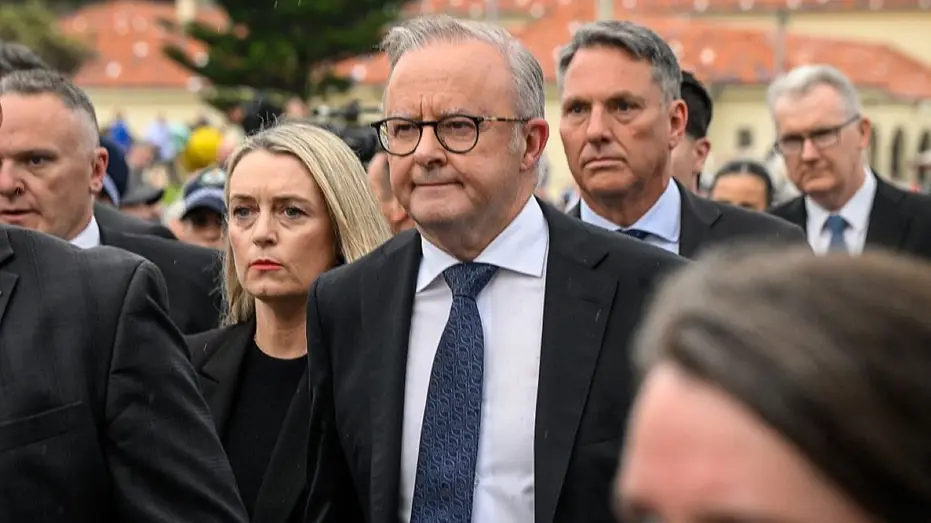
Prime Minister Anthony Albanese arrived at Bondi Beach on Sunday night expecting to save face. Instead, he walked into a stinging public rebuke.
As thousands gathered to mourn the 15 people murdered in the December 14 terror attack during a Chanukah celebration, the crowd booed Albanese on arrival, and again when his presence was acknowledged from the stage.
The reaction exposed the depth of anger within Australia’s Jewish community toward a prime minister many now see as absent, hesitant, and ineffective in the face of a surging antisemitism crisis.
The vigil marked a national Day of Reflection one week after the massacre. At 6:47 p.m., the moment the shooting began, the crowd observed a minute of silence. But the solemnity fractured as boos cut through the ceremony when Albanese appeared, seated in the front row wearing a kippah, silent and unscheduled to speak.
By contrast, New South Wales Premier Chris Minns was greeted with cheers, and former prime minister John Howard drew applause upon his arrival — a stark comparison that underscored where much of the crowd’s confidence now lies.
Albanese’s government has come under sustained criticism for its slow and insufficient response to antisemitism since the war in Gaza began. While the prime minister has issued condemnations and his government points to hate-speech legislation and the expulsion of Iran’s ambassador earlier this year, those measures have done little to reassure communities that say they feel increasingly unsafe and increasingly unheard.
The Bondi vigil made that political reality impossible to ignore.
“We have lost our innocence,” said David Ossip, president of the New South Wales Jewish Board of Deputies. “Like the grass here at Bondi was stained with blood, so, too, has our nation been stained.”
Ossip openly backed calls for a royal commission that would include the federal government — a direct challenge to Canberra and a signal that trust in existing leadership has eroded.
Security at the vigil was extraordinary: police screened attendees, stationed snipers on nearby rooftops, deployed officers carrying long-arm firearms, and patrolled offshore in boats. The heavy presence served as a grim reminder of how profoundly the attack has reshaped Australia’s sense of security and how little confidence many now place in political assurances.
Also in attendance was the father of Ahmed al Ahmed, the “Bondi Hero” credited with wrestling a gun from one of the attackers.
Albanese did not address the crowd. He offered no remarks, no public reckoning, no acknowledgment of the anger directed at him.
His silence, in a moment when the country’s Jewish community was demanding clarity and resolve, only amplified the criticism.
(YWN World Headquarters – NYC)
 Join the official YWN WhatsApp status