
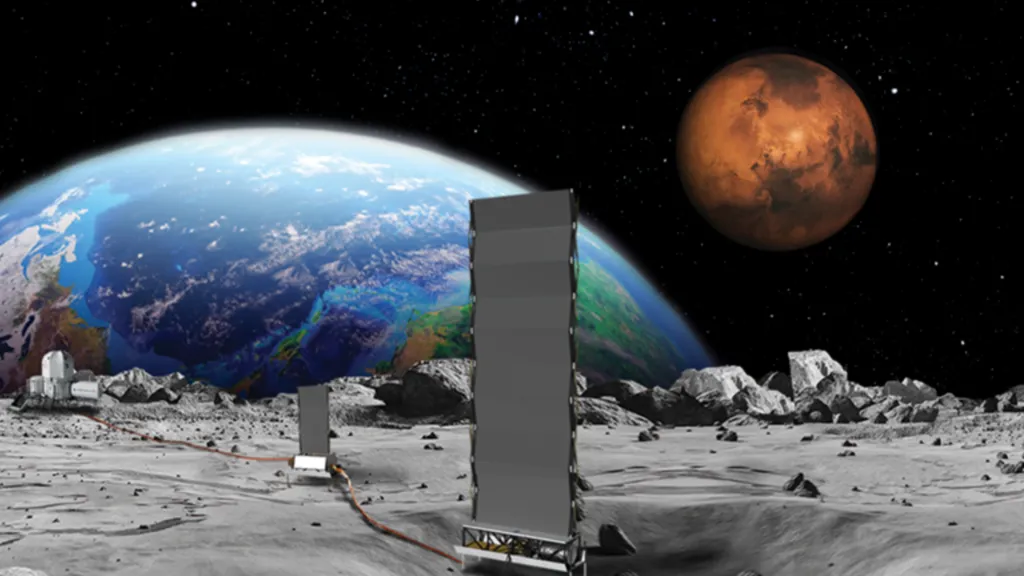
The United States and Russia are heading into a new phase of competition in space, with both powers planning to place nuclear reactors on the Moon as they race to establish permanent lunar footholds and secure strategic advantages beyond Earth.
Russia has announced plans to build a power plant on the Moon by 2036 to support its lunar exploration program and a joint Russian-Chinese research base. Although Moscow has not explicitly called the facility nuclear, the involvement of Russia’s state nuclear corporation Rosatom and the Kurchatov Institute–its leading nuclear research center–strongly suggests the reactor would rely on nuclear power.
Roscosmos, Russia’s state space agency, said the plant would supply energy to lunar rovers, scientific observatories, and the infrastructure of the planned International Lunar Research Station with China. “The project is an important step toward the creation of a permanently functioning scientific lunar station,” the agency said, signaling a shift from short missions to long-term occupation.
The move is widely seen as an attempt by Russia to reassert itself in space after years of decline. Once a trailblazer following Yuri Gagarin’s historic 1961 flight, Russia has struggled to keep pace with rivals. Its ambitions suffered a major setback in August 2023, when the Luna-25 spacecraft crashed during a Moon landing attempt, highlighting technological and financial pressures on its space program. Meanwhile, commercial launches led by Elon Musk’s SpaceX have undercut Russia’s former dominance in rocket launches.
Across the Atlantic, the United States is pressing ahead with its own plans. NASA announced in August that it intends to deploy a nuclear reactor on the Moon by the first quarter of fiscal year 2030. U.S. officials have said the project is essential to maintaining leadership in space and countering China’s growing influence.
“We’re in a race to the Moon, in a race with China,” U.S. Transport Secretary Sean Duffy said at the time. “To have a base on the Moon, we need energy.” He acknowledged that the U.S. had fallen behind in some areas and stressed that nuclear power would be critical to sustaining human presence on the Moon and enabling future missions to Mars.
International treaties ban the placement of nuclear weapons in space, but they allow nuclear energy systems if they meet safety and regulatory requirements. That legal framework has opened the door to reactors that could provide continuous power during the Moon’s long, two-week nights, which solar energy alone cannot reliably do.
The stakes extend beyond science. Analysts predict the Moon could become the focus of a resource rush. NASA estimates suggest it may contain up to a million tons of helium-3, a rare isotope on Earth that could one day fuel advanced energy systems. Studies also indicate the presence of rare earth elements crucial for modern electronics and advanced technologies.
(YWN World Headquarters – NYC)
 Join the official YWN WhatsApp status








2 Responses
“Nukes” refers to nuclear weapons, not nuclear power plants. People have been trying to figure out how to get nuclear power into space since before there was any sort of space travel. It would be a major breakthrough if someone manages to do so in a manner that they could be used to power interplanetary spaceships or colonies.
Weapons in space might be less useful since there is no place to hide them, unlike Earth where nukes can be put on trucks and moved, or based on submarines that can stay hidden for an indefinite time (n.b. one nuclear submarine could probably destroy Russia and China, by itself)
Please fix this false headline. A nuclear reactor is not a “nuke.” That nomenclature refers only to nuclear weapons, which are not in anyone’s plans.