
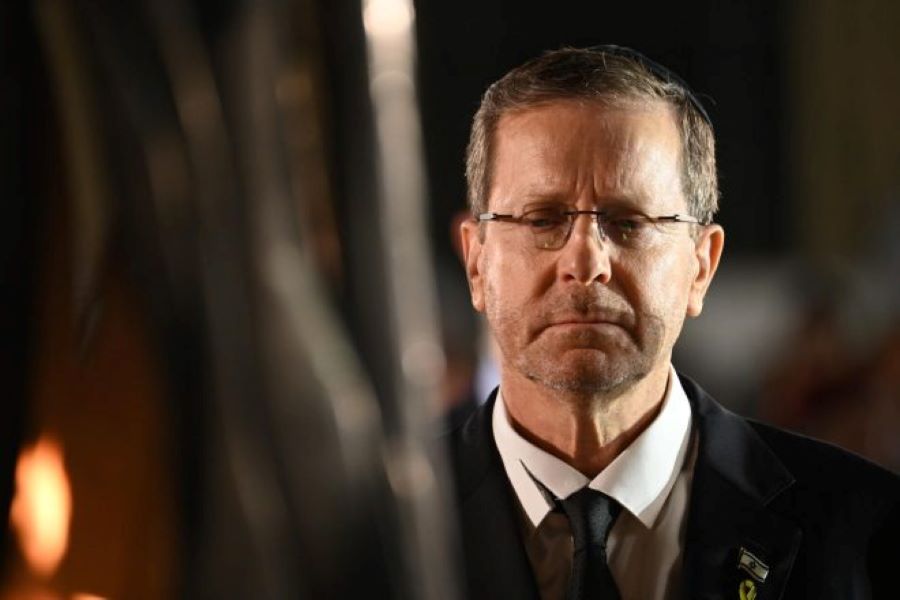
President Isaac Herzog was interviewed by Politico after President Donald Trump sent him a letter requesting that he grant a pardon to Prime Minister Binyamin Netanyahu.
During the interview, which took place before Netanyahu submitted an official request for a pardon last week, Herzog emphasized that he “respects President Trump’s friendship and his opinion,” adding that “Israel, naturally, is a sovereign country.”
After Netanyahu sent Herzog a request for a pardon, Politico requested Herzog’s reaction in a follow-up.
Herzog stated, “My office has now received the request for a pardon, as you know. There is a process which goes through the Justice Ministry and my legal adviser and so on. This is certainly an extraordinary request, and above all when dealing with it, I will consider what is in the best interest of the Israeli people. The well-being of the Israeli people is my first, second and third priority.”
In the original interview, Politico asked Herzog, “I read that you’ve described your current term as the most difficult ever faced by an Israeli president. Why do you feel that way?”
Herzog replied, “In this term so far, let’s remember I started with corona, then I went to the huge clashes and huge debate on [Netanyahu’s proposed] judicial reform, which tore apart the nation. Then the war, which lasts until today. My wife and I try to meet bereaved families on a daily basis–we’ve met over 1,500 families. They’re the most incredible people, and they tell you about their loved ones. And I’m not talking about the enormous pain we’ve endured with the hostages. Thank G-d the live ones are back, but there is still one missing. The enormous amount of wounded and post-traumatic stress and the inner tensions among all of the members of our society. Add to it the return of heated political tension and debate.”
“The emotional weight that I carry on my shoulders is huge, but I’m very proud that G-d gave me this role at this moment, to be there for Israel in its most difficult hour.”
(YWN’s Jerusalem desk is keeping you updated after tzeis ha’Shabbos in Israel)
 Join the official YWN WhatsApp status





2 Responses
His goal should be to get the Israelis to stop fighting each other, and be prepared for a world in which the United States’s “Pax Americana” is memory, including the possibility of a full scale world war. The United States appears to be very unstable (with basically four “parties”: MAGA, Woke/Progressives, RINOs and DINOs) and the growing divisions within America may render the United States incapable of projecting influence over the rest of the world. Israel has to get its act together to survive, and that means to resolving internal divisions.
Stop spewing out so many ??????? and such garbage and just do the right thing & get it over with:- PARDON PRIME-MINISTER BIBI NETANYAHU RIGHT NOW IMMEDIATELY!!!!!