
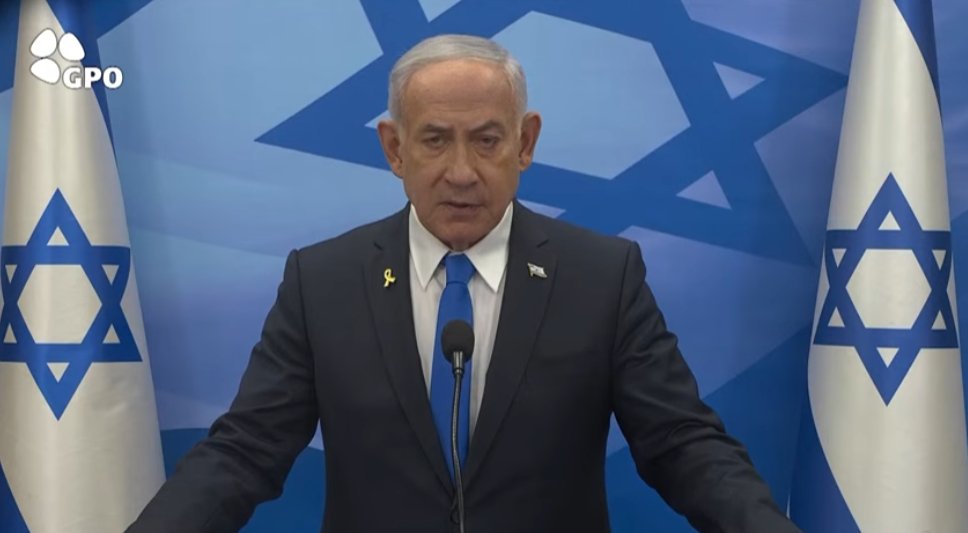
Prime Minister Benjamin Netanyahu said Monday that any government-backed commission of inquiry into the catastrophic Hamas onslaught of October 7, 2023 must examine decisions and developments stretching back decades — including the 1993 Oslo Accords, the 2005 Disengagement from Gaza, and the 2023 protest movement against his government’s judicial overhaul.
The remarks, reported by Channel 12, were made during a meeting of a ministerial committee headed by Netanyahu that is tasked with defining the mandate of a government inquiry. The move comes amid widespread public and political demands for an independent state commission of inquiry, a demand Netanyahu has consistently rejected.
According to the report, Netanyahu told ministers that the investigation must span “from Oslo, through to the [Gaza] Disengagement, and up to [reserve duty] refusal,” referring to declarations by some opponents of the judicial overhaul that they would suspend their service in the IDF reserves. Critics have accused Netanyahu of attempting to broaden the scope of the inquiry to dilute responsibility for the intelligence, military, and political failures that enabled Hamas’s deadliest attack in Israel’s history.
Netanyahu was prime minister for roughly 14 of the 15 years preceding October 7, yet he has steadfastly refused to accept responsibility for the failures that led to the massacre. Instead, he has repeatedly sought to place blame on former governments, the security establishment, the judiciary, and political opponents.
While Netanyahu has long positioned himself as an opponent of the Oslo Accords, his own record complicates that narrative. After first taking office in 1996, and again after returning to power in 2009, he did not reverse Oslo. On the contrary, he signed and partially implemented key components of the Oslo framework, including the Hebron Protocol and the Wye River Memorandum.
Similarly, Netanyahu has pointed to the 2005 Disengagement from Gaza as a root cause of Hamas’s rise. Yet as finance minister in Ariel Sharon’s government, he voted multiple times in favor of steps advancing the disengagement in 2004 and 2005. He resigned only days before the plan’s implementation, a move that allowed him to publicly oppose the withdrawal while having helped enable it.
Netanyahu also called for what he described as a “balanced” commission of inquiry, proposing that half of its members be selected by the governing coalition and half by the opposition. According to Ynet, he told ministers he is “prepared to be the first person to be investigated.”
Opposition figures and legal experts argue that such a structure would fundamentally undermine the independence of the inquiry, particularly given the coalition’s legislative push to sideline the judiciary from the process altogether.
Earlier Monday, the Ministerial Committee for Legislation approved a highly contentious bill that would establish a new type of commission of inquiry, with its members appointed by the Knesset rather than by the president of the Supreme Court, as required under current law for state commissions of inquiry.
Ze’ev Elkin was the sole minister to vote against the bill. He warned that a provision allowing the Knesset speaker to appoint commission members if the opposition boycotts the process — as it has vowed to do — could result in the coalition selecting all members of the panel.
The legislation has intensified accusations that Netanyahu is seeking to shape, delay, or control the investigation into October 7 — not to uncover the truth, critics say, but to spread blame as widely as possible while avoiding accountability for decisions made on his watch.
(YWN World Headquarters – NYC)
 Join the official YWN WhatsApp status




2 Responses
He’s not wrong. There really needs to be two inquiries. One to officially establish that the long-term policy of multiple governments since Oslo has been responsible for all of the thousands of deaths and the deterioration of Israel’s position in the world, leading up to the current crisis. But the other inquiry should focus narrowly on the immediate causes of the specific attack on Simchas Torah, and — taking as given the long term policy failings — what specifically could or should have been done that might have prevented that attack.
It is obvious that an inquiry must be bipartisan, and not controlled by the corrupt left-wing judiciary which no one trusts, and which is itself responsible for much of the problem that the inquiry would be investigating.