
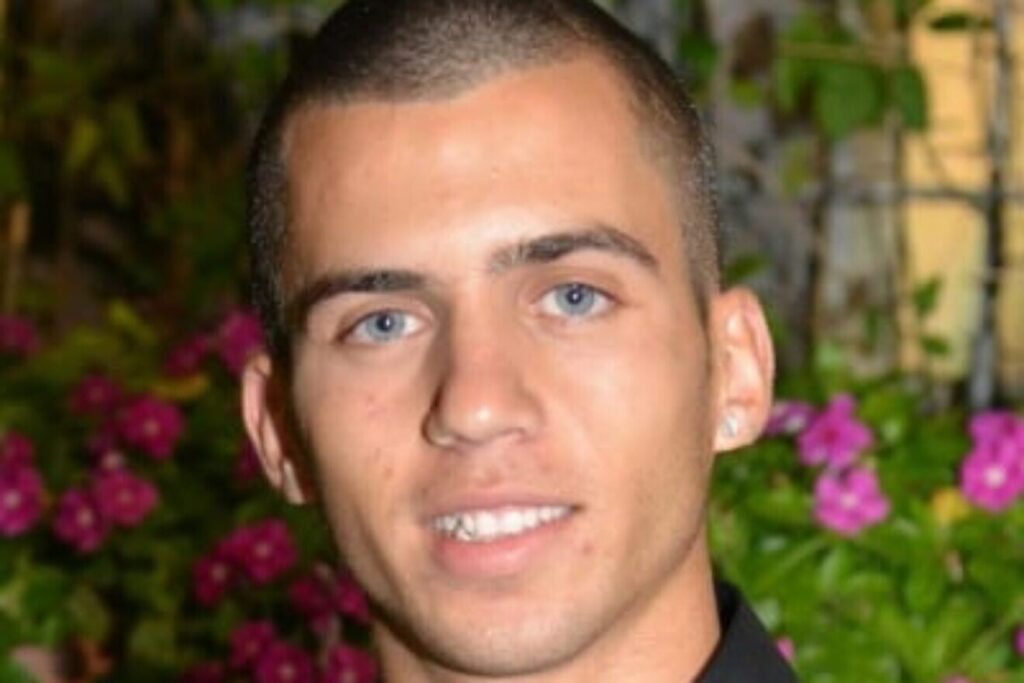
The recovery of Staff Sgt. Oron Shaul’s remains from the Gaza Strip in January 2025 was, on its face, a rare moment of closure in a war defined by uncertainty, hostage diplomacy and incomplete answers. But newly disclosed details show that the operation unfolded less like a standard military retrieval and more like a layered intelligence thriller.
Shaul hy”d, a Golani Brigade soldier, was killed during the night of July 19-20, 2014, when the armored personnel carrier he was riding in became immobilized and was hit by Hamas fire near the Daraj Tuffah area on the outskirts of Gaza City. Since then, Hamas had referred to him only by a code name: “the Daraj soldier.” For more than a decade, Israel had no confirmed location for his body.
The breakthrough came on the second day of Rosh Hashanah in 2024, during an Israeli raid in Gaza that produced an unexpected intelligence windfall: a seized computer containing correspondence between a Hamas operative and senior Hamas military commander Izz al-Din Haddad. In the exchange, the operative warned that among detainees taken from Shifa Hospital was someone who knew where “the Daraj soldier” was being held.
After reviewing detainees, Israeli intelligence focused on one suspect. He initially denied involvement but later said he had met two Palestinians in Khan Younis who claimed that a recently detained Palestinian had transferred Shaul’s body to a Gazan named Ibrahim Hilo.
According to the account, Hilo–once a Hamas platoon commander in 2014 but later operating as a merchant–had stored the body in a freezer beneath his home in Gaza City’s Sheikh Radwan neighborhood.
The information was far from airtight. Israeli forces had previously been in the building and had not inspected the freezer. A direct raid risked tipping off Hamas or endangering potential living hostages in the area. Officials concluded that if the lead was real, Hilo had to be taken quietly–before the body could be moved.
The solution was deception.
Intelligence services learned that Hilo had relocated to a displaced persons camp in Deir al-Balah. Israeli handlers made covert contact, drawing him into what he believed was a commercial arrangement. Unaware he was being manipulated, Hilo rented a warehouse near the Salah al-Din route and was conditioned to arrive there at irregular hours to receive goods, establishing a pattern that would make his presence unremarkable.
As the operation was coming together, diplomatic pressure was accelerating. On Jan. 15, Qatar’s prime minister announced an impending ceasefire between Israel and Hamas. A senior Israeli delegation was in Doha finalizing the deal, which would take effect on Jan. 19. The agreement ultimately secured the return of 25 living Israeli hostages and the bodies of eight others. But negotiators understood early on that the remains of Shaul–and fellow fallen soldier Hadar Goldin–would not be included.
Even as talks moved forward, Israeli security officials green-lit a parallel effort to bring Shaul home before the ceasefire began. Two days before the truce, the families of Shaul and Goldin were informed that negotiations had failed to recover their loved ones’ remains–at the same time senior officials knew a risky operation was in motion.
The operational phase nearly unraveled at the start.
Handlers persuaded Hilo to arrive at the warehouse at 11 p.m., where an elite unit lay in wait to abduct him. He refused several times, turned back en route and had to be convinced again. Then, at the critical moment, the truck designated for the operation failed to start. After tense minutes, it finally did. Hilo was seized.
Under intense time pressure, Hilo initially denied everything. With the ceasefire clock ticking and Israeli forces already preparing to withdraw from parts of Gaza, commanders faced a stark choice: stand down without confirmation, or act on unverified intelligence. Eventually, Hilo broke, admitting that Shaul’s body was in a locked ice-cream freezer beneath his house.
What followed was an unconventional decision born of necessity. Rather than send Israeli troops back into the neighborhood, officials approved a plan to use a Palestinian collaborator to retrieve the body alone. During the night of Jan. 18-19–just hours before the ceasefire–the collaborator made his way to the house. He found the freezer secured with a heavy padlock and warned his handlers that breaking it could alert the area.
To mask the noise, the IDF fired artillery into open areas nearby, creating a cover of sound. Under that barrage, the collaborator broke the lock, located Shaul’s body, wrapped it in a rug and carried it roughly a mile to a rendezvous point with Israeli forces. The remains were then evacuated in armored Namer vehicles belonging to the Golani Brigade–the same unit in which Shaul had served.
More than 10 years after he was killed and taken, Oron Shaul was brought home.
(YWN World Headquarters – NYC)
 Join the official YWN WhatsApp status





1 Response
Regarding the Miraculous finding of Staff Sgt. Oron Shaul’s remains; I am not finding this article at any loss at all. What I mean to say, is that Yeshiva World News has been instrumental in assisting Israeli Intelligence and not once backing down all of you from reporting a horrible tragedy like this one. May Staff Sgt. Oron Shaul now! rest peacefully in Shamayim and may his mourning and grief stricken Mishpacha find consolation that their Beloved Oron is finally HOME.
With Many Bracha’s and Tefila to all concerned,
Rebbetzin Yehudit Chana Chaya, ChaBaD Lubavitch