President Trump’s long-promised military “armada” is now in position in the Middle East, but U.S. officials say the buildup is less about launching immediate strikes on Iran than about bracing for what could come afterward.
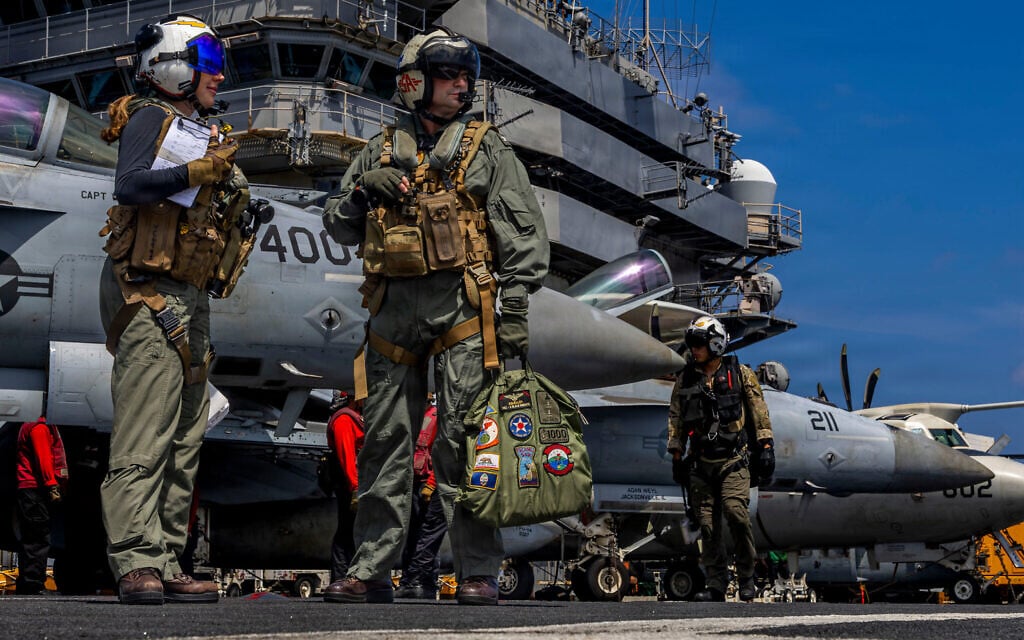
The USS Abraham Lincoln aircraft carrier strike group has recently entered the region, advanced fighter aircraft are moving closer to potential conflict zones, and the Pentagon is quietly rushing additional air and missile defenses to U.S. bases and allied territory across the Middle East.
Despite the visible show of force, American officials told the Wall Street Journal that U.S. airstrikes on Iran are not imminent. The priority, they say, is preparing for Iranian retaliation — especially if President Trump were to authorize a broader or more sustained military campaign rather than a limited, one-off strike.
U.S. military planners have developed options for limited airstrikes that could be executed quickly. But officials cautioned that the kind of decisive attack Trump has asked the Pentagon to prepare would almost certainly provoke a proportional Iranian response, requiring extensive defenses to protect Israel, U.S. forces and regional partners.
To that end, the Pentagon is deploying additional Terminal High Altitude Area Defense (THAAD) and Patriot missile batteries to bases in Jordan, Kuwait, Bahrain, Saudi Arabia and Qatar. THAAD systems intercept ballistic missiles at high altitude, while Patriots defend against lower-altitude and shorter-range threats.
“The air defense question is key,” Suzanne Maloney, a former senior State Department official who worked on Iran policy under both Republican and Democratic administrations, told the Journal. “The extent to which we have sufficient materiel to ensure that our troops and assets in the region are going to be protected from some kind of Iranian retaliation.”
The emphasis on air defenses reflects lessons from recent clashes. In June, the U.S. helped defend Israel from Iranian missile barrages during a 12-day conflict. During that time, U.S. forces carried out “Midnight Hammer,” a tightly scoped strike on three Iranian nuclear sites using B-2 bombers and submarine-launched cruise missiles.
Iran responded the following day by firing 14 missiles at Al Udeid Air Base in Qatar, home to the U.S. air command center for the region. American and Qatari Patriot batteries intercepted most of the missiles, though the Pentagon later acknowledged that one struck the base, causing minimal damage and no injuries.
Senior military officials described Midnight Hammer as deliberately limited. A broader campaign, they warned, would look very different.
“If the U.S. were to undertake a major air campaign, Tehran would respond with as much firepower as it could muster,” Maloney and other analysts told the Journal, including short- and midrange ballistic missile strikes against U.S. and Israeli positions and the activation of Iranian proxy forces across the region.
That could include attacks by Yemen-based Houthi forces on shipping and infrastructure, as well as strikes by Iranian-backed militias in Iraq and Syria. While Israel has severely weakened Hamas in Gaza and battered Hezbollah in Lebanon, U.S. officials believe Iran still retains significant escalation options.
The prospect of a renewed U.S.-Iran confrontation has unsettled Persian Gulf states. Saudi Arabia and the United Arab Emirates said last week they would not allow their airspace or territory to be used for U.S. attacks on Iran — a move intended to insulate them from retaliation. At the same time, Gulf states are strengthening their own defenses. Saudi Arabia has purchased seven THAAD batteries, several of which have already been delivered, a Gulf official told the Journal.
The U.S. military is also repositioning combat assets. Three squadrons of F-15E fighters have deployed to Jordan, where they could help intercept Iranian drones. Several Navy guided-missile destroyers capable of shooting down aerial threats have moved into the region, bringing the total within intercept range of Iranian missiles and drones to eight, according to a Navy official and open-source imagery cited by the Journal.
Additional movements include F-35s redeploying closer to the Middle East and Navy EA-18G Growler electronic-attack aircraft shifting from the Caribbean to Europe. But officials say the THAAD deployments are the clearest signal that Washington is preparing for the possibility of a larger conflict, especially given how stretched U.S. air-defense resources already are.
The U.S. has only seven operational THAAD batteries worldwide, and recent fighting burned through large numbers of interceptors. Over the summer, the U.S. fired more than 150 THAAD missiles — roughly a quarter of all such interceptors ever purchased by the Pentagon — as Israel ran low on its own Arrow systems.
Last week, the Pentagon and Lockheed Martin announced a framework agreement to quadruple THAAD interceptor production, alongside a separate deal to increase Patriot missile output. Officials acknowledged, however, that the production increases would do little to affect the near-term balance if a conflict erupts in the coming weeks.
(YWN World Headquarters – NYC)
 Join the official YWN WhatsApp status