
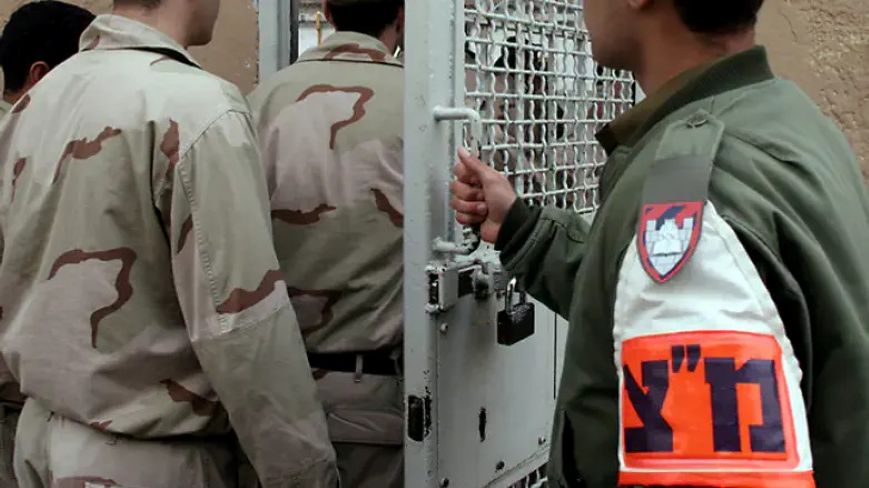
Attorney Shlomo Hadad, who represents many of the Chareidi bochurim and avreichim arrested for “draft dodging,” wrote a disturbing report about one of the bochurim he visited, who was severely injured by the police despite the fact that he did not resist his arrest.
Hadad wrote: “My first meeting with Yitzchak Revivo was not just another routine visit with a detainee. As attorneys who have represented hundreds of detainees over the years–Chareidi and non-Chareidi, civilians and soldiers–we are accustomed to difficult scenes. But what my partner, Attorney Itai Cohen, and I encountered this time was rare, shocking, and deeply alarming.”
“Revivo, a talmid at the Rabbeinu Chaim Ozer Yeshiva in Bnei Brak, was arrested three weeks after an earlier attempt to arrest him had been thwarted by crowds who came to protest outside his home in Ramat Gan.
“His back and pelvic area were severely scraped and bruised, to the point of bleeding. These were not minor injuries, not the result of a ‘fall,’ and not injuries caused by ‘resisting arrest.’ These were clear signs of serious violence inflicted during the arrest.
“Here it is crucial to emphasize an undisputed fact: from the moment the soldiers identified themselves as military police, Yitzchak did not resist arrest. He cooperated. He didn’t flee, fight back or threaten the officers. And yet, he was dragged along the road for a distance of approximately 100 meters. Dragging a person across asphalt is not an arrest method–it is humiliation, it is violence, and it is a clear crossing of a red line.
“The absurdity only deepens when examining the legal process itself. During the hearing in his case, Yitzchak was questioned about a protest that allegedly took place beneath his home. Yet at that very time, he was not even there–he was at yeshiva. He did not participate, was not involved, and was not aware of it. And nevertheless, the full period of detention was imposed on him.
“The picture that emerges is extremely troubling: a violent arrest, serious physical harm, followed by a legal process conducted as if the facts themselves are of little importance.
“Let this be stated as clearly as possible: we have no complaints against the military prison. On the contrary, the officials there are now acting professionally and responsibly in caring for our client. Our complaint is directed solely at the military police, and at the manner of the arrest and the culture of force that was revealed here.
“An arrest is not a punishment. And certainly, an arrest is not a license to inflict severe violence on a yeshiva bochur who cooperated with the police. The fact that he is Chareidi is irrelevant to the gravity of the act–but it is very relevant to the question: is there someone who feels it is easier to use force against certain populations?
“Given the severity of the incident, a formal complaint has been filed both regarding the arrest itself and the way it was carried out, and we have demanded a full, thorough, and uncompromising investigation. Not an ‘internal review,’ but a genuine investigation that will examine who gave the orders, who used force, and why no one stopped it in time.
“This battle is not only about Yitzchak Revivo. It is about every yeshiva bochur, every citizen, and the fundamental right–if one is arrested at all–to be arrested with dignity, within the bounds of the law, and with basic human respect.
“Because today it is him. Tomorrow, it could be anyone else.”
(YWN Israel Desk–Jerusalem)
 Join the official YWN WhatsApp status




5 Responses
can the police be sued?
What’s the shock we already know the hate for the ultra Orthodox runs deep in every University and on every channel, they were raised to hate religion and these beatings are only the result of constant propaganda toward our people. And they will continue until some type of revolution or Hashem brings the Redemption and burns all of them to shreds
we should call the police on them or even sue! oh wait… there is no one to turn to but Hashem
the police can be sued, but resisting arrest has consequences
This is not logical: so many resisted their own or someone else’s arrest (including during the previous attempt of his arrest) – and they were not hurt. Take one person who allegedly did not rests – gets hurt. Still, not clear, in what sense he was “not resisting” – when police came to arrest him last time, why he did not comply with a legal order and just went to the police station? did other law-breakers detain him?