
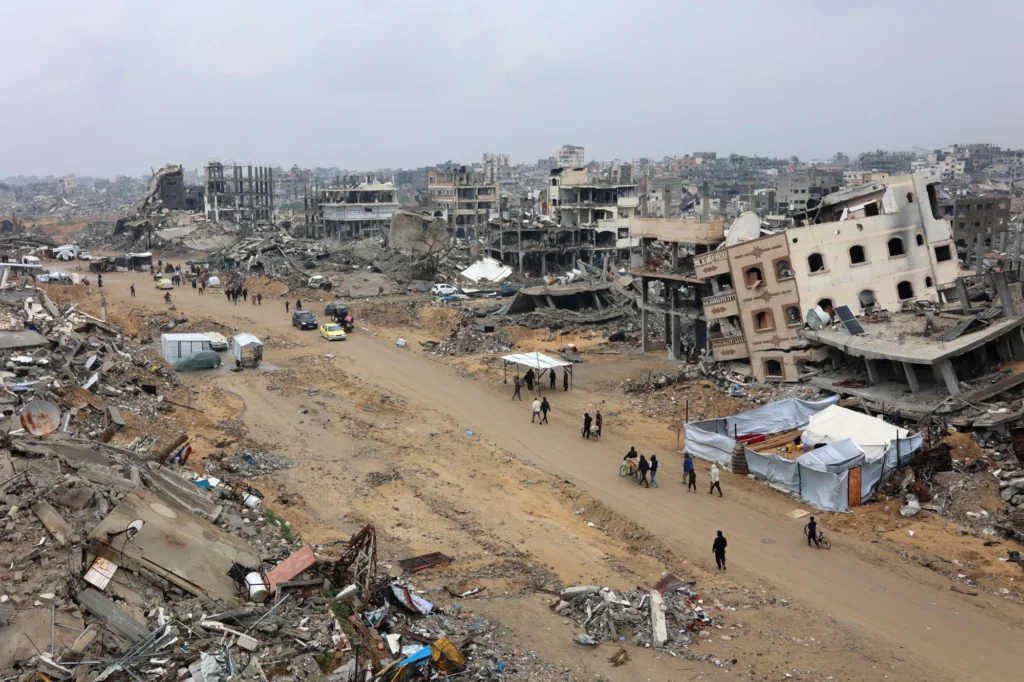
The Trump administration is quietly shopping an ambitious, multibillion-dollar vision to remake Gaza into a high-tech Mediterranean hub. The plan has drawn interest from regional power brokers even as it collides with the hard political reality of Hamas’ continued grip on the enclave.
Dubbed internally as a long-range redevelopment roadmap, the plan would pour as much as $112 billion into Gaza over its first decade, according to U.S. officials familiar with the effort and a Wall Street Journal report that detailed a 32-page PowerPoint presentation circulated to prospective donor governments.
The initiative was crafted over the past 45 days by a team led by Jared Kushner, President Donald Trump’s son-in-law, and Middle East envoy Steve Witkoff, and envisions a 20-year transformation of the war-ravaged Strip into what one earlier Trump formulation called the “Riviera of the Middle East.”
Under the proposal, Washington would “anchor” the effort with an initial $60 billion commitment, while expecting Gulf states and other regional partners to shoulder much of the remaining cost. U.S. officials also argue that Gaza could eventually self-finance parts of the reconstruction as investment flows increase and coastal assets are developed.
The plan has already been briefed to wealthy Gulf countries, as well as Turkey and Egypt — a sign the administration is testing whether there is real appetite among regional stakeholders to bankroll a project whose success hinges on security conditions that remain far from assured.
The vision divides Gaza’s rehabilitation into four stages over two decades, beginning in the southern cities of Rafah and Khan Younis, then moving north through the central refugee camps before culminating in Gaza City.
Early phases would focus on clearing rubble, unexploded ordnance, and Hamas’ extensive tunnel network, while erecting temporary housing and medical facilities for displaced civilians, though the materials reportedly do not specify where most residents would live during large-scale reconstruction.
Only after basic infrastructure is restored would permanent housing, public institutions, and utilities be built. The final stages introduce the plan’s most eye-catching elements: luxury beachfront residences, high-tech rail lines, and a rebranded coastal economy designed to attract international capital.
One slide labeled “New Rafah” envisions the city as the Strip’s future seat of governance, featuring more than 100,000 housing units, over 200 schools, at least 75 medical facilities, and roughly 180 mosques and cultural centers. Another portrays Gaza as a “smart city,” with technology-driven governance and services modeled on advanced urban centers elsewhere in the region.
By year 10, the proposal estimates that roughly 70 percent of Gaza’s coastline could be monetized, generating more than $55 billion in long-run investment returns.
But the plan’s most critical condition appears in bold red text: Hamas must “demilitarize and decommission all weapons and tunnels.” That demand, which both Israel and the United States have long insisted on as a prerequisite for rebuilding Gaza, remains a nonstarter for Hamas.
U.S. officials privately acknowledge that the proposal’s viability rests almost entirely on whether the terrorist group can be compelled — or replaced — as the Strip’s governing force.
The initiative revives and refines an idea Trump floated earlier this year, when he publicly suggested that the U.S. take over Gaza and redevelop it after relocating Palestinian residents elsewhere — comments that sparked international backlash but were welcomed by Israel’s government.
Trump has since walked back the notion of permanent displacement, and the current plan stops short of explicitly calling for Gazans to be removed long-term.
Still, skepticism runs deep inside the administration. Some officials doubt Hamas would ever relinquish its weapons voluntarily, or that donor nations would commit tens of billions of dollars without ironclad security guarantees. Others argue the proposal represents the most detailed and optimistic framework yet for Gaza’s future, precisely because it pairs reconstruction with governance reform and economic incentives.
“The Trump Administration will continue to work diligently with our partners to sustain a lasting peace and lay the groundwork for a peaceful and prosperous Gaza,” a White House spokesperson told the Journal.
The timing of the report is notable. Witkoff was scheduled to meet Friday in Miami with senior officials from Qatar, Egypt, and Turkey to discuss the fragile Gaza ceasefire and the long-stalled second phase of the agreement. Those countries believe both Israel and Hamas are dragging their feet on implementing the next stage and are weighing a coordinated push to force progress.
Under phase two, Israel would withdraw from parts of Gaza, an interim authority would replace Hamas’ rule, and an international stabilization force would deploy. But movement has been slow, with each side accusing the other of violations. Israel’s killing of senior Hamas commander Raed Saad last weekend reportedly prompted Trump to warn that the strike risked jeopardizing the truce.
So far, Palestinian terrorists have released all living Israeli hostages, with the exception of the body of police Master Sgt. Ran Gvili. The administration is now pressing to advance to phase two, even as Hamas’ refusal to disarm looms as the central obstacle.
Beyond that lies phase three: the massive reconstruction effort the Kushner-Witkoff plan seeks to define — rebuilding neighborhoods flattened during the war triggered by Hamas’ October 2023 attack on southern Israel.
Whether the proposal becomes a blueprint or a briefing-room thought experiment may depend less on architectural ambition than on whether the political and security realities of Gaza can be fundamentally altered — a challenge that has defeated far more modest plans for decades.
(YWN World Headquarters – NYC)
 Join the official YWN WhatsApp status





One Response
Trump often makes “delusional” suggestions that he is neither capable nor interested in implementing, but they to serve to cause his opponents to exhibit the symptoms of “Trump Derangement Syndrome”, which does help MAGA candidates since their opponents appear to be insane fools. A clever strategy: drive you opponents crazy and then argue you are the only sane one running.